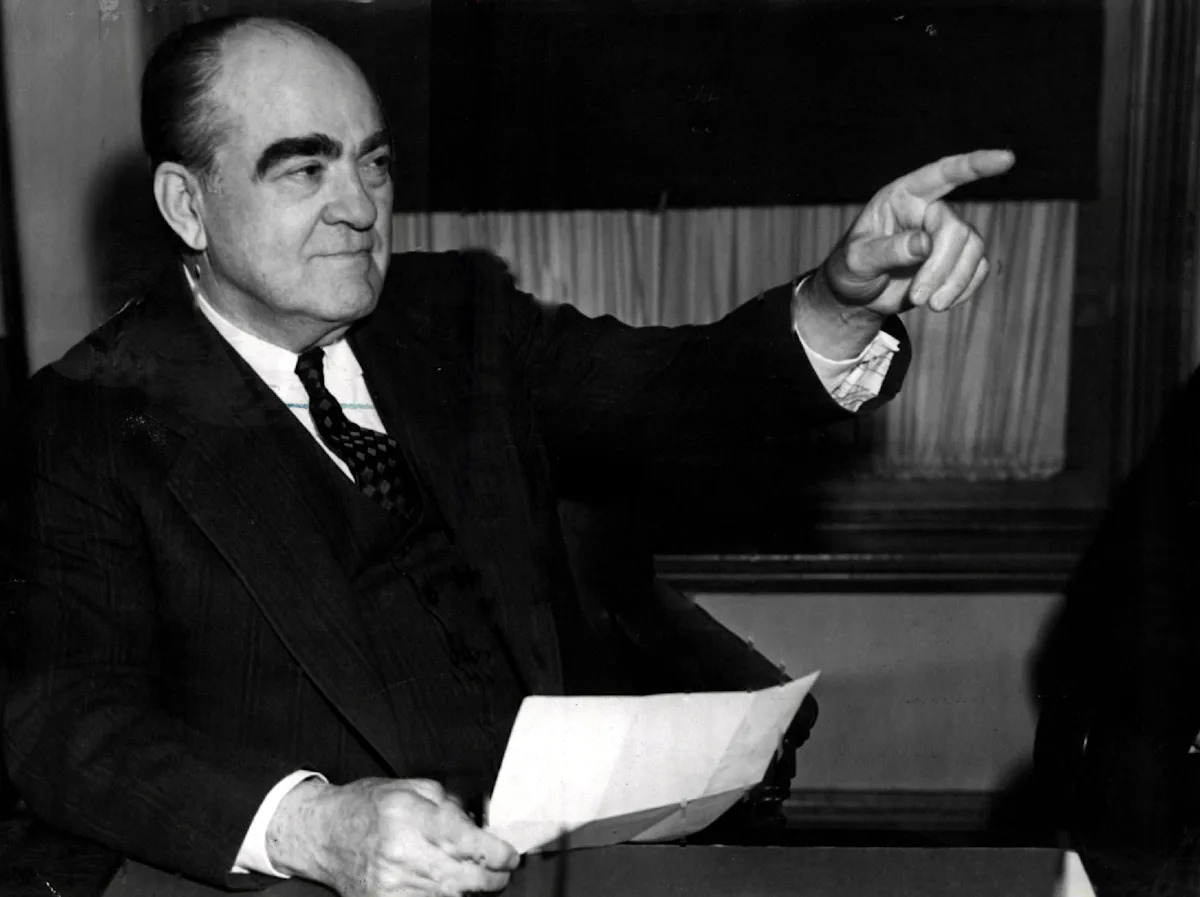
Most days during our Yankees Birthday series have been highlight a player who was born on that particular day. While the players are the ones we watch on a day in and day out basis, it takes more than them to make a baseball team go, and today we’ll look back on someone who had a major impact in franchise history off the field.
You can make an argument that Ed Barrow is one of the single most important people in franchise history. While in the front office, he played a key role in the Yankees finally getting over the World Series hump, and then them winning a bunch more, as they became the preeminent MLB franchise.
Edward Grant “Ed” Barrow
Born: May 10, 1868 (Springfield, IL)
Died: December 15, 1953 (Port Chester, NY)
Yankees Executive Tenure: 1920-45
Barrow was born in Springfield, IL in 1968, but his birth came as his family was moving to Nebraska in search of farmland. His family settled there for a couple years, but the Barrows would later move to Iowa, where Ed spent much of his youth.
As a teenager, Barrow began working as a mailing clerk for a Des Moines, IA newspaper, eventually working his way up to a reporter job with the Des Moines Leader. He used his higher position to create a local baseball team, which featured future Hall of Famer Fred Clarke among others.
Barrow later moved to Pittsburgh and worked in some other industries before returning to baseball. He bought pieces of several minor league teams, including the Patterson (NJ) Silk Weavers, eventually also managing the team. He ended up signing a young Honus Wagner from the team, giving the future Hall of Famer his start in pro baseball. After holding a number of positions around baseball, he bought a share of the Toronto Maple Leafs (the baseball version) of the Eastern League, also eventually becoming their manager. He managed to help turn them around from a struggling franchise to the EL pennant winners in 1902. That quick turnaround led to the Detroit Tigers hiring him as manager for 1903.
In Detroit, Barrow helped improve the Tigers’ spot in the standings in his first season. However that offseason, new owners bought the team and Barrow soon found himself at odds with some of the new brass and resigned partway through 1904. He returned to the minor leagues for a while after that, eventually getting the position of president of the Eastern League. Under him, the league was redubbed the “International League,” which it still exists as today in Triple-A. Later in his run, he tried to build up a third major league with some IL franchises, leading him to clash with some of the league’s owners and them eventually ousting Barrow.
By this point, Barrow’s reputation in baseball had grown enough that he was then quickly hired to manage the Boston Red Sox. Boston had finished in second in the AL the previous season, but with some savvy additions, Barrow took them to the AL pennant in 1918. However, the savviest move was putting to use the hitting ability of the young Red Sox pitcher Babe Ruth. In addition to hitting a league-leading 11 homers, Ruth then won two games on the mound in the World Series as the Red Sox won the title. As we Yankee fans once liked to point out, it would be Boston’s last for a while.
The Red Sox fell under .500 the following two seasons, and against Barrow’s wishes, Ruth was famously sold to the Yankees after 1919. His frustrations eventually boiled over, and the Yankees’ owners gave him an opportunity to become the team’s business manager. He took that opportunity, resigned from Boston, and jumped to New York. With the Yankees, Barrow’s position morphed into something resembling the general manager job of today. He was generally in charge of contract negotiation and player acquisition, while acting as an intermediary between ownership and on-field manager Miller Huggins.
While Ruth’s move to the Yankees did predate Barrow, almost every other move in the 1920s through the next couple decades, many of which led to championships, can be traced back to Barrow in some way. He hired scout Paul Krichell, who quickly discovered Lou Gehrig, and then also scouted and signed the likes of Tony Lazzeri, Phil Rizzuto, and Whitey Ford. Barrow stuck by Huggins despite internal and external pressure, who eventually led the Yankees to their first couple titles, and then later hired Joe McCarthy. He played a role in helping the Yankees secure their move to Yankee Stadium. He signed a young Joe DiMaggio out of the Pacific Coast League. His protégé, George Weiss, later became Yankees GM and led the team to a host of even more World Series titles. During Barrow’s tenure from 1920-45, the Yankees won 10 World Series titles, never mind the ones that came after that he deserves an assist for.
In 1945, the estate of Jacob Rupert, who had hired Barrow, sold the Yankees to Larry MacPhail, Dan Topping, and Del Webb. The new owners moved Barrow to a ceremonial position and advisor, and Barrow eventually retired from baseball in 1946. MacPhail briefly held the GM position for a couple years before Weiss took over and continued on with the franchise’s dominance.
After leaving the Yankees, Barrow was offered the position of commissioner, but declined, citing his age. He remained in the New York area until he passed away in 1953. Shortly after his passing, he was voted into the Hall of Fame and given a Monument Park plaque by the Yankees. Beyond what his teams did on the field, Barrow was the innovator of putting numbers on players’ uniforms, as well as retiring them, as he did initially with Lou Gehrig’s No. 4. He was the first to let fans keep foul balls. There’s so much about the Yankees and baseball that you can trace back to Ed Barrow in some form.
See more of the “Yankees Birthday of the Day” series here.