There hasn’t been a playoff series since the 2018 Western Conference Finals that carries as much anticipation as the upcoming Spurs-Thunder clash, and for good reason. Both teams could upset Adam Silver’s precious era of parity, and the only thing stopping one of them from becoming a dynasty is, well, the other.
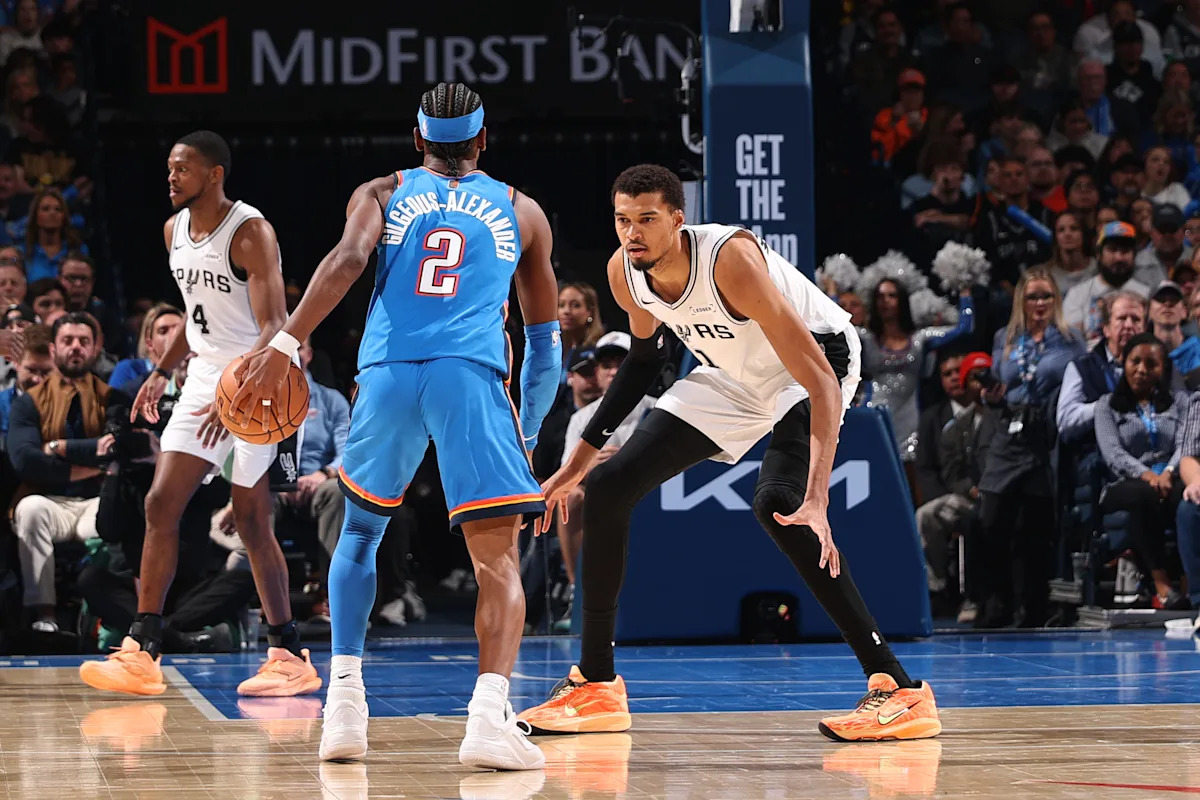
OKC has already reached the mountaintop, while San Antonio is nipping at their heels. This is the first matchup of what should be the rivalry of a generation, and whoever comes out on top between Wemby and Shai could also grab the title as best in the world.
So, let’s examine some of the key battles that will determine the war.
Rebounding
Rebounding has been OKC’s achilles heel for a few seasons now, and it could be problematic against the Spurs too. In the regular season, the Thunder’s 25.1% offensive rebounding rate ranked 25th in the league, while their 71% DREB was 16th. Meanwhile, the Spurs placed 9th (29.5%), and 1st (74.1%), respectively, in those categories, which played out in their regular season matchup, too: San Antonio scored 13 more second chance points in those games (+2.6 average).
Overall, the Spurs grabbed 12 more OREBs and 4 more DREBs across those five matches. It’s worth noting that those numbers are fattened by their fifth and final game, when the Thunder rested all their stars, and OKC has also been much better in the playoffs, with a 32.3% OREB compared to San Antonio’s 28.4%. On the other hand, the Spurs’ playoff opponents had much more capable frontcourts than what the Thunder faced, and the regular season’s larger sample should be more indicative of both team’s styles.
In such a close series, San Antonio needs to win on the margins, and that means dominating OKC on the glass.
Free throws
For as much hootin’ and hollerin’ there is around Shai’s foul grifting, he is still just one player. Even with his prowess getting to the line, the Thunder were “just” 9th league-wide in free throw rate, at 21.8% — just slightly behind the Spurs, who were at 21.9%. These two teams are neck and neck on the other end, too, as San Antonio was 1st in defensive free throw rate (17.9%) while OKC was second (18.3%), and none of those numbers have changed much in the playoffs. In the four regular season matchups when both Wemby and Shai played, the Spurs shot 15 more FTs than the Thunder did, though the large discrepancy is skewed by an outlier game that saw San Antonio have 17 more attempts in one night.

This will be a battle of strengths on both sides of the ball, and I’m fully here for the toxic discourse that will inevitably follow.
The Wemby mismatch
Wemby is a walking mismatch for every team in the league, but it was most pronounce against the Thunder due to the level of competition he dominated. In their regular season series, OKC had an abysmal 99.6 offensive rating with Wemby playing, which was largely caused by their shots (or lack thereof) at the basket: the Thunder only attempted 25.3% of their shots around the rim, which would’ve ranked 29th league-wide and was 6% lower than their full season average (31.3%). They had no answer to Wemby defensively, as he was always able to roam the paint by either matching up against a non-spacing big (Hartenstein), or sagging off of a guard who struggles to shoot (like Caruso, who went 2-12 from three in one game).
It’s a high risk, high reward strategy since Caruso (and other Thunder guards) has shown the ability to get hot from deep, but the Spurs have counters to that as well. In the Minnesota series, the Wolves forced Wemby to guard Terrance Shannon Jr. at times in the corners, but the Alien recovers so fast that he’s able to get back in the paint without giving the opposition an advantage, and that’s also aided by San Antonio’s impeccable defensive rotations beside him.
Shai hasn’t passed the Wemby test, either. The Alien allows the Spurs’ perimeter defenders (especially Stephon Castle) to guard the MVP aggressively: if they get beat off the dribble, they know that Wemby’s behind them to provide help, and because of this, Wemby’s presence has detered Shai from driving, forcing him to take difficult shots instead.
The one thing OKC can try is using Gortat screens to prevent Wemby from getting in position to contest shots. Minnesota did it multiple times in the first few games to some success, and the Thunder have better personnel to make it a more consistent strategy. It won’t work everytime, but if OKC executes it properly, some key possessions could be swung in their favor.
Offensively, Wemby renders one of the Thunder’s strengths moot. San Antonio made an absurd 70.5% of their attempts at the rim, which is over 10% higher than what OKC normally concedes in that area (60.2%, first in the regular season). Having a 7’5” alien as a lob threat certainly helps, but Wemby’s impact goes far beyond that. His gravity creates open driving lanes for San Antonio’s guards, or cuts that they can make for wide open finishes, like the example below.
In the regular season games, the Thunder used a smaller guard/wing on Wemby, allowing iHart or Chet to roam and provide backline help. This was largely ineffective due to Wemby’s shooting ability, his gravity, and the Spurs off-ball movement, so OKC tried playing Chet straight against him instead. Well, that didn’t even last a half, and OKC seemed lost during all of the Wemby minutes.
Still, Mark Daigneault has had over three months to gameplan against the Alien. He’ll have moree tricks up his sleeve now, and there’s still a wrinkle that was barely employed in the regular season: using one of Chet/iHart against Wemby while the other one acts as a roamer by sagging off of Castle. It’s a risk given that the latter is shooting 44% from three in the playoffs and has dealt with this type of coverage before, but neither Castle nor Wemby has experienced it against an all-time great defense that has had months to prepare for this specific matchup.
If anyone can find an advantage over Wemby and the Spurs, it would be this OKC squad.
X-Factor: Spurs’ 3-point volume vs Thunder’s points off turnovers
As was outlined by Jeje in the series preview, the Spurs allowed much fewer turnovers against OKC compared to the Thunder’s season average, and that resulted in San Antonio scoring more points off TOs than OKC did. Essentially, the Spurs turned off the Thunder’s superpower, which was caused by a few factors. One, OKC’s perimeter defenders weren’t hounding San Antonio’s guards as much as they usually do, instead giving them more space. This is because the Spurs’ guards are the only ones in the league that can match the Thunder backcourt’s physicality and athleticism, so San Antonio could play bully ball and drive past the defense if they were pressed too hard. OKC also wanted to swarm Wemby more, and with none of the Spurs guards being elite shooters, the Thunder were comfortable giving them more space to operate on the perimeter.
Obviously, the drawback to that is the lack of turnovers created. Given the lack of success that this scheme had in the regular season, I expect OKC to go back to their usual aggressive defense, but that would result in more defensive rotations that opens up threes for their opponents. The Thunder have successfully lived with this trade-off for multiple seasons now, finishing tied for first in turnovers forced this past season (16.8%) but also conceding the 6th most threes (40.4% of opponent shots came from beyond the arc) and the most corners threes, too (12.4%). That latter number is especially important because the Spurs generated the most corner threes (12.9%) in the regular season, which increased to 13.8% with Wemby on the floor — one of the highest figures ever.
In other words, the Thunder can either play conservatively on defense and risk losing the turnover battle again, or they can go back to their usual scheme and live with the Spurs shooting threes. This will be the most important stylistic battle to monitor, and whoever comes out on top will have a massive advantage in the series.