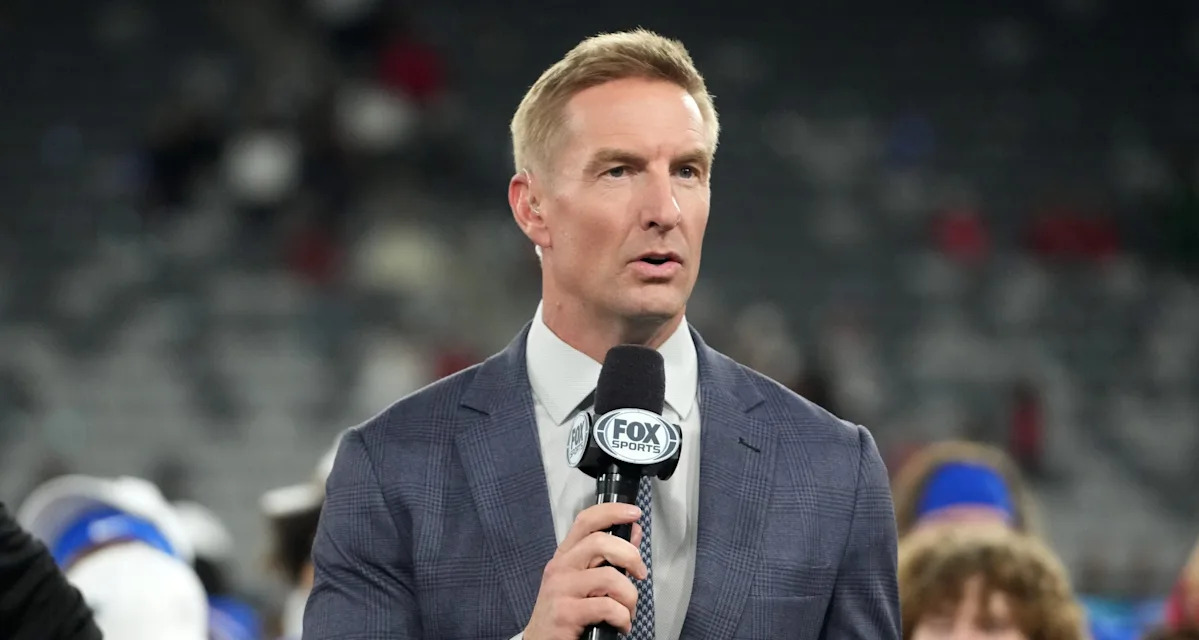
Joel Klatt isn’t blaming ESPN for what’s happened to college football. He’s just explaining why ESPN is the reason it happened.
The Fox Sports analyst made the case on his eponymous podcast that the College Football Playoff has swallowed the sport’s entire narrative whole and that ESPN, which is paying over a billion dollars annually for the rights, is doing exactly what any rational business would do.
Klatt’s network and the Worldwide Leader are currently locked in an extended proxy war over the future of the playoff format, with Fox Sports CEO Eric Shanks endorsing a 24-team bracket, specifically because anything beyond 14 teams would trigger open-market bidding and break ESPN’s monopoly on the postseason. And yet here is Fox’s lead college football voice essentially telling you that if the roles were reversed, his network would do the exact same thing.
“I’m not going to sit here and bash on ESPN,” Klatt said. “Because if Fox had the 12-team playoff and we were the sole partner, guess what? We would focus all of our energy into maximizing the importance of that playoff. That’s all ESPN has done. That’s their job. They made a giant investment into the College Football Playoff — over a billion dollars annually — in order to televise the College Football Playoff. So, what should they do? Make it the most important thing possible; derive all meaning into that area of the season. So, they’re doing exactly what they should do. This is not their fault. In a lot of cases, they built college football into what it is now. And now all they’re doing is they’re protecting their billion-dollar investment — as they should.”
ESPN pays $1.3 billion annually for CFP rights through 2031, re-upping in February 2024 after a bidding process in which Fox reportedly made a significant bid that ultimately didn’t materialize. The network also owns SEC rights through 2034 and runs the SEC Network. ESPN does sublicense some games — TNT gets two first-round games and, starting in 2026, two quarterfinals and one semifinal annually through 2028 — but that’s still fundamentally ESPN’s deal to carve up. TNT is renting rights from Disney, not competing for them, which doesn’t solve what Klatt is actually getting at.
And therein lies the problem.
“But what has happened now is the weekly rankings, all the talk, and all the narrative. All it suggests is that if you’re not within that ‘Who’s in?’ model, then who cares?” Klatt continued. “And, yet, all of those programs are still expected to have this major investment from outside boosters in order to try to build a roster to get to that point, and it’s really hard to get to that point.”


The sport has reorganized its entire identity around a playoff that excludes most of it. Every Tuesday from October through conference championship weekend, the conversation narrows to whoever is in the bracket picture. The weekly ESPN rankings, which have drawn calls for abolishment from voices across the sport, have effectively turned the sport’s discourse into a 14-week “who’s in, who’s out” exercise. The 100-something programs that have no realistic path to the field exist primarily as résumé-building fodder for the teams that do. And yet the financial demands haven’t gone anywhere for those programs. Schools are spending at historic levels to chase a postseason that the current structure makes extraordinarily difficult to reach, while the weekly television narrative tells their fans that if you’re not in the picture, you don’t matter.
None of that, according to Klatt, is ESPN’s fault, though. Even if he believes the network “chose the wrong path when it comes to the presentation of this playoff,” and that no postseason should belong exclusively to one television partner.
“That’s how you know this isn’t a Fox-ESPN thing for me,” he said earlier this year, “because I don’t think it would be great if we at Fox solely had the College Football Playoff.”
What Klatt is really describing is a sport that sold its identity and is only now reckoning with the price. College football’s entire value proposition — the thing that separated it from every other sport — was that the regular season was the playoff, that a loss in September could end everything, that every game carried a weight the NFL could never replicate. ESPN didn’t invent the College Football Playoff or force the sport to reorganize itself around it. The conferences and universities did that voluntarily, in exchange for the kind of money that makes billion-dollar television deals possible in the first place. ESPN just showed up with a check and did what any rational business does with an asset it paid that much for. The tragedy isn’t that one network now controls the narrative. It’s that the sport handed over the thing that made it worth watching in order to get there.
The post Fox’s Joel Klatt defends ESPN’s stance on CFP expansion appeared first on Awful Announcing.