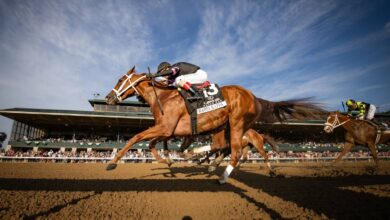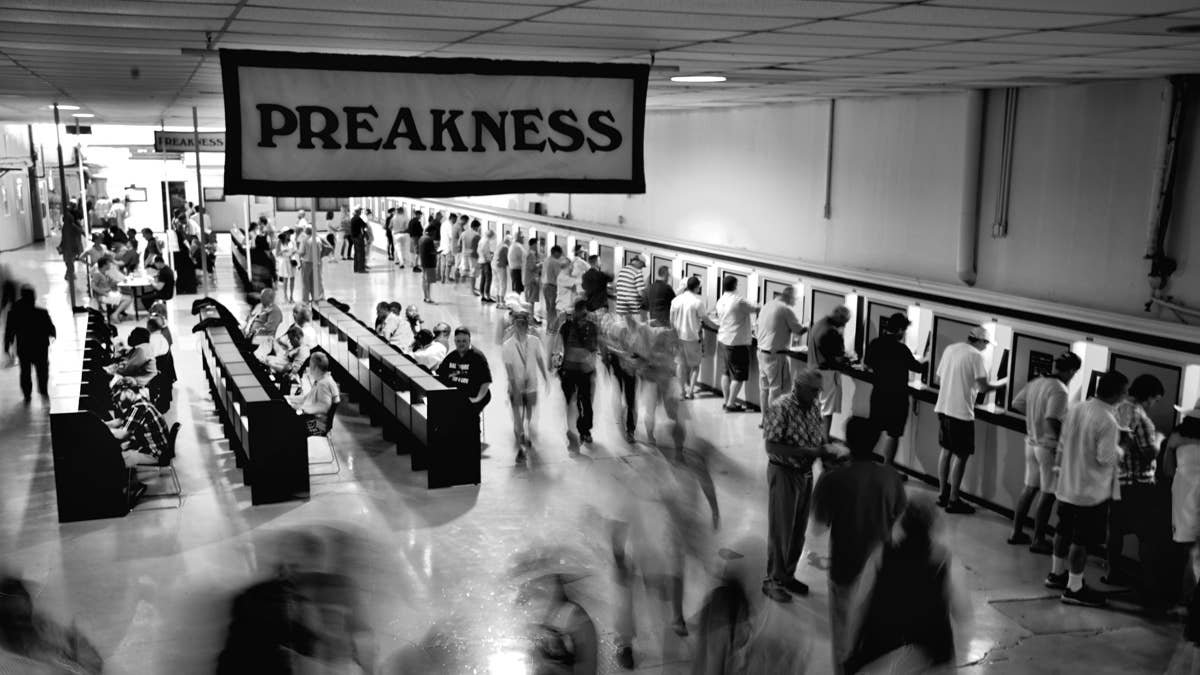
When Laurel Park plays host to the 151st Preakness Stakes (G1) May 16, it will mark the 17th time – and first in well over a century – that the Middle Jewel of the Triple Crown has been held away from the city of Baltimore and Pimlico Race Course.
It has been so long, in fact, that when the last of 15 straight Preaknesses was held in 1908 at the old Gravesend Race Track in Brooklyn, Laurel Park was still three years from opening its doors. Another 22 years would pass before the Kentucky Derby, Preakness and Belmont Stakes were aligned into the series that the late Charles Hatton – famed Daily Racing Form columnist and member of the National Museum of Racing’s Joe Hirsch Media Roll of Honor – popularized as the American Triple Crown.
North Baltimore native Joseph Challmes, an author and reporter for the city’s Sun newspaper, revealed in his 1975 book The Preakness: A History that the race’s lengthy residency near Coney Island wasn’t unearthed until the late 1940s by Pimlico’s director of publicity, David F. Woods. Helping to mask their existence was the Great Baltimore Fire of 1904, which destroyed much of the Maryland Jockey Club’s early records.
According to Challmes it was Woods, acting on a tip, dusted off old racing volumes housed in the cupola of Pimlico’s old Victorian clubhouse and – after confirming reports from New York-area newspaper accounts of the time – “discovered” that the Brooklyn Jockey Club held a race called the Preakness for a decade and a half. Another edition, in 1890 at Morris Park in the Bronx, was uncovered in the mid-1960s by Wood’s successor, Joe Hickey, and likewise adopted into Preakness lore. As a group, the 16 New York races became known as the “lost Preaknesses.”
The Preakness made its debut on Tuesday, May 27, 1873 at Pimlico, six years after the inaugural Belmont was held and two years before the first Kentucky Derby. Survivor galloped to a 10-length upset at odds of 11-1 while favored Catesby – whose owner, former Maryland governor Oden Bowie, attended the famous dinner party in New York that would lead to the Preakness’s creation – could do no better than fourth. The winning margin wasn’t approached until Smarty Jones smashed it with an 11 ½-length decision in 2004.
One of the first states to resume racing in the aftermath of the Civil War, Maryland was soon competing with nearby New York and New Jersey as well as Kentucky – and losing. The result saw steep reductions in field size, handle, prestige and popularity among racegoers and with it brought financial hardship.
By August 1889, only three months after Buddhist beat just one horse to win the 17th Preakness, the Maryland Jockey Club – with origins dating back to 1743 and members that included future presidents George Washington and Andrew Jackson – made the hard decision to give up its lease on Pimlico and suspend racing.
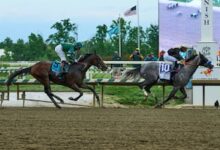

The Preakness needed a new home and found it at unique Morris Park, which existed from 1889 to 1904 featuring an uphill backstretch and downhill homestretch that widened from just 80 feet at the top of the stretch to 240 feet by the finish line. As a new track seeking to fill out its stakes with races that held some prestige, the Preakness was an attractive addition and, in fact, shared the June 10, 1890 program with the Belmont Stakes.
Contested at 1 ½ miles instead of the current 1 3/16 miles and not restricted to 3-year-olds as it is today, the 1890 Preakness saw four horses entered, none of them sophomores, including 8-year-old Ten Booker. The 5-year-old Montague, favored at 5-to-4 and fittingly owned by Preakness Stables of New Jersey, won by three lengths “in a canter,” according to the official chart. Ten Booker, a distant last, made history by being the first horse to run in both the Derby and Preakness, though his Derby run came in 1885.
To date no record exists of the Preakness being run from 1891-1893 though Hickey, whose research was thwarted by the July 1966 fire that destroyed Pimlico’s famed clubhouse and who passed away in 2013 at the age of 86, told the Sun in a 2006 article it was his belief the race was run somewhere in New York during that time.
“If someone dug long enough into the right places,” Hickey said, “I’m betting they’d find Preaknesses.”
Gravesend Race Track was owned by wealthy brothers Philip and Michael Dwyer and located on the former Prospect Park Fair Grounds, which had been previously used for harness racing. On May 17, 1894, Assignee bested 13 rivals to win a 1 1/16-mile maiden contest for 3-year-olds named the ‘Preakness Stakes.’ Interestingly, and without specifics, all 14 jockeys in the race were fined $25 for ‘misbehavior.’
Dutch jockey Fred Taral won a second straight Preakness May 25, 1895 when the race was restricted to 3-year-olds that had not won a race worth more than $1,000. Belmar finished first by a length over April Fool despite carrying 10 pounds more than the lightweight’s 105. Belmar would go on to win the Belmont that fall.
“The colt’s victory was largely due to Taral’s brilliant and vigorous finish,” Challmes quoted from the New York Times in his book. “He clearly outrode Griffin, who had the mount on April Fool.”
Not at the stature of New York’s big-name races such as the Brooklyn and Metropolitan handicaps, the 1896 Preakness saw future Hall of Fame jockey Henry Griffin, vanquished the prior year, guide Margrave to the wire first. Intermission, who finished third, raced in the wrong silks after being sold earlier in the day to J. E. McDonald by Green B. Morris. His trainer, Byron McLelland, was fined $25.
The 1897 Preakness was run in a driving rain that forced seven of its 14 entrants to scratch. The horse Paul Kauvar rallied past pacesetting Elkins to win by 1 ½ lengths in a race described by one writer as “all that could be expected on a track where the horses floundered along,” according to Challmes, “when a rear position close up to a leader meant a blinding mud bath for horse and jockey.” Before the race jockey Tod Sloan, riding favored On Deck, was unhurt when thrown into the mud and climbed back aboard after cleaning his face with the starter’s flag.
Challmes noted that Sloan rode crouched with his feet high on a horse’s back, unlike the straight-legged fashion that jockeys had used with Thoroughbreds for more than 150 years. Weighing between 90 and 100 pounds and winning at a 40 percent clip in his prime, “his famous ‘monkey-on-a-seat’ riding style changed forever the style of jockeys,” Challmes wrote.
The Preakness was still a minor race when Sly Fox won it in 1898, but that perception would change the following year when the highly regarded Half Time bested two rivals as the feature on Gravesend’s Memorial Day program. Having already beaten Brooklyn Handicap winner Jean Baraud, Half Time led wire to wire in what the New York Times described as “a cracking good race,” Challmes wrote.
Hindus, last in the 1900 Derby, rebounded to win the Preakness by a head at odds of 15-1 after trailing seven horses at the top of the stretch. Unknown at the time, Hindus was the first horse to contest the Derby and the Preakness in the same year. The Parader held on to win the 1901 Preakness by a head in spite of his jockey, Frank Landry, who eased up on his mount prematurely.
The first-ever California-bred horse to run in the Preakness, Old England, won it by a head in 1902 for Green Morris, the owner who sold the eventual winner on the day of the race six years prior. The 1903 Preakness jumped in class to 3-year-olds that had not won $3,000 or more in a single race and was again the Memorial Day feature, even outdrawing the Brooklyn Handicap program two days earlier. Flocarline found room on the rail to stun favored Mackey Dwyer and become the first filly winner.
Bryn Mawr was a popular winner of the 1904 Preakness despite breaking poorly, outclassing his nine rivals, six of which went off at odds of 15-1 or higher. In 1905, the days before photo finishes were used to determine close results, favored Cairngorm edged the filly Kiamesha though the New York Times reported “there would have been no dispute by the crowd had the filly been placed first, so close was the race,” Challmes wrote.
Whimsical, with 16-year-old jockey Walter Miller aboard, became the second filly to win the Preakness in 1906, the sixth of seven straight years it was run at a mile and 70 yards. Miller was one of the most sensational riders of his era, winning more than 300 races in 1906 and 1907 though his career all but fizzled out by the time he was 20. His 388 wins in 1907 was the single-season benchmark for 45 years.
August Belmont sent out a brother of future Hall of Fame mare Beldame, Don Enrique, to win the 1907 Preakness, though the prominent New York owner-breeder was absent, crossing the ocean by boat for a European holiday. Don Enrique’s $32 win price matched Hindus from 1900 as the largest payoff in race history. The current record of $48.80 was set by Master Derby in 1975.
The 1908 Preakness was the last at Gravesend and proved an ignominious end to the race’s stay in New York, run at 1 1/16 miles under allowance conditions. Royal Tourist won by four lengths for owner-breeder Harry Payne Whitney, who would win four more Preaknesses in the 1920s when the race rose to American Classic prominence.
Challmes wrote that when When the Hart-Agnew Bill was passed in June 1908, outlawing wagering in New York, tracks began dumping stakes races in order to save operating costs ahead of projected income losses. Gravesend would close its doors in 1910.
A 2019 article in The Equiery noted that some steeplechase and harness racing helped fill the void at Pimlico while the Preakness was in New York. ‘Old Hilltop’ also had a stint as Camp Wilmer, named after then Maryland Adjutant General L. Allison Wilmer, where members of the First and Fifth Maryland Volunteer Infantry trained for the Spanish-American War beginning in April 1898.
In 1904, a new version the Maryland Jockey Club under the leadership of William P. Riggs had resumed a scaled-down racing schedule. Challmes wrote that its officials visited New York several times in early 1909 and by mid-March, Riggs announced that the Preakness Stakes, at one mile for 3-year-olds, would “be run as the feature event at Pimlico” that May.
After a long and winding road through the boroughs of New York, the Preakness had made its way home.
This story was originally published by Paulick Report on May 12, 2026, where it first appeared in the News section. Add Paulick Report as a Preferred Source by clicking here.