AUGUSTA, Ga. — Everyone knows that on Masters Sunday, you treat the 12th hole at Augusta National like the heavyweight champion of the world: nothing good comes from challenging it. Unless, that is, you’re the reigning heavyweight champion yourself.
Rory McIlroy stepped to the 12th tee on Sunday afternoon knowing that he was one stroke ahead of Justin Rose, knowing that his lead was as fragile as crystal, and knowing the hole’s diabolical history. So many Sunday hopes have drowned in Rae’s Creek, most notably, for these purposes, the afternoon in 2016 when Jordan Spieth saw his dreams at a Masters repeat die at this same tee.
So with all that pressure, all that history, all those nerves and expectations weighing on him, what did McIlroy do?
Drop the closest approach of the entire day right onto the devious green. One 7-foot putt later, and McIlroy had a two-shot lead over the field. He increased the lead to three strokes with a birdie on the 13th, playing Amen Corner a full five strokes better than he had on Saturday. He’d blown every bit of his six-stroke lead on Saturday, and he’d fallen two strokes off the lead early on Sunday, yet here he was, five holes to play and a three-stroke cushion on the field.
But even after a heart-pounding moment on 18, when McIlroy drove his tee shot deep into the woods on the right, there was still no catching him, not even from world No. 1 Scottie Scheffler, who trailed McIlroy by a dozen strokes entering the weekend only to finish one shot back — McIlroy’s 12-under to Scheffler’s 11-under.
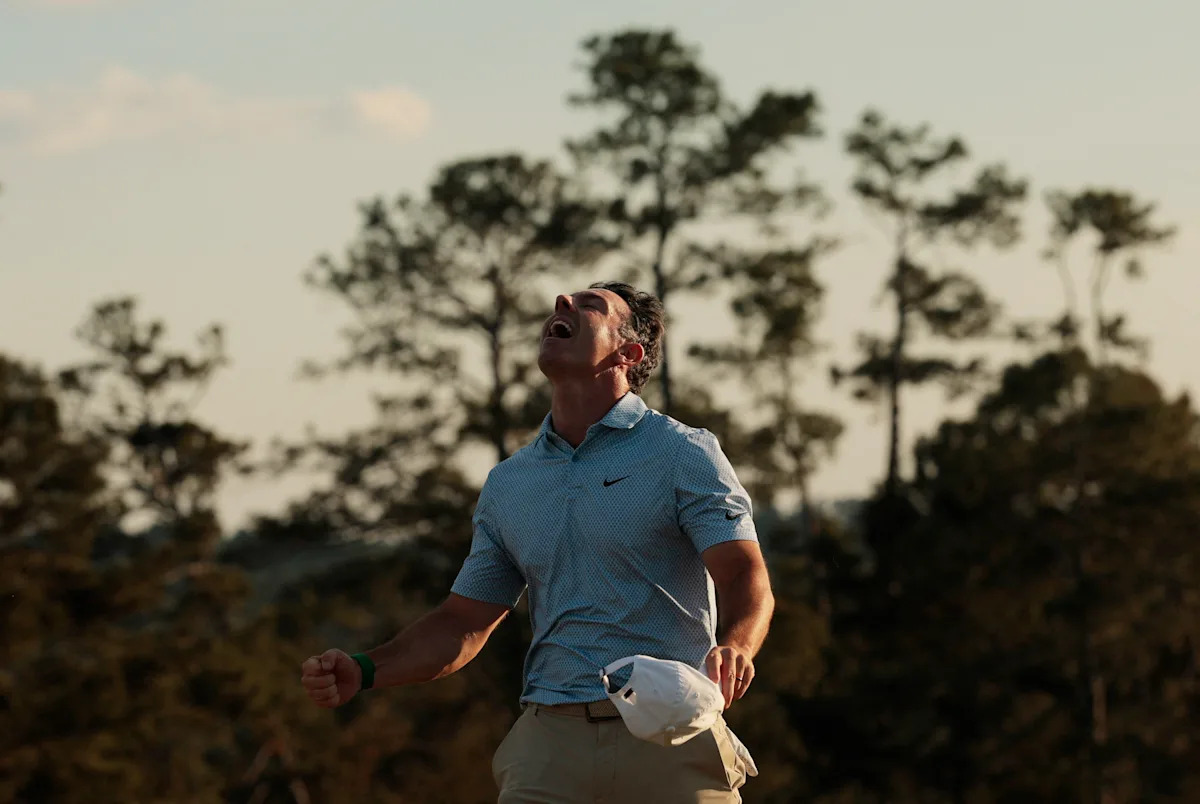
As the final putt dropped — a tap-in bogey from inside 12 inches — McIlroy looked to the sky and let out a scream.
After a 17-year wait for his first green jacket, McIlroy has collected a second straight, becoming just the fourth player to win back-to-back at Augusta, joining the elite group of Jack Nicklaus, Nick Faldo and Tiger Woods.
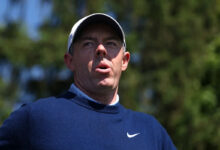
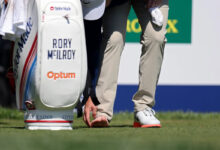
It’s the sixth career major championship for McIlroy, which puts him in a tie with Lee Trevino, Faldo and Phil Mickelson for 12th-most all time.
“When the ball trickled by [the hole on 18] and I marked it there from two inches or whatever, I just looked at the back of the green, and I give it one of these because I saw my mom and dad and [wife] Erica and [daughter] Poppy, and I was just like, I can't believe I've just done it again,” he said. “Yeah, more joy, more — yeah. Not as emotional, but just, wow, it's amazing. I can't believe I did it again.”
Year of the gnome
Coming into the week, the dominant storyline of Augusta National was … there was no dominant storyline. McIlroy had finally won his green jacket and closed off the career grand slam last year, after all, so what was left? Scheffler had been scrambling the last few weeks. McIlroy had been dealing with back issues. The dominant forces on the PGA Tour were Chris Gotterup and Jacob Bridgeman, both playing in their first Masters. The foundational pillars of LIV, Jon Rahm and Bryson DeChambeau, were both racking up strong performances on the competing circuit, but how well would that translate to Augusta National?
The largest pre-tournament storyline, as it turned out, came from the smallest figure on the Augusta National grounds — the 13-inch gnome that’s become an instant collectible, inspiring Black Friday-esque rushes on the Masters merch tent. With rumors swirling that this would be the final year for the celebrated little fellow, rumors that Augusta National chairman Fred Ridley didn’t exactly dispel, patrons gathered outside the gates in the predawn hours and spent up to 90 minutes of their precious Masters day just standing in line to get into the merch shops.
The Great Gnome Hunt, along with a heavy social media influencer presence, multiple exclusive “experiences” for certain patrons, and a par-3 tournament presentation that edged perilously toward College GameDay territory, all combined early in the week to give the sense that the Masters was drifting away from its golf-first, golf-always origins. And with a second straight year of aggressive crackdowns on the secondary ticket market, the Masters further consolidated its control over every element of the patron experience.
Rory begins his defense
Rory McIlroy celebrates on the green on the 18th hole after winning The Masters. (REUTERS/Brian Snyder) (REUTERS / REUTERS)
As always, though, the best cure for the proliferation of non-golf stories at the Masters is … golf. Once Jack Nicklaus, Gary Player and Tom Watson began the Masters on Thursday with the traditional ceremonial tee shots, the golf itself claimed center stage. (The merch shop lines, though … they remained long enough to require a snack midway through.)
The weather was simply magnificent all week long — high sunshine, warm temperatures, gentle breezes — which makes for a memorable patron experience and a potentially devastating golf course. Greens on Thursday were as tough as they’ve been at Augusta National in a decade, with only three holes playing under par. Alongside Sam Burns, McIlroy posted a 5-under round to claim the Thursday lead. Rose lurked three strokes behind at -2.
McIlroy remains golf’s most fascinating figure, and this week has demonstrated exactly why. He’s gone from Masters pariah, staring up at the Tuesday night champions’ dinner on the veranda last year, to Augusta National ambassador, taking the green jacket literally all over the world and spreading the word of the Masters far and wide. He absolutely torched a receptive Augusta National on Friday afternoon, looking for all the world like he was about to become the fourth man to win the Masters back to back. No one has ever held a larger Friday lead at Augusta National than McIlroy’s six strokes as the sun set on the course.
McIlroy’s only problem? The fact that the tournament was only halfway done.
Nothing ever, ever comes easy for McIlroy, and Saturday was a perfect example of why. On a day when so many big names dove deep below par — Scheffler and Young carding 65s, Patrick Cantlay and Russell Henley bringing home 66s, dozens of players finishing with red-number rounds — McIlroy could only struggle home with a 1-over 73. His wayward driver and questionable decision-making hammered at his scorecard, including a double bogey-bogey pairing on the 11th and 12th.
Young, meanwhile, surged relentlessly forward, putting a Thursday first-nine 40 far, far behind him as he knifed up the leaderboard. Each round built on the one before, as he posted 73-67-65 over the first three days of the tournament, catching and briefly even passing McIlroy for the lead. They ended Saturday tied at -11, McIlroy’s entire six-stroke lead obliterated. Rose, too, stayed patient, recording a 3-under round to lurk at -8.
So when McIlroy and Young walked to the first tee a few minutes before their 2:25 p.m. tee time under a punishing sun, they knew the immensity of the task they faced to outlast the other. They also surely knew that there were scores to be had out on the course; earlier in the day Keegan Bradley and Gary Woodland had both posted rounds of 6-under 66.
Young and McIlroy scuffled through their first three holes, both heading to the fourth at -12 … where disaster awaited for McIlroy. He three-putted from inside of 5 feet, carding a double bogey as Young salvaged par. That left Young two strokes ahead of the field, and McIlroy just one stroke ahead of the most rabid pursuers.
Just like he did last year, Rose charged up the Masters leaderboard on Sunday, this time right from the jump. He birdied the first, fifth, seventh and eighth to get to -11, the key shot of the first nine a miraculous pine straw save on the seventh:
When Young flinched and bogeyed the sixth and seventh, Rose held the solo lead at -11. He added another stroke to his lead at the turn, birdieing the ninth to get to -12, two strokes clear of the field.
Henley entered the conversation by going -4 over the opening 8 to get to -10, and Tyrrell Hatton reached that mark on the 16th after four straight birdies. But Hatton ran out of holes.
McIlroy and Young both closed the gap on Rose with a pair of birdies on the par-5 eighth, landing them at -11. But McIlroy again missed a short birdie putt on 9 that would have given him a share of the lead; Young made his third bogey in four holes to slip back to -10.
As the final pairing made the turn, then, Rose held the lead at -12, followed by McIlroy at -11. Hatton and Young stood at -10, with Henley and Scheffler at -9. And then — on the second nine on Sunday at Augusta, as the legends foretold — the chaos truly began.
Hatton staked the clubhouse lead at -10, which, considering the carnage that came shortly afterward, seemed a fairly safe place to stand. Rose gave away a stroke on the 11th and flubbed his greenside chip on the 12th to fall out of first place at -10.
McIlroy, meanwhile, calmly made his way down into Amen Corner with the solo lead at -11. He rolled in a nervy putt on 11 that, had he missed, would have dropped him into a five-way tie. He took aim at the flag on 12 and curled his tee shot to within 7 feet — the tightest anyone had been all day — then rolled in the birdie to take a two-shot lead.
“[The wind] was in off the left — that was where the wind was,” he explained. “I waited — this is going back to one of my first-ever practice rounds here. I played a practice round with Tom Watson in 2009, and he said to me on the 12th tee he always waited until he felt where the wind should be and then just hit it. You know, just hit it as soon as you can.
“… I was patient, and I waited to feel where the wind should have been coming from, and I knew it was just a perfect 3/4 9-iron. … [A]bsolutely huge, huge shot in the tournament.”
Amen Corner devoured Rose; after a magnificent approach on 13 and an eagle opportunity, he walked off the green with a par to go with those two prior bogeys, remaining two strokes behind McIlroy.
Another birdie from McIlroy at 13 extended the lead to three shots … and from there it was just a matter of closing the door on a second-straight green jacket … at least until Scheffler made a late charge.
Birdies at 15 and 16 closed the gap to two shots, and if his putt at 17 would have fallen instead of burning the edge of the cup, it would have been one.
“I started the weekend 12 shots back and ended up only one shot back,” Scheffler said after a closing round of 68 that nearly got him in a playoff. “If I am going to blame anything, I should probably blame the first two rounds before I start looking at stuff from the last couple.”
Walking to 18, leading by two, McIlroy sliced his tee shot into the woods on the right side. Not knowing where it was when it landed was his most nervous moment of his round, he said. The drive, however, was so far right he actually had a clear enough look toward the green. He was able to dump his approach into a greenside bunker, and from there salvaged bogey to win by a single stroke over Scheffler.
There would be no collapse. Only history for McIlroy.
“It took me 10 years to win my fifth major, and then my sixth one's come pretty soon after it,” he said. “I'm not putting a number on it, but I certainly don't want to stop here.”