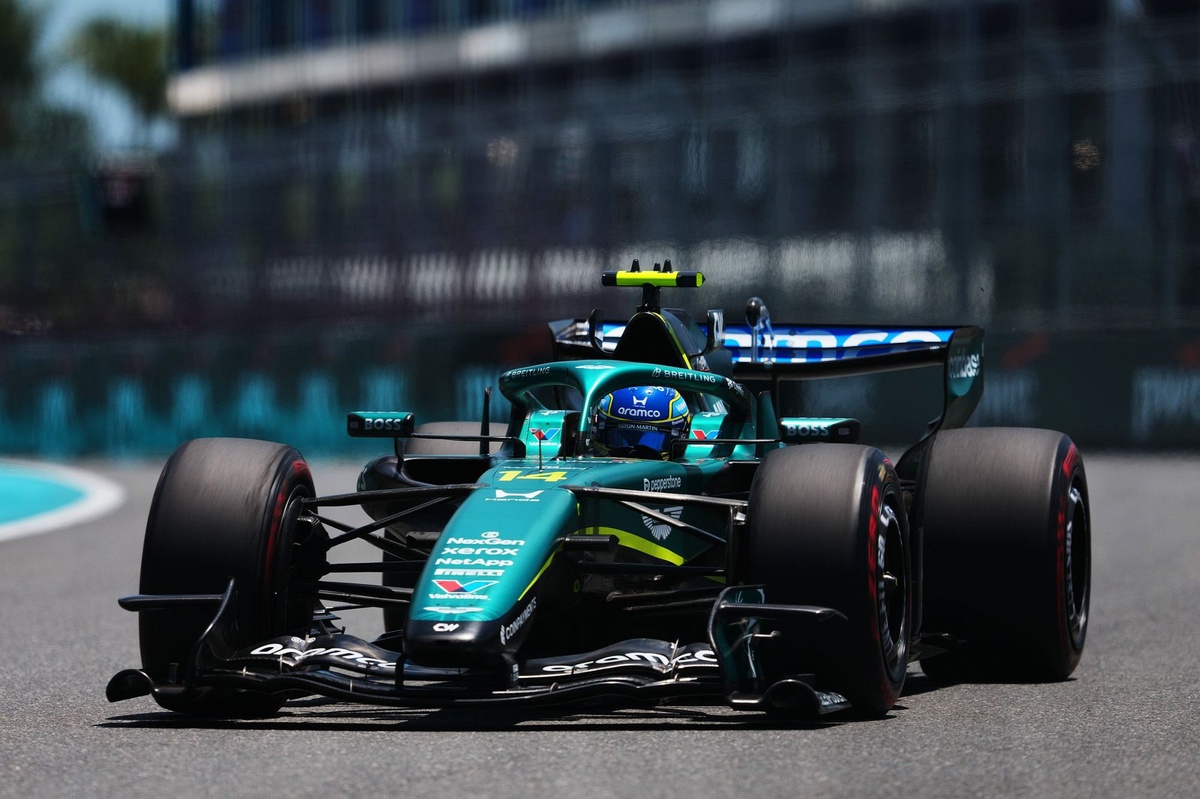
Just two months ago, it was nearly unthinkable for an Aston Martin car to complete a Formula 1 grand prix.
The team’s switch to a works Honda power unit deal from customer Mercedes powertrains backfired, with the Japanese engine generating vibrations that repeatedly damaged batteries and tended to numb drivers’ bodies.
As a consequence, Aston Martin recorded just one official finish over the first three grands prix, totalling four retirements while Lance Stroll was unclassified in Melbourne, unable to complete more than 15 laps without a break.
Read Also:
Aston Martin kept the AMR26 in Japan to test Honda vibration fixes on dyno bench
However, one of the AMR26s stayed in Japan following the Suzuka round to be studied by Honda engineers during F1’s unexpected five-week break in April, and the Miami Grand Prix marked a significant improvement, as both cars finished the sprint and the main race in Florida.
“The reliability and the vibrations are much better than what it has been so far,” Fernando Alonso commented after qualifying. “That's the main positive of this weekend. Let's say we can tick that box because the car behaves normal now. No issues to finish the race tomorrow. No reliability concerns.”

The Spanish veteran confirmed after the main race that he had no vibrations on Sunday, while Stroll laconically reported “less vibrations”.
Lance Stroll, Aston Martin Racing
Lance Stroll, Aston Martin Racing
Aston Martin chief trackside officer Mike Krack and Honda Racing Corporation trackside general manager Shintaro Orihara were subsequently asked about the issue and the drivers’ somewhat divergent comments.
“I think we are happy with it, and I think our partner wants to do more,” Krack elusively replied, with Orihara adding: “After the Japanese Grand Prix, I mentioned HRC and Aston Martin worked very hard to bring countermeasures here. We confirmed them working well, and also, drivers gave us positive comments. That's good progress for Aston Martin and Honda.
“We have completed a full race distance and also a sprint race distance without any major reliability issue. That is good progress. Then, next focus point, we can focus to optimise our data setting for energy management and also drivability. There is still a lot of room to improve on our power unit. That's the next step for us.”
Orihara did clarify that “countermeasures from both sides” were required to fix the vibrations issues, given they spread into the chassis.
The team’s focus will now be on performance, which the AMR26 has clearly been lacking regardless of reliability.
Alonso and Stroll qualified respectively 18th and 19th for the grand prix, a whopping 1.2s down on the Q2 cutoff time, though the Spaniard was hampered by gearbox issue causing “random downshifts”. Cadillac was their only rival in the race – which Aston finished 78 seconds away from points.
“In terms of pace, we didn't bring any part here,” Alonso pointed out after qualifying. “Probably we fall behind a little bit extra than the last race.” So, the two-time world champion is not expecting any breakthrough before the summer break, as the team refrains from bringing upgrades.
Fernando Alonso, Aston Martin Racing
Fernando Alonso, Aston Martin Racing
“I'm at peace because I understand the situation,” he added after the race. “The team explained to me that we are P20 or P19 and the next car is one second in front, so even if we bring two tenths every race, it doesn't change our position – and it's a huge stress in the system, in the budget cap and things like that.
“So, until we have a 1.5s or two-second improvement, it's better not to press the button in production, because we waste money.”
Krack confirmed that stance, explaining that Aston was yet to optimise the current AMR26 package.
“We also must acknowledge that there is a big gap to close and this will not be the work of a week,” he concluded.
Additional reporting by Stuart Codling and Cihangir Perperik
To read more Motorsport.com articles visit our website.