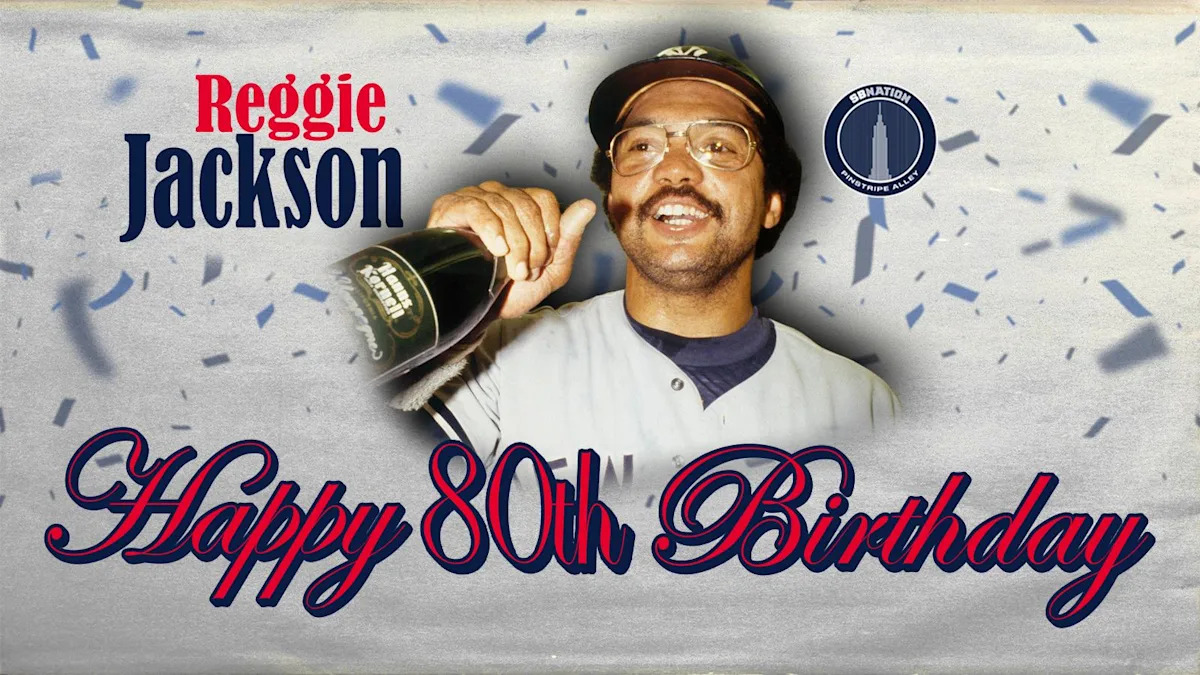
Reggie Jackson arrived at Yankee Stadium on October 18, 1977 with a chip on his shoulder. In part, it was because that was his natural state. But he had something in particular to prove that day. Despite winning a trio of championships — and the 1973 World Series MVP — in Oakland, he had yet to show what he could do in New York. After Jackson went 3-for-22 through the first seven games of the Yankees’ postseason run in ‘77, team captain Thurman Munson sarcastically dubbed him “Mr. October,” a snarky reminder of how his larger-than-life persona was not yet lining up with his results on the field.
Reggie responded, going 5-for-11 with two long balls in the next three games as the Yankees took a 3-2 series lead over the Dodgers. But it was on this day that he’d metamorphose from superstar into legend, transforming a snide moniker into an earnest superlative.
Reginald Martinez “Reggie” Jackson
Born: May 18, 1946 (Abington, PA)
Yankees Tenure: 1977-81
Reggie grew up in a working class family within a more affluent suburb of Philadelphia, where he was often among the only people of color in his classes at school. He was an extraordinary athlete, excelling in several sports in high school before narrowing his interests to baseball and football at Arizona State University. After his sophomore year there, the Kansas City Athletics took him second overall in the 1966 MLB Draft. With the first pick that year, the Mets selected Steve Chilcott, a catcher who never made it to the big leagues. Jackson would later claim the Mets passed him over because he had a white girlfriend.
In 1967, Jackson played for the Double-A Birmingham A’s. This relocation led to culture shock for the 21-year-old, who was forced to deal with the tail end of the Jim Crow era in the South. Upon his return to that team’s home ballpark, Rickwood Field, nearly 60 years later, he eloquently and emotionally recounted his experience dealing with segregation that threatened both his career and his life. Instead of pulling quotes from the below clip, I’d encourage you to watch it in full so you can hear from Reggie in his own voice.
Despite facing the adversity with which most of his teammates and opponents did not have to contend, Jackson’s talent shone through. In 114 games that season, he slashed .293/.372/.562 and earned a call to The Show. For the first time in his career, he struggled, hitting just .178 for Kansas City before getting sent back down. After helping Birmingham to a first-place finish back at Double-A, Reggie closed the chapter on minor-league baseball.
Jackson earned the starting right field job with the nascent Oakland Athletics before the 1968 season and was an instant star. He hit 29 home runs in 553 at-bats while striking out 171 times, the first of four straight years in which he’d lead the league in that category. He’d follow up that breakout campaign with the best year of his career. By early July in ‘69 the phenom already had 34 home runs, ahead of Roger Maris’ record-breaking 61-homer pace. That brought Jackson national media attention. “Microphones were shoved in my face for the first time,” he would later say. “Fans grabbed and screeched for autographs.” By his own account, this onslaught got to him, limiting him to one homer in September. He finished the season with a career-high 47 dingers, a league-leading 1.018 OPS, and valuable experience about handling pressure.
Reggie would play six more years in Oakland, helping the team ascend from afterthought to perennial contender while winning AL MVP honors in 1973. That run culminated in five AL West titles and the only three-peat in MLB history by a franchise other than the Yankees, from 1972-74. A nasty leg injury sustained in the 1972 ALCS victory over Detroit prevented him from participating in the first of those A’s World Series, but he absolutely made his presence felt in the latter two against the Mets and Dodgers. Jackson hit .302 with a .400 on-base percentage in those Fall Classics, establishing himself as a playoff MVP and seasoned postseason performer while still in his 20s.
View Link
Before the 1976 season, with his franchise disassembling and amidst contentious contract talks with his homegrown superstar—and the new concept of free agency on the horizon—A’s owner Charlie Finley traded Jackson to the Orioles. Despite the glory to come, he would later say that “the eight years I spent in Oakland were the best baseball years of my life.”
After a single successful year in Baltimore, Jackson hit free agency at 30 years old. Yankees owner George Steinbrenner pounced, signing him to a five-year, $2.96 million compact that made him the team’s highest-paid player. It’s hard to believe now, but the Yankees were actually outbid by the Montreal Expos and San Diego Padres. Steinbrenner won Jackson over with the allure of being a star in New York City. The expectations that came with that contract, paired with Jackson’s bravado and the existing tensions within the “Bronx Zoo” clubhouse of the era, led to a tumultuous first season in pinstripes.
In a June article that would become the stuff of legend, Reggie was quoted as saying, “This team, it all flows from me. I’m the straw that stirs the drink. Maybe I should say me and Munson, but he can only stir it bad.” Jackson continues to deny having made the comments, though the damage was done. When told Reggie had claimed he was misquoted, Munson supposedly retorted, “For 12 fucking pages?”
An even more contentious relationship developed between Jackson and his manager, Billy Martin. “He lied to people,” Jackson later wrote of his skipper. “That was his history. He lied to the general manager; he lied to the owner. He lied to players all the time, which was a big reason why he wore out his welcome.”
The drama bubbled over in public view on June 18th. During a nationally televised game, Martin pulled his star right fielder mid-inning, accusing him of not hustling. The two got into a shouting match in the dugout and likely would have come to blows if not for coaches Yogi Berra and Elston Howard separating them.
As was a trend throughout his career, this rancor did not prevent Jackson from performing, as he posted a .925 OPS with 32 homers and 110 RBI as the Yankees won 100 games and the AL East title. And, after getting swept by the Reds in the World Series the year prior, the newly christened “Mr. October” helped the Yankees to their first title since 1962, hitting three home runs to punctuate the decisive Game Six victory.
View Link
The distinctive title by which he remains best known became something of a double-edged sword. “I’ve got to live with it both ways,” Mr. October said in 1980. “It’s tough to have a big name like this when you’re not hitting, but I don’t mind the name. I just don’t want to be ridiculed.”
There would be nothing to ridicule in 1978, when Reggie hit .417 with four homers in the postseason as the Yankees repeated against Los Angeles — now managed by Bob Lemon instead of Martin, who had resigned shortly after insulting Jackson and Steinbrenner to the media in July. While he posted a typically excellent season in 1979, the loss of Munson in a mid-season plane crash was a crushing blow which dulled the Yankees’ momentum as they missed the playoffs altogether.
Although Martin had briefly returned in the latter part of the ’79 season, there would be less manager/star tension heading into the new decade. An offseason brawl with a marshmallow salesman led to Martin’s second dismissal, and he was replaced by the level-headed Dick Howser. Jackson felt more supported by the level-headed Howser, who had previously been a longtime Yankees coach. Reggie would have perhaps his best regular season in pinstripes in 1980 under Howser, hitting .300 with 41 homers while finishing runner-up to George Brett for AL MVP, but the Yankees got swept by Brett’s Royals in the ALCS.
1981 would be Jackson’s last year as a Yankee, now teamed up with a new superstar outfielder who joined the team in free agency, Dave Winfield. At the age of 35, Jackson looked somewhat diminished, playing in 94 games and hitting just .237. He was back for the playoffs, performing well in another pennant run as the Yankees fell to the Dodgers .
With Winfield effectively replacing him in the middle of the order, Jackson exited, signing a five-year deal with the California Angels. In total, he’d hit 144 home runs while batting .328/.417/.672 with 12 homers and a 1.090 OPS in 34 playoff games, netting two rings during his five years in New York. That cemented a legacy which would later earn him a spot in Monument Park.
Jackson’s five years with the Angels were a mixed bag, punctuated by an MLB-leading 39 home runs for a division-winning team in 1982, slugging No. 500 in 1984, and a memorable appearance in The Naked Gun. He played one more season, his 21st in the MLB, at the age of 41 in 1987, returning to Oakland to round out his career while playing with ascendant stars José Canseco and Mark McGwire. Reggie’s 563 home runs and big game pedigree earned him first-ballot induction into the National Baseball Hall of Fame in 1993.
View Link
Reggie went in with a Yankees cap despite spending twice as many years with the A’s, a sign of how much he personally valued his time in the Bronx. The Yankees retired his No. 44 the same year and followed with a Monument Park plaque in 2002. He was a fixture at the club’s Old-Timers’ Days and the spring training facility for many years, a tradition that concluded when he became a special advisor to the Astros in 2021 but could one day resume after he departed that role in the fall of 2024.
Reggie Jackson remains a true icon of the game, the type who commands attention whenever he speaks and whose exploits on the field are intrinsic to the story of Major League Baseball. Join us in wishing a very happy 80th birthday to Mr. October.
See more of the “Yankees Birthday of the Day” series here.