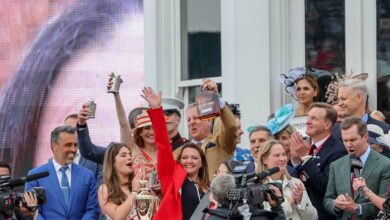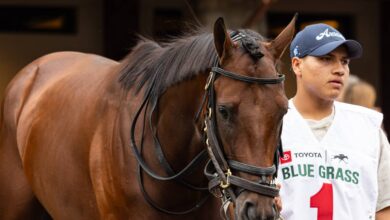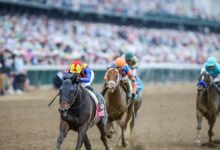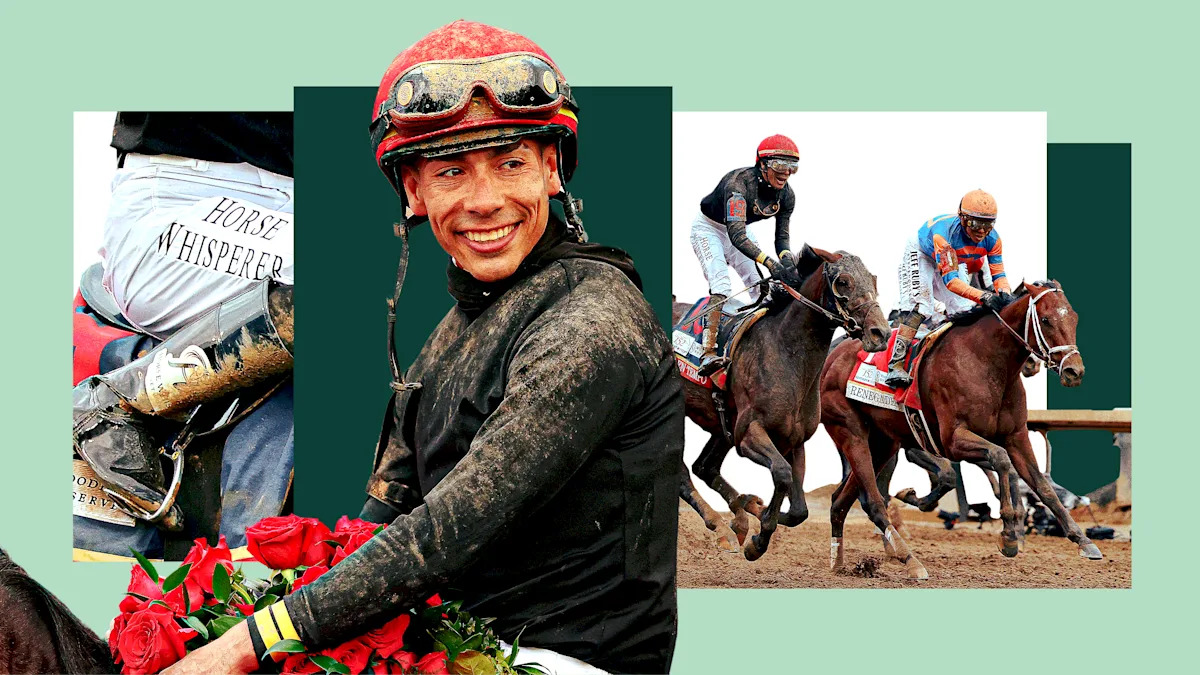
There won’t be a Triple Crown-winning horse this year, as Kentucky Derby winner Golden Tempo will skip the Preakness Stakes on Saturday. There could, however, be a Triple Crown-winning human.
That trifecta possibility puts significant history and money on the line.
More from Sportico.com
-
Club Sportico: Kentucky Derby History Is a Marketing Masterclass
-
Churchill Downs Drops $85 Million to Buy Preakness Stakes IP Rights
-
High Horse Debate: A Trainer’s Suspension Tests Views on Meth Exposure
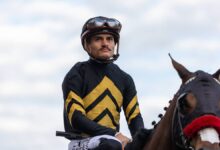
José Ortiz, the jockey who rode Golden Tempo to a thrilling, come-from-behind Derby victory, will race in the Preakness atop Chip Honcho—one of the favorites at 5-to-1 odds. If Ortiz also rides in the third leg of the Triple Crown, the Belmont Stakes, as expected, he has a chance to become the only jockey to ever win all three legs of the Triple Crown despite switching horses.
Additionally, a win from 5-to-1 contender Taj Mahal would make trainer Brittany Russell the first ever female trainer to win the Preakness. That would keep another Triple Crown variant alive—the female trainer Triple Crown—after Cherie DeVaux became the first female trainer to ever win at the Derby.
Those aren’t just interesting fun facts; they could lead to more exposure—and more sponsorship money—for the jockeys involved.
For the three legs of the Triple Crown, jockeys earn a wide range of sums to wear brand logos on their pants, typically varying from low to mid five-figures. For the Derby, which nearly always draws the highest viewership, deals can routinely come in above $25,000. Many agreements also have win bonuses.
“It’s an NIL deal with the jockey, essentially,” Apex Marketing Group president Eric Smallwood said. “There’s social media posting, there’s pre-race interviews … where the jockeys will wear a ballcap of the brand … there’s a lot of pieces that go into it.”
Deals are made directly with the jockeys and can represent the lion’s share of their earnings from a race. Jockeys pocket roughly 10% of the prize money (at the Derby, this would come out to $310K, $100K, $50K, $25K, and $15K for the top five finishers). But most entrants don’t win any prize money, and owners typically don’t pay jockeys aside from a small mount fee. Furthermore, jockeys may have to cover expenses such as travel and lodging.
Apex Marketing Group analyzed jockey Jaime Torres’ partnership with Dude Wipes when he won the 2024 Preakness riding Seize the Grey. The firm estimated the total value added to the brand from the TV broadcast at $640,000. The most valuable logo locations were the right pant leg, which is usually featured in the photo of the finish, at roughly $229,000, followed by the left pant leg at $154,000 and the ball cap worn during the interview at $135,000.
“What was interesting about Dude Wipes was the ancillary promotion they got after the fact,” Smallwood said. “When [the Preakness] promoted the 2025 race they would use photos from the 2024 race… so the finish line photo is very powerful.”
For a non-winning horse, the value of the brand exposure can range from $20,000 to $150,000. Finishing one length behind the winner versus five lengths behind can make all the difference.
“The second place horse was on the inside of the winner for the [2026] Derby, and you can see those pants somewhat more prominent than the winner’s pants in some photos,” Smallwood said. “So some of it is luck.”
The 2025 Preakness Stakes averaged 4.56 million viewers for the race segment on NBC and Peacock, down 16% from the prior year. In the 2000s and the early 2010s, before it became more common for Derby winners to skip, ratings were often twice as high. For comparison, the 2025 Kentucky Derby drew 17.7 million viewers, landing in the top 100 most-watched telecasts of the calendar year.
“It’s so different from any sport,” Smallwood said. “The length of the event is two minutes. A lot of lead up to it. It captures the audience for a short period of time.”
A televised one-on-one jockey interview can also skyrocket brand exposure. This is where those pieces of history come into play, since jockeys riding notable contending horses are more likely to get TV face time.
Even small details are relevant, such as the fact that the 2026 Preakness will feature the maximum number of horses at 14, compared to nine last year. That means attention will be more spread around and the average time any individual horse is featured on camera will be smaller.
Deal value for the Belmont fluctuates the most; it depends on which horses are running and whether there is a Triple Crown at stake. Meticulous Talent Management owner Angie Athayde Stevens, a leader in jockey sponsorships who has worked with over 100 brands, said that in the 2010s a brand paid seven-figures for a deal involving the entire team (owner, trainer, jockey and horse) attempting to complete the Triple Crown.
These sponsorships, which are not unlike the one-off patch deals seen at tennis’ Grand Slam events, were not allowed in horse racing until 2004, when a federal court judge ruled in favor of a group of jockeys who had been prohibited from wearing corporate and union logos at the Kentucky Derby. The business of jockey sponsorships has since taken off, with the money concentrated at the top.
“It is such an underdeveloped market,” Stevens said. “The top seven to 10 jocks have year-round sponsorship deals that are typical, structured sponsorships from a brand, signed. Everyone else has handshake deals or wears [different] sponsors for different races.”
For the 2026 Kentucky Derby, Ortiz wore the logo of Horse Whisperer Network, a horse racing media platform. Seven of the next nine jockeys to cross the finish line had “Jeff Ruby’s” on their pant legs, representing the culinary company known for its steakhouses in Ohio, Kentucky and Tennessee. Years ago, Ruby began donating to the Permanently Disabled Jockeys Fund. Those donations developed into sponsorships, which turned into year-round partnerships with jockeys.
“It has now turned into just a crazy exposure level where, if you look at what he’s getting in marketing value for his spend, his ROI is amazing,” Stevens said.
Multiple jockeys in the Kentucky Derby had no visible sponsors. Racetracks can prohibit certain logos (such as a competitor to a corporate partner). Other times, jockeys need owner permission to endorse a sponsor. Rules vary by state.
“Some owners want white pants, and that’s all there is to it,” Stevens said. “As a jockey, they don’t really want to argue with that, because the owners and trainers are the ones putting them on the horse, and they can replace them and put someone else on the horse.”
Best of Sportico.com
-
Most Expensive Sports Memorabilia and Collectibles in History
-
The 100 Most Valuable Sports Teams in the World
-
NFL Private Equity Ownership Rules: PE Can Now Own Stakes in Teams
Sign up for Sportico’s Newsletter. For the latest news, follow us on Facebook, Twitter, and Instagram.