DENVER — A split-second read, a fearless jump over the boards, and a burst of Pavel Bure-like speed turned Martin Nečas into the unlikely architect of Colorado’s overtime series-clinching win.
Overtime Instinct
In the Stanley Cup Playoffs, legends aren’t always born in highlight-reel goals or thunderous hits. Sometimes, they’re born in the smallest fractures of a moment—seconds that feel like they barely exist, and yet somehow decide everything.
For Martin Nečas, one of those moments is now carved into Colorado Avalanche lore.
Moments before the Avalanche struck for the overtime winner that would send them to the Western Conference Final—a 4–3 victory over the Minnesota Wild at Ball Arena—Nečas was back on the bench, still catching his breath from his last shift. More than 18,000 fans packed into the building roared like a living wall around him, the sound so heavy it felt physical, pressing into the chest of everyone inside it and rattling through the bones.
Teammates leaned over the boards, calling for fresh legs, sticks tapping in rhythm, the bench itself alive with tension, urgency, and belief. But amid all of it—the noise, the chaos, the rising stakes—Nečas saw something that didn’t belong.
Something was off.


The Avalanche didn’t have enough skaters on the ice.
It takes a rare kind of awareness to catch that in real time—especially in overtime, when the game stops being structured and starts becoming instinct—and Nečas didn’t hesitate for a second.
No glance to the bench. No hesitation. No request for permission.
He just moved.
And in an instant, the picture on the ice shifted. What fans initially processed as a routine rotation suddenly revealed its reality: Nečas was out there with Parker Kelly and Jack Drury, thrown into the moment as if the game itself had quietly rearranged the pieces without telling anyone.
The Avalanche didn’t question it. They attacked.
Kelly got to the puck first and sent it out of the defensive zone, a simple, necessary play meant to survive pressure—but that’s where everything turned. Nečas had already read it, already gone. The second the puck cleared danger, he exploded through the neutral zone like he’d been fired out of a cannon, separation opening up behind him in a way that felt almost unreal. For a split second, it had that unmistakable Pavel Bure look to it—the kind of speed where defenders aren’t beaten so much as they’re left behind.
By the time Minnesota realized the shift had happened, it was already too late.
Nečas corralled the puck in stride, cut behind the net with control, and suddenly the play had weight to it. He didn’t rush it. He didn’t force it. He circled with purpose, head up the entire time, reading the ice as it formed in front of him, waiting for something to appear.
It did.
Brett Kulak had drifted into space at the top of the right circle.
One pass. Clean. Immediate.
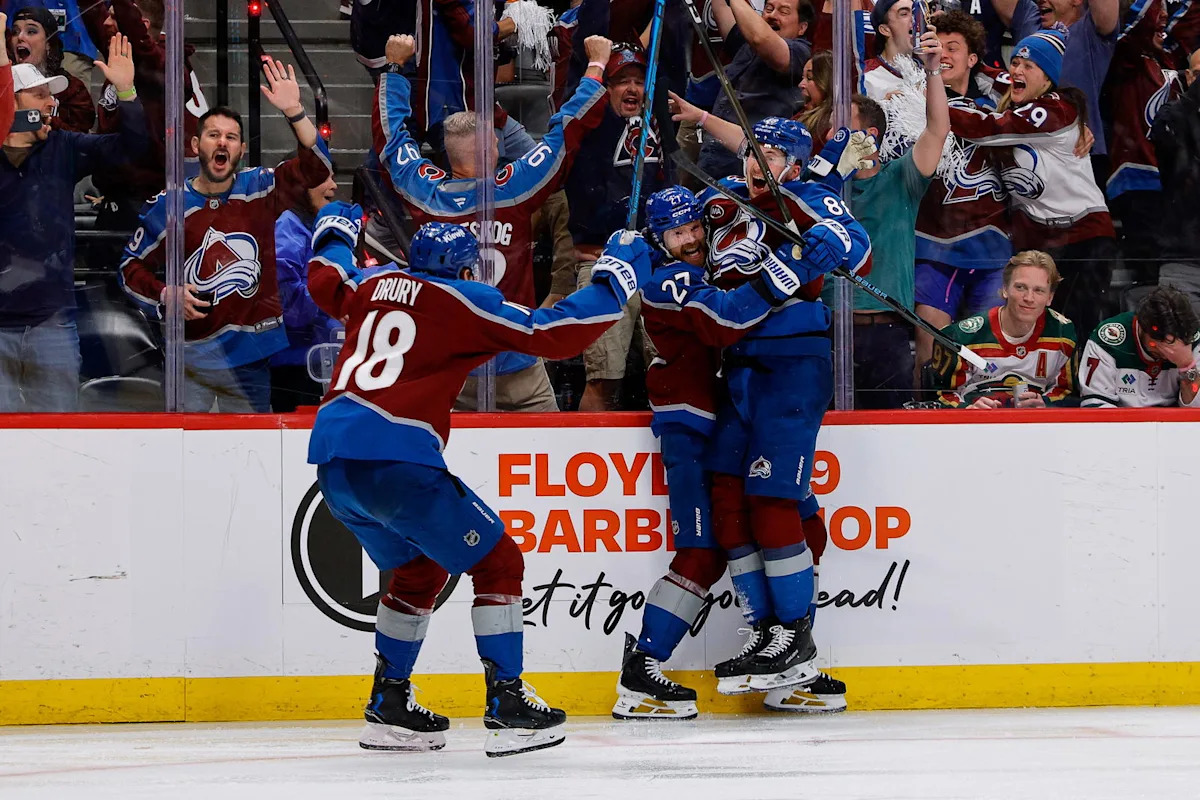
Kulak didn’t think twice. He stepped into it and ripped a one-timer through traffic, past an outstretched Jesper Wallstedt, and just like that—Ball Arena detonated.
The Avalanche were headed to the Western Conference Final.
“I just saw we had four guys on the ice,” Nečas said afterward with a dry, almost disbelieving laugh. “I actually wasn’t supposed to go on the ice, but I just jumped. Great play by (Parker Kelly). I just tried to do whatever I could.”
“Might As Well Jump There”
When asked to break down the awareness in that moment—the split-second recognition that something was wrong when everything around him was chaos—Nečas shrugged it off, as if it was instinct more than anything else.
"I just started going," he said with a smile. "We were coming back in our zone; we had four guys, so I was like, 'Might as well jump there; I don't care.' Yeah, it worked out."
Everyone inside Ball Arena was thankful it worked out, but perhaps nobody appreciated it more than Brett Kulak.
The overtime winner was the fourth postseason goal of Kulak’s career and the first game-winning playoff goal he’s ever scored, a moment he’ll carry with him forever. And afterward, Kulak made sure the spotlight found its way back to Nečas for recognizing the situation before anyone else did.
"For him not even to have the tap on the shoulder to get out there, but just to see we need someone," Kulak explained. "In OT especially, guys are tired. It's been a long night. Shift lengths are going to change, so you can't always be ready and know for sure and have the time to know who's going next. So, credit to him being on his toes and wanting to be out there and wanting to play and make a difference."
Changing The Conversation
And if Nečas hadn’t already silenced the criticism from those who once labeled him a “playoff ghost,” there isn’t much left for them to say now.
Before this postseason, Nečas had recorded 35 points in 66 career playoff games—solid production, but not the kind of consistency that places a player among the NHL’s true postseason game-breakers. Fair or not, questions still followed him about whether his dynamic regular-season skill set could consistently translate when the ice tightened and every mistake carried weight.
This spring in Colorado has started changing that conversation.
After arriving with the Avalanche and producing the best regular season of his career—38 goals and 62 assists for his first 100-point campaign—Nečas has carried that same pace and confidence into the playoffs. His 11 postseason points (one goal, 10 assists) trail only Nathan MacKinnon on the Avalanche roster. MacKinnon leads the team with 13 points behind seven goals and six assists, but Nečas has become one of Colorado’s steadiest offensive drivers this postseason, impacting games with far more consistency than he had earlier in his playoff career.
And after signing an eight-year, $92 million extension on Oct. 30, he’s already playing like every dollar was well spent.
On a night that demanded instinct, urgency, and fearlessness, he delivered maybe his biggest moment yet.
Because of it, the Avalanche are going to the Western Conference Final.
Image