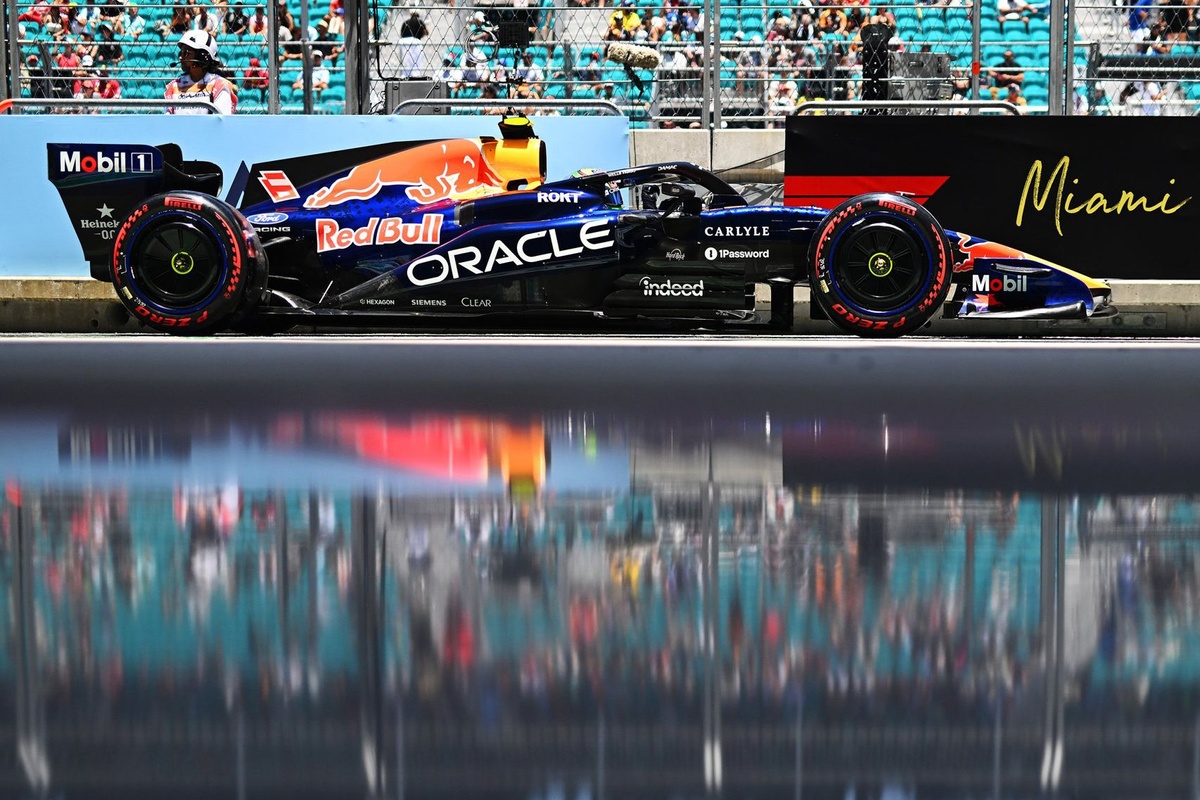
While the opening race weekends of the year proved particularly challenging on the chassis side for Red Bull – before it made significant progress during the April break – the team managed to surprise some of its rivals on the power unit front.
Although Toto Wolff’s remark in Bahrain about Red Bull being the “absolute benchmark” was clearly politically motivated, it did underline that Red Bull Ford Powertrains is at least not making a fool of itself as a newcomer.
Max Verstappen echoed that view after the troublesome Japanese Grand Prix, stating that both the combustion engine and the deployment of the electrical power were “certainly not” Red Bull’s biggest problems.
The fact that the power unit is at a competitive level is not only an important confirmation for Red Bull itself after the bold decision to fully take its fate into its own hands, but also for its new partner Ford.
“It’s been a long journey, three and a half years to get the power unit on track, so it was fantastic to see that in Melbourne for the start of the season. And it’s great for Ford to be properly back in the sport,” Ford Performance director Mark Rushbrook told Motorsport.com during an exclusive interview.
“We knew what an incredible challenge it would be, simply to get on the grid with the new power unit, to be honest. But to be in the mix like we are, it certainly feels good.”
The end product is the result of an intense process that started in 2021, after Honda decided to pull the plug on its F1 project. The construction of Red Bull's new facility was completed in just 55 weeks, while a diverse workforce was assembled under the leadership of Ben Hodgkinson – including numerous hires from Mercedes High Performance Powertrains.

Construction of the Red Bull Ford Powertrains facilities were completed in just 55 weeks
Construction of the Red Bull Ford Powertrains facilities were completed in just 55 weeks
After the lengthy negotiations with Porsche collapsed, Ford stepped in as Red Bull's commercial and technical partner, with Rushbrook simply sending former team boss Christian Horner an email, although the American stresses that the relationship has changed since then.
According to Rushbrook, Ford has contributed more than initially agreed. The American manufacturer was supposed to focus mainly on the electrical side of things, though that changed over time – also linked to Ford's strategy on the automotive side, with the company reversing its earlier decision to stop producing cars powered solely by combustion engines.
“The biggest area that we didn't expect is how far it's pushed us on some things like additive manufacturing or advanced manufacturing. The ability to print parts, make them so quickly with the turnaround, and with the quality control and the precision that's needed, the dimensional control that's needed,” Rushbrook explained.
“That has pushed us much further than we ever anticipated, but that's been a huge benefit for other racing programmes as well.”
Why the competitive picture partly depends on the conditions
The result of that process is, as Rushbrook indicates, “in the mix”, although he adds that the outright competitiveness of Red Bull's power unit can vary depending on the circumstances.
“I think the conditions certainly have an impact on it, because these power units are certainly sensitive to temperatures and to the environmental conditions. So we are seeing differences in those different conditions, and that's part of what we need to sort out as well.”
According to Rushbrook, the FIA must take this aspect into account when deciding who does and does not qualify for Additional Development and Upgrade Opportunities [ADUO], the safety net included in the 2026 power unit regulations.
Mark Rushbrook, Global Director of Ford Performance
Mark Rushbrook, Global Director of Ford Performance
“Obviously, the FIA and F1, they need to look at the data and make those decisions, but they've got to do it by looking at the context of it, not just blindly looking at the data. But really understanding what's contributing to it.
“Just the conditions under which we're running on track, the temperatures, the humidity, the environment that you're racing in, because every power unit has different sensitivity to those conditions.”
However, the FIA has clarified that, after discussions with all the teams and PU manufacturers, it wants to keep the ADUO measurements as simple as possible.
“From the outset, it has been transparently discussed between the FIA and the PU manufacturers, that certain factors that may ultimately affect ICE performance, such as fluid temperatures, external aerodynamics, and similar variables, would be captured as part of the on-car measurements, and that no correction methodology would be applied.”
When Red Bull and Ford look at their own data, they can clearly see the strengths and weaknesses of the DM01 power unit under different conditions. Internally, there is a clear picture of what is still lacking and what is needed to become more competitive, although Rushbrook does not want to discuss that publicly.
“We do have a clear picture of that, but that’s not something that we want to talk about,” he adds.
Read Also:
Ford in talks with Max Verstappen about WEC Hypercar opportunities
How the Red Bull-Ford F1 engine project fared on its Australian GP debut
Reliving Ford's F1 rollercoaster
At the very least, he agrees with Verstappen that the Mercedes power unit still appears to be the benchmark in the current field, and that Red Bull Ford still has steps to take to match both its outright performance and its consistency.
“Well, yeah, it’s pretty good,” Rushbrook smiled when asked about the Mercedes power unit.
To read more Motorsport.com articles visit our website.