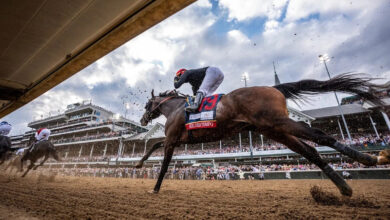
You didn’t need the track veterinarian’s walkie-talkie to know Great White was being scratched from the Kentucky Derby.
You didn’t need to hear the announcement from one of the two announcers in different booths several stories over Churchill Downs, or the talking heads around the desk on the television broadcast.
All you had to do was look at Alex Achard’s eyes.
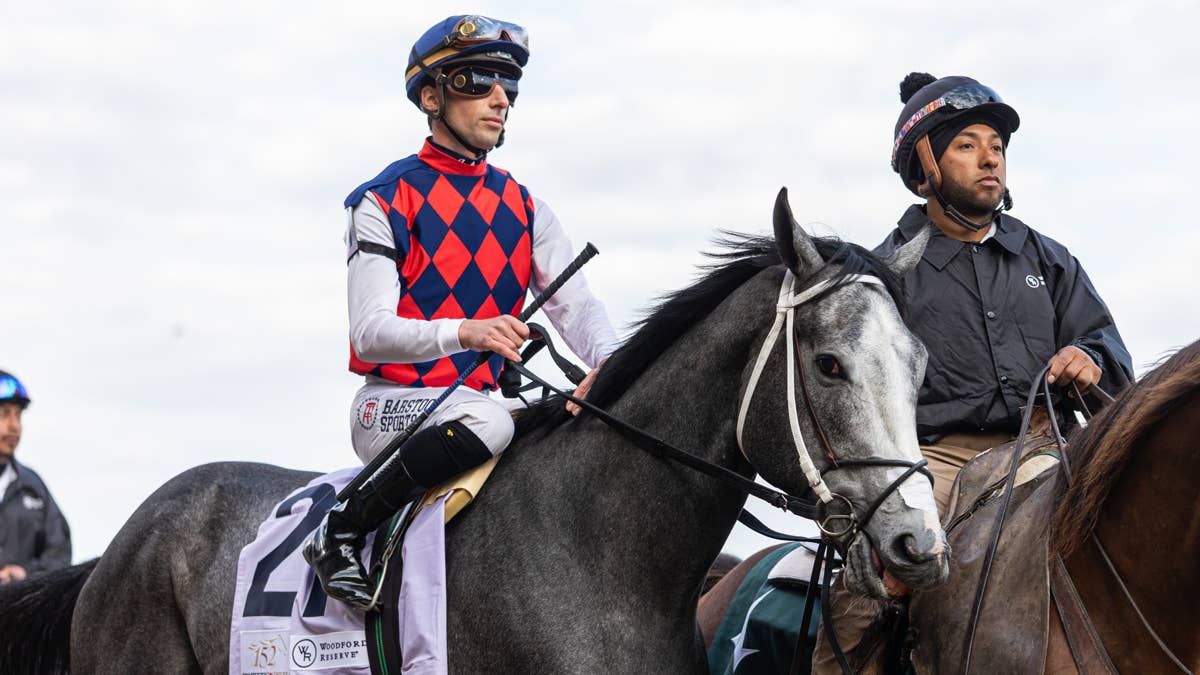
They were still obscured by his goggles in the whirlwind moments after he was first separated from the gargantuan gray in mid-air; the jockey was still acting on instinct, assessing what had just happened after getting up from the harrowed dirt. His first Kentucky Derby was in jeopardy, and he was piecing together his future in front of a live audience.
Seconds earlier, Achard and Great White were circling behind the starting gate, just a few horses away from entering their stall, when the gelding's trademark exuberance gradually took command of his body. Great White tossed his head, and when he hit the tension of the lead rope, he pulled back harder.
It's in these moments that the biggest horse race in the world can become claustrophobic. The number of horses that surrounded the towering Great White became hard to ignore when the brief tug-of-war evolved into a rear, and Achard was suspended in the saddle without many good landing spots beneath him when the horse reached his tipping point. Somehow, Achard landed in just the right spot, barely grazed by the falling horse. Great White, meanwhile, hit the dirt on his rump and somersaulted, rolling down his spine until the back of his head reached the ground.
The horse popped up immediately and was caught by an outrider as soon as he had four feet under him. Then, Achard became the solitary still figure in a whirlwind of officials and outriders inspecting Great White to determine whether he could enter the starting gate.
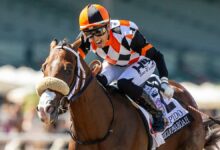
It was extremely unlikely that the regulatory veterinarians would let Great White race after a fall like that, but there is always hope until there isn't, so the goggles stayed on.
When Achard finally lifted the goggles off his eyes a split second before the scratch was relayed to the stewards, all of the load they were bearing was released. The muscles in his face dropped. He kept his distance to let the professionals do their job, but he followed each of them with his eyes. He looked lost, and not a soul could blame him. Achard left his home in France, took his lumps in the mornings, and scrapped in bottom-level claiming races in front of empty grandstands to enter the most famous starting gate in the sport, and the opportunity slipped out of his hands with the reins a few steps before they could latch the gate.
Great White was untacked and led around the starting gate, and Achard watched what could be a once-in-a-lifetime shot grow smaller in the distance, moving away down the same stretch he expected to be traversing himself. Millions of eyes were on him, watching on televisions and phone screens around the globe, but in that moment, he was all alone as the world moved on without him, and the remaining horses were reloaded for their bid at history.
Achard’s girlfriend, Erin Salyer, planned to watch the race from the owner’s box with the connections of co-owners Three Chimneys Farm and trainer John Ennis. She heard the crowd react before she saw what happened on the screens, but she immediately understood what was being revealed when the jockey removed his goggles.
“When you don't know somebody, it's hard to tell by their facial expressions what they're thinking, and later on, reading through social media, there were some comments about how he was mad at the horse,” she said. “That's not anger. That’s literal shock. I had seen that in his face before. I just knew that he was trying to reconcile the events that just happened because it just came so fast.”
Getting a horse turned around from a setback is the result of a deep support network going back to the drawing board and working together to build them back up. The same goes for jockeys.
Getting Great White and Achard turned around for the Preakness Stakes two weeks after a public letdown of that magnitude was as much about their respective teams reinforcing emotional resiliency as anything to do with physical ability. The result of Saturday's race was important, of course, but getting there was the true victory.
The Aftermath
Life goes on after any kind of setback, but rarely so bluntly as it did for Achard after he was separated from Great White.
The only thing hurt after the spill was his pride, but protocols still dictated that Achard take a ride back to the jockey's room in the ambulance. He watched the start of the Derby from the cab of the vehicle positioned behind the gate, the worst seat in the house.
The ambulance remained stationed in the small chute at the top of the Churchill stretch as its inhabitants watched the race from a screen, then it took chase after the field turned for home. As Golden Tempo went one way into the history books, Achard went the other way to the jock’s room, still trying to piece together why it all happened.
“We were so pleased with the way he was in the paddock, and even in the post parade,” the jockey said, going over the event again in his head. “The horse was great, and that’s the worst thing, he didn't show anything like he was going to do something like this. No warning, whatsoever. When it’s that way, you don’t expect it, and then you get caught off-guard.”
Meanwhile, Great White waited in the Churchill Downs paddock for the race to finish, where he was quickly met by Ennis, who made a beeline from the owner’s box as soon as the scratch was announced. Ennis watched the race from the monitors outside the saddling stalls, the same as many of the trainers with horses still in the race. He was embarrassed, but more than that, he was confused by Great White’s outburst, and he watched his horse circle the paddock, trying to understand what could have caused this mess.
After the race, Ennis followed Great White through the tunnel from the paddock to the track, and he passed Achard in the middle of the chaos. Their exchange was brief but meaningful.
“I felt bad for Alex more so than myself because this was his first Derby, his first chance,” Ennis said. “He has a lot of faith in the horse, so he was devastated, and he really wanted the horse to run. He was probably more beat up for a few days than I was. I said, ‘Don't worry. Everything happens for a reason. Everything will be fine.’”
Salyer also left the owner’s box as quickly as she could, with a different destination.
“I immediately just ran back to the jock's room to try to catch him before he went back in,” she said. “I yelled to him, and as soon as he turned around and saw my face, he just deflated.”
Salyer then paused for a moment. Thinking about Achard’s sunken expression in that moment, even weeks removed, still pushed her to the brink of tears.
“It was really tough to see somebody in that position,” she said. “Their whole career leads up to one moment, and this game can take it away from you at the very last second. He's like, ‘Can we just leave?’ And I'm like, ‘Yep, get your stuff, let's go.’”
It was quiet in the jock’s room when Achard got through the door. Eighteen of the riders who would have been in there were still out on the track, and the jockeys and valets who weren’t booked for the main event were in a different room watching the race.
That was fine by him. He got a quick shower and headed for the exit, but not before one of the veterans of the jockey colony stopped him to offer some reassurance.
“Briefly, James Graham came to me, and he was very kind by saying, ‘More will come,’” Achard said. “That's about the only one I saw, because I left before almost everyone came back. I didn't do that on purpose, but I was like, ‘I need to be as fast as possible,’ and there was no reason to spend some time or try to make anything more complicated.”
Great White after scratching from the 152nd Kentucky DerbyLillian Davis photo
On a normal traffic day, it can take about an hour and a half to get from Churchill Downs to Lexington, Ky., where Achard and Salyer live. When the Derby lets out, it can be an eternity.
Achard described it as a long, silent drive, and Salyer gave him the space to sit with it for as long as he needed. A jockey’s life is full of peaks and valleys under normal circumstances, much less on a stage as grand as the Derby, and Salyer has gotten good at helping Achard through the lean times over their four years together.
“She does know what I need, and she always tells me, ‘We can talk whenever you want, and it doesn't have to be right now, it doesn't have to be tomorrow, it's just whenever,’” Achard said.
However, Salyer did lay down one major ground rule for both their sakes.
“We turned our phones off immediately on the way home,” she said. “We're not gonna talk to anybody, because I think a lot of times, it's everyone's natural instinct after something really disappointing happens for them to want to pull you out of it immediately. Like, ‘You'll get ‘em next time, you'll get another shot,’ and the reality is you may not have another shot.
“I think it's really important in the moment that something really disappointing happens to not immediately try to make somebody feel better, just give it the gravity it deserves in that moment. Just sit with somebody in that uncomfortable feeling of disappointment, or sadness, or whatever it is. Sometimes, I think we do that for ourselves. We want to make somebody else feel better so we don't feel bad, and I think you need to take some time and just feel like garbage about it for a minute.”
It was a long drive, too, for Ennis, who also lives in Lexington. The veterinarians were waiting for Great White when he returned to the barn, and he came out with a clean bill of health. Then the horse got a bath and some time to graze. Save for the added veterinary attention, Great White’s routine looked about the same as it would have if he’d won the race or finished at the back of the pack.
Watching his horse placidly eat grass outside his barn and ruminating on the day behind the wheel quickly got Ennis thinking about the next chapter and booking a van to Laurel Park.
“I wanted the ground to swallow me up when it happened,” he said. “Everybody was looking at me, and cameras, and I'm sure everybody felt bad for me as well, but I couldn't believe something like that happened in the Kentucky Derby, because it's so hard to get there."
“I went home, I took the kids and the dog for a walk, and then everything was fine," Ennis continued. "I digested it during that hour drive home, and I was like, ‘You know what? Nobody's died. The horse is fine. Alex is fine. It's unfortunate, but it wasn't meant to be, and it wasn't my time. The next morning, I got up with a clear head, and everything was perfectly fine.”
Lillian Davis photo
The Support System
For the race’s winner, the morning after the Kentucky Derby is a blur of interviews and camera lenses, fueled by the still-fizzling adrenaline of the night before.
For the horse that got scratched behind the gate, it was a pre-dawn van ride from Churchill Downs to Ennis’ base at the Thoroughbred Center outside Lexington with little fanfare.
For Achard, it was about seeking comfort in the familiar during an unfamiliar time. He got up, he cut the grass, and he played with his dog. Then, he saw a friendly number calling his phone: longtime standardbred owner Josh Green. Green had recently bought a farm and took Achard out to show him around.
“We had lunch right after, and I really appreciated that he did that, because it helped me get through at least the very next day (after the Derby). I just thought the next day would be the hardest. Then if I got through that, I would be okay, and because of that, keeping your mind busy actually helped a lot."
Picking up the phone meant a lot. What Green did before he picked up the phone showed how much he really cared about not only helping Achard through the day, but Salyer as well.
“He texted me before, and he was like, ‘I'm gonna call Alex and see if he wants to go to lunch and see a farm that we just bought, and I'm not even gonna mention (the Derby) unless he brings it up,’” Salyer said. “I liked that because I was trying to think, should I try to get him out of the house? Should I just let him mope around? What should I do? And then luckily, our friend immediately thought, ‘I'm just gonna go pick him up and just get his feet moving.’
“I think it's like with horses,” she continued. “If their feet are moving forward, the energy is there, but when the feet get stuck, the mind is stuck.”
The diversion alone would have gone a long way in helping Achard find his way back to sea level, but he also walked away from the visit learning an unexpected lesson on managing the thoughts that might creep in after a large-scale disappointment.
“Lately, (Green) has been doing yoga classes, and something they teach him is, ‘Negative thoughts don't go through your mind. They just bounce off,’” Achard said. “It was very funny because that day we met, he mentioned it so many times to make sure it went through my mind until I repeated it, and I thought that was actually something very helpful. Obviously, it's easier said than understood, but if you are able to manage this way, you should be alright.”
The harsh reality, or perhaps one of the great advantages, of a jockey's life is that there isn't much time to ruminate on the past before it's time to get back to work. Playing air-traffic control for Achard's schedule is his agent, Francisco Torres, a former jockey who had his own history with Derby heartbreak.
Torres had gotten Globalize to the precipice of the 2000 Kentucky Derby. However, he was one in a long line of jockeys who fell victim to a bigger name becoming available for the Derby, and trainer Jerry Hollendorfer replaced him with Hall of Famer Mike Smith. The horse was ultimately scratched just before the race, but chances like that don’t come along every year for a rider at any level.
A good agent's job is to help pick up their riders when they get knocked down, and when Torres spoke to Achard after the race, he did so as much as a peer as an agent.
“I’ve been through it,” Torres said. “I told Alex, ‘Trust me, you have the ability. Just be positive and it’ll happen again.’ In this business, you have to turn the page, move forward. You can’t dwell on it because it’ll destroy you. It’ll break you."
Practically every time a member of Achard's support system described both what made him a good jockey and what best made him equipped to pick himself up and dust himself off after an incident like Great White's Derby, the word "calm" inevitably entered the conversation: calm with the horses, calm in high times and low, and calm in the eye of whatever storm might surround him.
That kind of emotional balance is not always a guarantee when listing a jockey's notable traits. Juggling the vocation's litany of demands – maintaining weight, the travel, job insecurity, politicking with trainers to get mounts, social media mudslinging, wins, losses, and everything in between – has fried a lot of riders who lacked the constitution.
It was easy to help Achard after the Derby because it was easy for him to help himself.
“You’ve gotta feel it all, and he does," Salyer said. "He allows himself to feel it, and then he moves on, and I think that's really healthy. And, it's great for me because I don't have to come home and deal with somebody who has big feelings all the time and makes it my problem.
“From a relationship standpoint, it’s great, to be honest, because there's so many times I'm like, ‘Oh my God, I'm dreading the car ride home,’ after a bad day, and he always finds a way to pick it up and move on,” she continued. “That's what I'm most proud of him about – not all the races that he's won. It's that when he comes home, he's Alex. He leaves it all out there. We talk about it, obviously, and it's a part of our lives, but his issues or his challenges, they're not everybody else's problem. He deals with it in the most mature way, and that's one thing I really love about him.”
Great White with trainer John EnnisNellie Carlson photo
The Horse's Role
Achard was a frequent rider for Ennis in the time between the Derby and the Preakness, and the jockey stopped by Great White’s stall to check on his partner a few days after the Derby incident to make sure he was still in good condition after the incident.
There were no hard feelings; nothing to forgive on either side.
“He has a very good mind, and obviously he didn't do that to hurt anyone,” the jockey said. “It was just a freak accident.”
That's the unpredictable nature of dealing with animals. They are independent beings with their own free will, separate from anything we can harness with training and equipment. The reason we gamble on horses is because no one can divine with perfect accuracy what they’re going to do in any given moment.
Because of that, people who work with horses generally operate under the guideline that whatever happens, it's almost never the horse's fault.
Great White is a stakes-winning racehorse. His athletic ability is already greater than most horses will ever achieve, but watching him graze outside his barn made it clear the gelding was still in the process of figuring out his mind and his body. With each nibble, he put thought into carefully arranging his legs in just the right way so his mouth could make the long trip down to reach the grass below him.
With Ennis at his side, the top of his head well below his horse's withers, Great White curiously probed everything around him with his nose, tugging gently at his lead rope to guide the trainer toward his next target. If the horse wanted to, he could use his size and speed to render anyone on the other end of the shank defenseless, but his intentions were innocent as he took the trainer from bits of sod to inspect a rack lined with leg wraps drying in the sun.
Great White is a young horse, even among his cohort of 3-year-olds. His third birthday came just two days before the Preakness, and the horse's trainer and jockey both pointed toward his immaturity as a key factor in his behavior at Churchill Downs. Still, both agreed the outburst could not have been predicted by past performance.
“He's typically a quiet horse, and he's a good boy,” Ennis said, comparing the horse that stood before him with the one the world saw at Churchill Downs. “He’s a pony, really, but he has to be feeling good to run good. He has to be feeling full of himself, and he does that. He’ll jump around and play, and that's him, but he's never going to fall over or do anything like that. He's just a kindhearted horse.”
Though Ennis was gracious with his time reflecting on the past, he was more intent on looking ahead toward Great White’s future.
It was reported shortly after the Derby that Ennis planned on sending Great White out to the Preakness post parade without a pony horse. It wouldn’t be a huge adjustment for Achard, as a rider who came up in the European style which frequently relies less on equine escorts, and it would be one less thing to react to if Great White’s youthful exuberance burst through again.
“The only reason I don't want a pony is in case he does rear up and play around, I don't want anyone touching his mouth,” Ennis said in the days before the race. “I want everything to be on his own. I'd have a lot of confidence in him not doing anything silly when he's left on his own.”
Great White trains at LaurelMaryland Jockey Club photo
The Preakness
When the stakes barn fills for the Preakness, the media coverage for each contender is typically boiled down to a defining feature that gets asked about over and over again by reporters: their most recent race, the story behind a unique name, or a connection doing something they’ve never done before. With most of the horses, connections, and reporters crammed into the same barn, it can turn into an assembly line of answering the same question into a series of different microphones.
Great White’s defining features leading into the Preakness were obvious – his size and the Derby scratch – and Ennis was ready to face it going into the weekend.
When he gave a leg-up to exercise rider and FanDuel TV analyst Andie Biancone to send Great White out for his morning exercise, a voice called out, “You ever throw out your shoulder getting ‘em all the way up there?”
Ennis turned his head and fired back, “Only when they’re really heavy.”
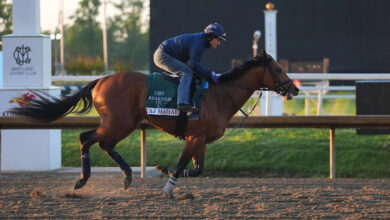
Where getting Achard to Laurel Park was an exercise in building back up, Ennis knew getting Great White to the Preakness was about keeping him level. The gelding was playful on the track, returning to Ennis after his morning jogs on his toes and proudly tossing his head. This was the high-energy, high-confidence version of Great White that Ennis wanted to see in the days leading up to the race, and to maintain that balance, the trainer allowed him to further let off steam with some carefully monitored time in the round pen outside the stakes barn. Everything was consistent, just like the questions and answers.
It was an early morning for Achard on Preakness day, coming in with Salyer on a 5:30 a.m. flight from Kentucky. Showing his identification to airport security blurred into pulling out his card at the track's licensing office later that morning. Like many attending the Preakness during its (hopefully) brief time away from Pimlico Race Course, Laurel Park was a new pin on his professional map, and he'd be back on a plane to Kentucky by 9:50 p.m. to ride a different horse for Ennis at Churchill the following day.
The attendance was capped for this year's Preakness Stakes to a fraction of what it's been during Pimlico's salad days, but it was nonetheless a crowded scene inside and around the Laurel Park paddock when the horse, jockey, and trainer came together again.
The tote board is a popularity contest voted on with dollars, and while Great White was a fringe candidate in that race, he was a runaway winner by the decibel counter outside the paddock. As he reached each new section of the walking ring, the cheers for the gray overpowered those for anyone else in the field. Great White's unique look and hard-luck story gained him a cult following among racing fans in the time between the first two Triple Crown races, and that charisma made him a magnet for hoots and hollers as soon as he left the barn area on Saturday evening.
Great White in the paddock ahead of the 2026 Preakness StakesJoe Nevills Photo
Meanwhile, Ennis and Achard discussed the careful plan to get the horse from the paddock to the gate. The jockey said his instructions from the trainer were simple.
"Be careful," he said. "He's got a light mouth. Make sure you use the neck strap (a piece of equipment used to take the pressure off the bit during the break), and just never stop. Keep moving forward, and the horse is going to be fine."
Achard gave Great White's groom a fist bump when the call for "riders up" rang through the Laurel paddock, and Ennis launched the jockey into the irons. It was another claustrophobic moment in the cramped walking ring, but this time it was just a thought, not a split-second problem to be solved.
True to Ennis' plan, Great White and Achard went out to the track without a pony. Together, they galloped down the stretch on a different plane from the pomp and circumstance of the post parade.
It was the right call. Achard took Great White into the turn behind the starting gate while the broadcast cameras were still cycling through the rest of the field, and he allowed the gelding to be his youthful self. Great White had room to jig. He could toss his head without playing tug-of-war with a pony rider's rope. Instead, Achard was an able partner to apply counter-pressure to the gray's motion without pushing him too far. For better or worse, Achard was in control without a safety blanket.
That in no way means the two were out for a leisurely Saturday evening hack out there. Though he handled the horse softly, it took strength in his legs to stay grounded in the saddle through each question Great White asked him. It takes a solid core for the jockey to maintain his balance, and it took incredible control of his upper body strength to communicate with the horse without overpowering him into something he didn't want to do.
Achard continued to give Great White space from the rest of the field as post time approached, content to join them in a few loops behind the gate to get him acclimated, but not so much to get him overstimulated.
Time slows down before a big race, whether it's because of anticipation or post drag, and Great White had been behind the gate longer than anyone. It wouldn't be hard to let anxiety creep in at this juncture, waiting for the horse to hint at a repeat from the Derby, but negative thoughts don't go through your mind. They just bounce off.
"It was forever, but that's always the case with those big races," Achard said. "It's for the show, for the fans. But that's just the way it is, and we have to deal with it."
The procession of Preakness contenders lined up behind the gate to begin loading, and Achard still kept Great White behind the rest as long as he could. He was the #13 horse in a field of 14, meaning he'd load second-to-last. With a cluck and a lurch forward, the latch clicked behind them. The hurdle that tripped them two weeks earlier had been cleared.
"I was like, 'Okay, we're getting closer now, we just have to stay on until the gate actually opens,'" Achard said. "That was a relief for sure."
To say it only took a few assistant starters to get Great White into the gate Saturday evening would be underselling the weight of what just happened. When the horse set his feet in the stall, the handiwork of myriad people who cared about the horse and his rider at their lowest, and the strength of that horse and rider to lift themselves up from the dirt in Louisville, paid their dividends.
Great White and Achard spent 10 seconds together in the Preakness starting gate. Then, the front latch sprang open. After that first jump, everything else was playing with house money.
Jockey Alex Achard aboard Great White in the starting gate for the 2026 Preakness StakesJoe Nevills Photo
This story was originally published by Paulick Report on May 17, 2026, where it first appeared in the News section. Add Paulick Report as a Preferred Source by clicking here.