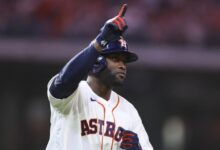
Three years ago the Chicago Cubs traveled to Atlanta in late September for an important series that was briefly upstaged by a tribute to Braves outfielder Ronald Acuña Jr.
After Acuña swiped second base in the 10th inning of a tie game for his 70th steal, becoming the first player with 40 home runs and 70 stolen bases in a season, the game was delayed as he picked up the base and celebrated his feat while a highlight montage played on the video board.
“We’re really stopping the game for a highlight montage?” Cubs announcer Boog Sciambi asked aloud on Marquee Sports Network.
Analyst Jim Deshaies added: “Can we get the base after the game? This is pretty absurd. I mean, it’s a hell of an accomplishment, but …”
The Cubs lost the game moments later and would fall out of a wild-card spot in what would become the beginning of the end of manager David Ross’ tenure.
Craig Counsell’s Cubs begin another big series against the Braves on Tuesday at Truist Park, a matchup of two of the best teams in baseball. Any interruptions or celebrations will be understandable as Atlanta pays tribute to former Braves owner Ted Turner and Hall of Fame manager Bobby Cox, both of whom died last week.
Turner was a game-changing owner who turned the Braves into “America’s Team” by broadcasting them over his superstation, TBS — a move that Tribune Co. successfully replicated with WGN-9 and the Cubs. He also was the last owner to manage a game, sending Dave Bristol on vacation and installing himself as skipper after a 16-game losing streak in 1977.
Can you imagine Cubs Chairman Tom Ricketts or White Sox Chairman Jerry Reinsdorf donning a uniform and managing a game?
I’ll pause while you clean up the spill from spitting out your coffee.
Turner had no idea what he was doing, and when Braves pitcher Phil Niekro jokingly asked where he would bat, Turner replied: “Hell, I don’t know. You’ve been around here long enough. Hit wherever you want.” Niekro told Turner to insert him into the usual 9-hole. The Braves lost, and Turner was banned from the dugout after that blatant breach of baseball etiquette.
The Braves are just a part of the legacy of the media mogul who started CNN. But Turner turned the sad-sack team into one of the most successful pro sports franchises of the 1990s and 2000s, aided by Cox and Hall of Fame general manager John Schuerholz.
In any other week, Turner’s death would’ve been the talk of Atlanta. But Cox was even more beloved and likely will upstage his former boss in the memorials this week.
Cox is fourth on the all-time managerial wins list with 2,504, a number that speaks for itself. When the late Tribune columnist Jerome Holtzman mentioned to Cox that Connie Mack once said pitching is 75% of the game, Cox smiled and replied: “When Sandy Koufax was pitching, it was 98%.”
Pitching was the hallmark of the great Braves teams under Cox. He had three Hall of Fame pitchers in Greg Maddux, John Smoltz and Tom Glavine, making his road to 2,504 wins a little easier than it would’ve been with only one elite starter.
The Braves won 14 consecutive division titles under Cox, aided by Turner’s signing of Maddux, the former Cubs ace, in 1993.
Cubs shortstop Dansby Swanson missed playing under Cox when he played for the Braves from 2016-22, but he recalled the legendary manager driving around their Florida spring training complex in a golf cart as an adviser.
“Fourteen (titles), it’s hard to imagine that getting broken, especially in a game like baseball, where there are so many variables to it,” Swanson said. “It was a special run, and it started by going from worst to first (in 1991).”
The Braves won only one World Series in that span — in 1995 against Cleveland — but they might have had at least one more if not for plate umpire Eric Gregg’s egregious strike zone in Game 5 of the 1997 National League Championship Series between the Braves and Florida Marlins.
Marlins rookie Livan Hernandez struck out an NLCS-record 15 batters to outduel Maddux in a 2-1 win, giving Florida a 3-2 series lead thanks in part to Gregg’s generous interpretation of a strike. If ABS had been in use back then, Gregg’s calls might have been challenged a couple dozen times.
That game also included a young Marlins second baseman named Craig Counsell. Covering the NLCS for the Tribune, I can attest that several national reporters with no stake in the outcome were left shaking their heads at many of Gregg’s calls.
“We don’t mind if they call it 4, 5 inches off (the plate) and do it for both sides,” Cox said afterward. “That’s fine. From what everyone was yelling from the dugout and everywhere else, they were a lot further.”
The Marlins won the series in six games and then beat Cleveland in the ’97 World Series.
Cox’s temper was also a big part of his legend. He was ejected from a major-league record 162 games — an entire season’s worth. Only two other managers were ejected 100 or more times: John McGraw (121) and Leo Durocher (100). The closest active manager is Terry Francona with 54 ejections; Counsell has 34 and none this season.
Swanson said it’s not surprising, “knowing how much he cared for players and was passionate about having their backs. He was intense when it came to winning games. He just believed in people, and that’s a special trait for somebody that’s managing other grown men.”
Cox famously threw a helmet onto the field during the 1992 World Series and was ejected in Game 6 of the 1996 World Series after another bad call when New York Yankees catcher Joe Girardi threw out Marquis Grissom attempting to steal second. Replays indicated Grissom was safe, but replay challenges were years away from being part of the game.
“I thought it was time to say something,” Cox said afterward. “We held all of our remarks the entire series until tonight.”
Umpires give managers a lot of leeway in a World Series; it was only the sixth managerial ejection in World Series history.
Cox also had his own set of clubhouse rules that stood apart from the rest of baseball, including a ban on music before and after games. Players had to wear headphones if they wanted to listen to anything. That was in stark contrast to the Cubs clubhouse in the late 1990s and early 2000s, where Sammy Sosa’s famous boombox was constantly playing salsa and rap, aggravating some of his teammates.
The reason for Cox’s ban was simple.
“He didn’t want people’s music forced on him, and he didn’t want to force his music on other people,” Maddux told me after re-signing with the Cubs in 2004.
Cox was a player’s manager, particularly well-liked by role players and veterans past their prime. He liked grinders and once said of Counsell: “He never has a starting job with most clubs that he’s been with, and at the end of the year, he’s grinded it out and he becomes the starter. He’s the guy that knows how to play the game of baseball.”
Cox knew how the game was supposed to be played and expected his players to respect it. You can expect the entire Cubs team to be watching from the dugout during any pregame tributes to Cox, showing respect for one of baseball’s all-time greats.