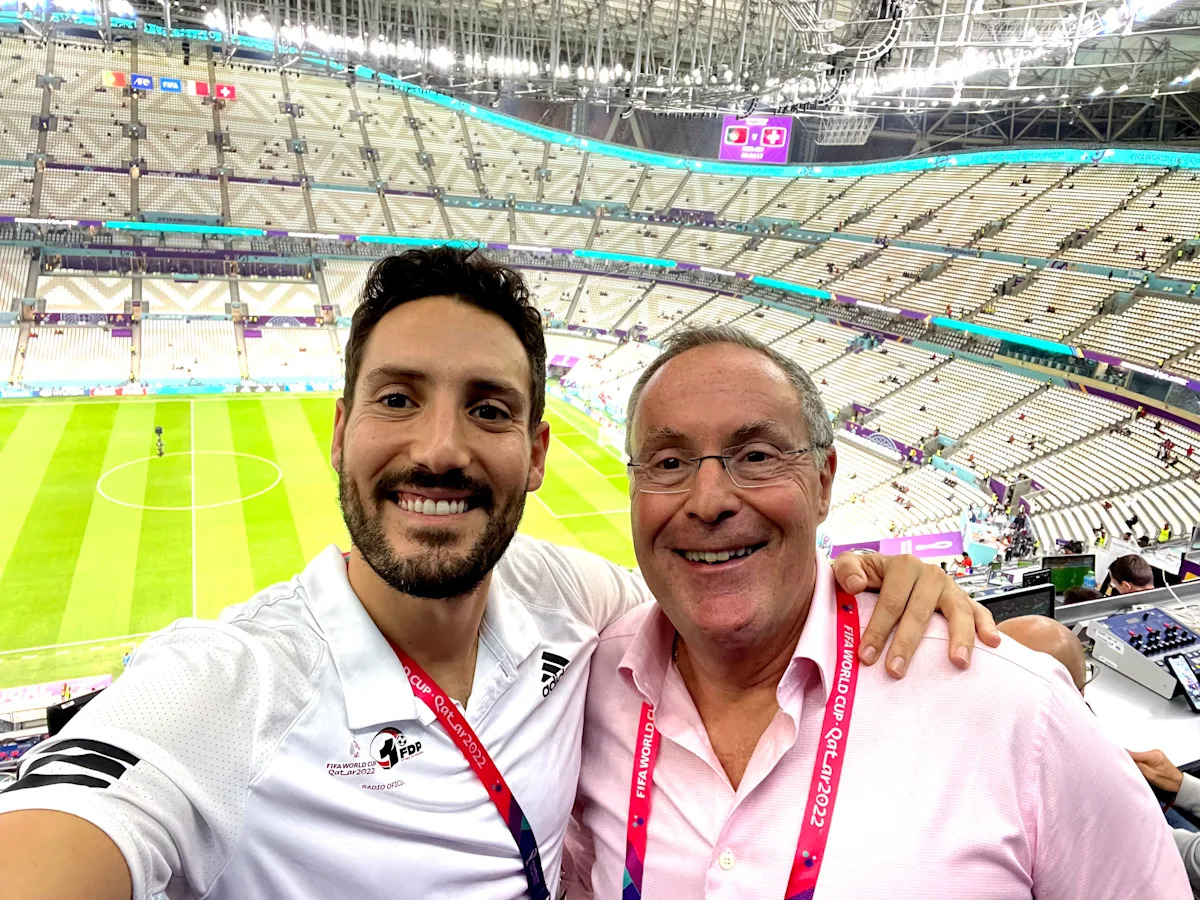
The World Cup is about a month away, and America’s most famous soccer announcer, Andrés Cantor, has joined his son, Nico, a broadcaster himself, in the same space in New York as Lionel Messi.
Well, it’s not actually Lionel Messi. It’s an inflatable Messi, standing 10 feet tall, lit up, in a corporate-logoed blue uniform, smiling and bearded, looking vaguely like the supernatural Argentine forward.
“The GOAT,” the elder Cantor says with a grin.
Andrés Cantor’s love for all things Argentine soccer is no secret. Born in Buenos Aires 63½ years ago, he remains a diehard Boca Juniors supporter. His passion for Boca, Argentina and the sport at large has infected Nico, a 32-year-old Miami native who has followed his father into the broadcast world.
The lead play-by-play voice for Telemundo and Peacock after starting his career at Univision, Andrés is preparing for his 10th World Cup as a broadcaster and 12th tournament overall. The first two weeks alone, he will work matches in nine venues across all three host countries (United States, Mexico and Canada).
“Counting the days,” he said.
Play 2026 Soccer Pick 'Em with FOX One and make your picks for the world's biggest soccer tournament


Nico is an on-air reporter for CBS Sports and Paramount+, which carries the UEFA Champions League and Italy’s Serie A, among other properties. Without broadcast rights to the World Cup, the younger Cantor will hit the road in an RV, bouncing between all 11 U.S. venues across 41 consecutive days and 11,000 miles to tell the stories about fans, soccer and culture.
“The quintessential American experience, coast to coast,” he said. For the fourth consecutive World Cup, Nico will also do sideline reporting for Fútbol de Primera, his father’s radio network.
Father and son expect to cross paths during the 39-day, 48-team competition, starting with the U.S. opener June 12 at SoFi Stadium outside Los Angeles.
“We need to match our itineraries, side by side,” Nico said.
(Photo courtesy Nico Cantor) (Nico Cantor)
As for Argentina, Andrés will call La Albiceleste’s first match, in Kansas City, Missouri, and Nico will be on hand for the second group game, in Arlington, Texas.
They’ll see Messi in his sixth and final World Cup, assuming he plays, of course. Soon to turn 39, Messi has yet to announce his intentions, though the soccer world expects him to give it one more go and help Argentina defend the trophy it hoisted in Qatar after the epic 2022 final with France.
“He hasn’t said it officially, but all I know is that he's training and playing obviously in preparation for his sixth World Cup,” Andrés said. “So I think he will play — yes.”
Messi has played a profound role in the sport’s growth here since joining Major League Soccer’s Inter Miami in the summer of 2023.
“We are enjoying him in Miami,” Andrés said. “We see him in real size, but he's the GOAT, so he's that big,” referring to the inflatable, which is part of a campaign launched by Lowe’s, the home improvement retailer. Both Messi and the Cantors are involved in the ad blitz.
Working Argentina matches can be tricky, but Andrés says he sets aside fandom to call the action fairly.
“I try to keep my emotions inside and not reveal them until somebody hits the winning penalty shot in the World Cup final, and then I lose it,” he said. That is what happened in 2022, when a remarkable match ended in a 3-3 draw through 120 minutes before a shootout settled matters.
“I had the same enthusiasm for France as I did for Argentina,” he said.
Until, of course, Argentina’s Gonzalo Montiel secured victory in the shootout. That’s when all the emotions of Andrés’ Argentine soul poured out in the broadcast tribune high up Lusail Stadium.
First came his famous “Goooooal” call.
Then, “Argentina campeón del mundo!” over and over again as tears trickled behind his glasses.
“I try to keep my emotions to myself and do a very balanced broadcast, as much as I do for the U.S. national team, which I also consider almost my own” after moving to California as a teenager, Andrés added.
Nico sees the game through the lens of a second-generation immigrant.
“Yeah, sure, I want Argentina to do well,” he said. “Honduras isn't at the World Cup — my mom is from Honduras — and it's no secret I want the countries that my parents are from to do well. But I feel like, here in the United States, because we speak to such a multicultural audience, we're supposed to be so cautious about the things we say.”
He explained, “It's no secret we want the U.S. to win the World Cup. Of course, we can give praise when praise is due and be critical when criticism is due, but it would only behoove us if the U.S. wins the World Cup, right? So I think that's part of the beauty of the World Cup and the delicate nature of being a journalist.”
As his career has evolved, the New York University graduate said “a lot of that fan passion has died down. I feel the passion for covering it. I love the journalism and the broadcasting component of the World Cup, rather than the fanaticism of the World Cup. So that has kind of helped me, and maybe it's because I saw Argentina lose so much growing up that it was a defense mechanism to try to be objective in those moments of pain.”
In the days before the World Cup in Qatar, Nico told his father he’s not going to think about Argentina because “every time we go into a World Cup we do badly. You got to see them win twice [1978 and ‘86] and I don’t want to be in a bad mood when they’re eliminated.”
Andrés responded, “Nico, have hope. I really like this team, and I think you're going to see them win the World Cup.”
Argentina’s triumph in Qatar ended a 36-year wait.
The one team for which Nico retains unbridled passion is Boca Juniors — “the team this crazy man to my left made me support when I was little,” Nico said while nodding in his father’s direction. The family visits La Bombonera stadium regularly.
But they are also ingrained in the American soccer culture, one that has swelled since the World Cup was first staged in the U.S. 32 years ago.
“I waited for the 1994 World Cup to come around so much because I knew it was our time for soccer to take off in America,” Andrés said. “And it did two years later with MLS, and look what they built today. I'm looking forward as much to this one, because it's home, full circle.”
He added, “With the exponential coverage this World Cup will have, I think there will be nobody that doesn't know that soccer exists in America, and hopefully that will be the legacy for this World Cup that fans will go support their local [pro] teams or just create more fandom around the game.”
With a new MLS contract, Messi plans to remain part of it the next few years. The Cantors, well, they are in it for the long run.
Said Nico: “The World Cup is going to be a massive game-changer for the sport, for everybody.”