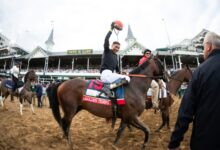
I didn’t expect the 2026 Kentucky Derby to hit me as hard as it did.
Perhaps it was the visual that got me. The reaction shot now seen and heard round the world shows trainer Cherie DeVaux in ecstatic shock, screaming her horse home in her now-iconic red jacket. As Golden Tempo hits the wire, she’s surrounded almost entirely by women who crumple together in a group of happy tears. There’s something about the physical manifestation of a group of horse girls literally holding each other up as they cheer, as they cry. As they do metaphorically, quietly, less literally, day in and day out.
I felt my throat close the first time I watched it. I’ve seen it a dozen times and still, my eyes well up.
My day-to-day connection to horse racing isn’t what it used to be after I left the industry last summer. After 13 years of spending Derby Day working 12 hours straight, fingers flying, with steam coming out of my ears, I was able to tune in to the NBC broadcast around 4 p.m. and take in the event and its key players at a less urgent, sometimes more detached pace.
I’m no less a “horse girl,” as we’re often called; if anything, with more time to revel in the joys of my off-track Thoroughbreds, I more fully represent the term coined for the one odd girl in every grade school classroom whose Breyer models and horse-covered notebooks gave you a warning that she has one topic of chosen conversation, and one topic only. I came to racing by way of the horses; the fascination with the sport and the business came with time and experience.
I’ve always been made uncomfortable by the tendency we all have in the final moments of a horse race to make the horse a flat avatar. “Come on, three.” “Let’s go with the seven.” We seem to forget them as athletes and see them (briefly, hopefully) as vehicles. They’re carrying their jockey, our wagers, and whatever hopes and dreams we’re projecting onto them. If they knew, they’d probably find it all heavy. We forget their names. We even forget the rider, sometimes. We remember only how they relate to us.
I hadn’t seen Golden Tempo coming until the final strides, but when I did, I broke my own rule. I didn’t shout, “Come on, buddy!” at the horse. I shouted, “Come on, Cherie!”
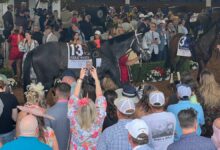
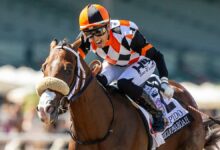
‘What is wrong with you?’ I keep wondering. ‘You don’t even know this woman.’
For DeVaux and her team, the historic weight of the moment didn’t settle at first.
“It's funny because I watched the race with her assistant [Pearl Hagadorn] in the paddock, and Pearl and I had watched so many races together before,” said Adrianne DeVaux, herself a trainer and Cherie’s younger sister. “We were together for Cherie's first graded stakes race, and, you know, we were acting like we won the Derby then. We’re cheering, and it didn't even hit that she was the first female trainer. You were just like, ‘Oh my God, my sister won this huge race.’ Everyone in racing knows just how difficult it is to even get a horse to be considered a Derby horse. And then for her to make it in the field and then to win, you know, it doesn't — the historic side of everything didn't hit me until much later.”
Anytime a woman does something for the first time, there’s a stir. From the people who want to scream it from the rooftops and the ones who would rather it hadn’t happened. But there’s everything in the middle, too.
A week in, DeVaux has taken on a whirlwind mainstream press tour in New York City that included an appearance on The Today Show and throwing out the first pitch at Yankee Stadium. She probably couldn’t count the number of times she’s been asked about how it feels to be a woman while winning the Derby.
For many women who are among the first to do something, it can get exhausting to constantly be framed in the context of gender. To essentially have your own anatomy pointed out with each question. Jockeys have the most experience with this push/pull in racing.
“It’s so ‘been there, done that.’ For that to be the focus now, here in North America especially, is old news,” Queen’s Plate-winning jockey Emma Jayne-Wilson told me in 2018. “To continuously focus on ‘Oh she’s a girl, she’s a girl, she’s a girl,’ it’s almost perpetuating the idea that everyone thinks that girls can’t ride. It’s been proven [they can]. Let’s kick on.”
Early pioneering female jockeys would similarly answer questions mindfully, demurely, focusing on their love of riding and desire to be allowed in the saddle and parenthetically, to be left alone. The few who have worn their differences out loud by posing in men’s magazines or for high-fashion shoots with horses became infamous for doing so.
In the culture of the backstretch, your words live over your head forever. Some of the most successful women have learned that being too loud about uneven ground (also known as discrimination) won’t win them friends or clients. The greatest equalizer can sometimes be neutrality.
In a podcast interview with Sinead Halpin Maynard, Rosie Napravnik recalled the roughriding dealt to her by the Fair Grounds jockey colony in her breakout season there this way: “They would, you know, they would try to intimidate me. And I would just stay quiet, not complain, and just push back or not even push back, actually, specifically not push back … I just knew that if I were to complain [to the stewards], I would be seen as being weak.
“By the end of the meet, I felt like I had everybody’s respect.”
It’s ultimately fruitless to pretend that racing isn’t, in practice, a gendered space. That it took more than a century and a half for a female trainer to win its greatest race should demonstrate that. We’re still waiting for the first woman to ride the winner. But unlike jockeys, there’s no misguided argument about physical strength to excuse why there should be a gender disparity in training, and yet only 18 other women had saddled a horse for the race before. The first was Mary Hirsch, daughter of legendary trainer Max Hirsch, who was the first woman to be granted a trainer’s license in this country in 1935 and went on to saddle No Sir in the 1937 Kentucky Derby. Even after that historic moment, Hirsch’s top runners were often credited to her father’s string (even when she had been chosen by owners over her father to get inside a tough horse’s head).
In case it’s tempting to dismiss that mentality as a relic of the pre-World War II culture, let’s not forget the moment at the post position draw for the 2000 Santa Anita Derby when Bob Baffert sarcastically asked Chris McCarron who trained The Deputy – McCarron or conditioner Jenine Sahadi. Sahadi had the last laugh days later when The Deputy made her the first woman to train a Santa Anita Derby winner and one of the 18 women who made the walk over to the Kentucky Derby, where he finished 14th.
Whether it’s giving someone else the credit or giving them the opportunities, things haven’t changed as much as it seems like they should have. Even today, you have to go down to the 21st spot on Equibase’s list of 100 all-time top trainers by earnings before you find a woman’s name (Linda Rice), and another 49 spots after that before you find Josie Carroll. Overall, the list is 97 percent male in a country that is nearly 51 percent female.
The playing field hasn’t ever been level, and it isn’t now, either.
Trainer Jen Antonucci and Arcangelo (photo provided)
“We just have to generate business differently,” said Jena Antonucci, who became the first female trainer to win a Triple Crown race with Arcangelo’s Belmont in 2023. “We’re not going back to the barn, slinging back with the boys. We have to do things differently, and that’s ok. It’s changing the code of the good ol’ boys club. But everything is changing. It’s about doing it gracefully, respectfully. I’ve never been one to be in people’s faces about it.”
Adrianne DeVaux (the sister with a self-described polar opposite personality) worked in Cherie’s barn from 2020 until she hung out her own shingle in 2024. She saddled Shoot the Nickel to her first career win on the first try, in an Aqueduct maiden optional claimer in September 2024, and read comments online from people who dismissed the notion she’d done the training herself. Apparently, they thought no woman could be that skilled on her first try.
“I think you're navigating it in racing; it's definitely a touchy subject,” she said. “You don't want to blame being a female for opportunities you may not have been given. That does happen. That’s not to say it’s happened to me or Cherie, but historically, there’s been lost opportunities because someone views a female as not being able to do what a man can do, which is absolutely ridiculous.”
If anything, Antonucci and DeVaux’s success demonstrates how readily women can train top horses well. DeVaux limits her operation to around 120 horses, while Antonucci keeps hers at 50 or 70. Training for any single prestige race is a numbers game (hence the rise of the super trainer), which makes a victory outside of the super trainer ranks all the more improbable.
But don’t get it twisted, Antonucci reminds me fiercely. Yes, the playing field has historically been skewed, but no one – especially not the women trying to right it by example – is asking for special treatment.
“In my opinion, we’re so far past that,” said Antonucci. “It would be a disservice, taking that point of view, for every woman who’s with us or behind us in age. We are what we do. We don’t need a special invitation to the table because we’re women. That’s absolutely ridiculous. The fact that it took us this long to have these opportunities, okay. You may have to work twice as hard to get half the credit. All the things I said before are still true today. No one’s asking for a handout, and no one’s asking for a tissue.
“To walk in and expect a different accolade, or to expect this is different because I’m a woman, it’s not a handicap. And to talk about it from that point of view makes it sound like it’s a handicap. It’s a superpower, it’s not a handicap. We connect with these horses in a way most men can’t.”
The morning after the Derby is traditionally a slow, happy moment as the winning connections shake off the sleep in their eyes to see if they dreamed it all. Photographers and media crowd around the appropriate cinderblock barn and ask unanswerable questions about how the trainer and groom feel in this moment. Usually, the trainer is coaxed into standing outside with the winning horse, often looking nervously at a 3-year-old colt mentally processing dozens of strangers in the early, foggy chill. In so many of these images, the trainer’s body language implies there might as well be something as foreign and worrying as an enraged emu on the end of the shank.
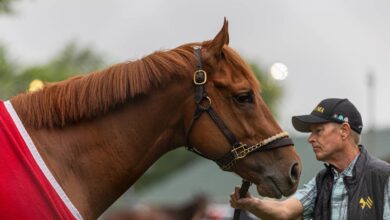
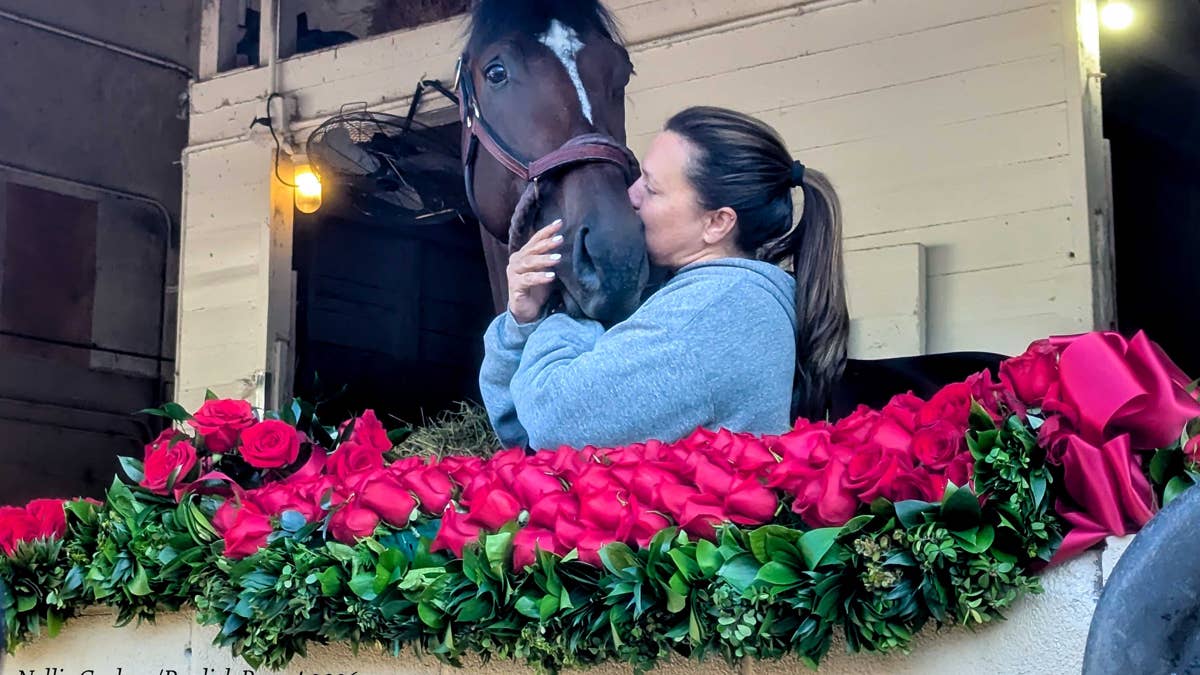
Cherie DeVaux and Golden Tempo the morning after the Kentucky DerbyLillian Davis photo
Cherie’s Sunday morning looked a little different. She lingered at the front of Golden Tempo’s stall, holding his head in her arms, tickling his nose, and giving him kisses. The camera lenses clicked. She likely would have been doing the exact same thing if he’d run dead last and the lot outside her barn was empty.
“That’s how she’s comfortable,” said Adrianne. “If you interview her when she’s standing next to a horse, you’re going to get a much better picture of who she truly is. Because she’s a #horsegirl.”
The concept of the “horse girl” goes back many generations, even if it didn’t have its own term until recently. Most people remember the classmate from middle school whose personality was mostly that she loved horses – from the library books spilling out of her backpack to the herds of model horses running across her shelves to the lumpy sweaters with horses’ faces on the front, gifted by well-intentioned aunts. Some were lucky to find their place at a riding barn or with a similarly-minded friend group. Many were teased for their weird, singular obsession, an early lesson that people will stereotype each other for almost anything.
Horse girls are kind of having a moment. High fashion brands have spent the past year or two trying (sometimes badly) to work equestrian themes into their clothing lines as current and former horse girls get back in touch with the joy they felt briefly borrowing a horse’s wings.
“I always am the consummate horse girl,” said Cherie. “Like, yeah, I love the horses. That's why I'm here. I love the process of getting horses to the races and watching that— watching them go through it, have that ‘aha’ moment. I love all of them.”
And that love, combined with years of experience and long hours, is a powerful tool for people responsible for a horse’s well-being. But being tender, showing your kindness, and showing your feelings isn’t something that’s always rewarded in this business.
I can remember sitting on the patio outside a prominent Thoroughbred sales pavilion, not that many years ago, surrounded by my fellow grooms after a long day showing yearlings. There was a man sitting behind us, having a frustrated conversation on his cell phone with someone. I took him to be an agent (and if I knew his name, I’d tell you).
“She’s just so stuck on this horse, and I keep trying to tell her, but you know how women are,” he huffed. “They get too emotional about it. They’re all so stupid.”
I turned around and stared at him. He looked into my eyes, unflinching. I’ve always wondered who was signing his checks.
Within the racing world, there’s always been a truism that (when given the chance) women connect with horses differently. Some horses are supposed to prefer female grooms or exercise riders for a more nuanced, gentle, intuitive hand. Are we more patient? More observant? Or do we indeed possess some kind of otherworldly magic with these creatures ten times our size?
Of course, there’s no reason male horsefolk should not be equally capable of creating that quiet, zen for an amped athlete without the luxury of spoken language. Some of them clearly are. But for as much as horse girls have had to endure, seeing one of them live out this dream is its own kind of victory.
“I can tell you all the people that made fun of me in middle school or high school for posting picture after picture with horses, and if you go through [Cherie’s] old Facebook pictures from like 15 years ago, it’s the same exact girl that you’re looking at today, snuggling on the horse,” said Adrianne.
The post-Derby media frenzy within racing has cooled somewhat, but DeVaux and her team are still fielding appearance and interview requests, all while trying to maintain a schedule that allows her to give her horses the personalized attention that got her here. Late in the week, after announcing Golden Tempo would skip the Preakness, she said she’s still averaging four hours of sleep a night and trying to fit in naps where she can. The adrenaline still hasn’t come all the way down, which helps.
Some of these appearances are about enjoying the moment, but mostly, and much more importantly, DeVaux recognizes the moment she’s been given to be an ambassador for the sport – and many around her see her taking on a role she probably didn’t anticipate at the Churchill wire.
“With everything with HISA and our reputation coming back a little more, racing is more accepted in 2026 than it was in 2023,” said Antonucci. “I think Cherie’s accomplishment gives us a broader opportunity to tell our story. It continues to be our responsibility to write our story and put our own headlines out. We keep allowing other people to write our headlines in an irresponsible manner, and that’s our own fault.
“The biggest difference between 2023 and now, is I was in crisis clean-up mode for the industry. A lot of people forget that because time makes it softer. We need to be happy we’re here, and keep working on that.”
But what does the woman at the center of the storm think about the gender angle?
“I don’t think [being a trainer] was harder for me as a woman," Cherie said. "That’s me, though. I do think there’s a double standard. I’ve always lived my life on my own terms. I’m not out here doing this as though my gender is a plight. I’ve had things go wrong in my life, and I’ve somehow continued to just move forward and tread along and get here. And if that’s a story that others can identify with, why not tell it for the greater good?”
I’ve seen people ask why it matters that the trainer of the Kentucky Derby winner is a woman. It matters that the door was closed, and it matters that now it’s open wider. First Antonucci, then DeVaux. Already, there’s a different energy behind the women looking through it. You’ll no doubt see a lot of coverage this week of Brittany Russell’s Taj Mahal heading into the Preakness. Like DeVaux, Russell’s career has been hands-on, in the saddle – a #horsegirl if ever there was one. She’s already been the first woman to win a race meet title in Maryland and is going strong there with a stable of around 80. In interviews about her historic accomplishments, she agreed with her colleagues – she doesn’t get up every morning and think about being a woman in a man’s world. But she also knows that while she is one, her daughter, Edy, is looking on.
Whether the next deep closer in a Triple Crown stretch comes from Cherie (the Belmont’s calling), or Russell, or Antonucci, or Adrianne, or another woman, it will be bigger than the horse. It’s bigger than the trainer herself.
I think Cherie’s win as a female trainer … she kind of healed a part of any female in the industry or anyone who’s ever been told ‘No, you can’t do this.' She’s become a kind of hero for people who haven’t been heard throughout the years.
For every jockey who was told by a trainer that he doesn’t hire women to ride races. For every groom who flinches as she’s catcalled walking to work each dark morning. For the girl who has a shank ripped from her hands and given to her male colleague before she’s had a chance to learn. For the agents whose eyes and minds plan the matings and the purchases someone else claims credit for. For every trainer who watches women-branded ownership syndicates pop up that ironically do not hire her. For every one who watched the horse walk out of the barn and wondered whether it was because of who she was instead of the way she worked. For the horse girls who hopped over makeshift crossrails in their backyard, dreaming of the day a horse could carry them somewhere far away. For all those who had to work twice as hard for half the credit, but haven’t yet hoisted a trophy to prove it. For everyone who got angry or jaded or exhausted in her pursuit of a world that did not seem to want her there.
Golden Tempo has carried them all.
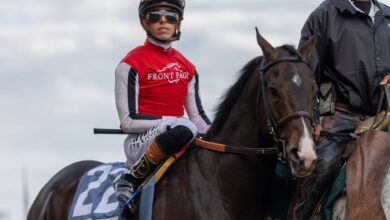
Trainer Cherie DeVaux welcomes Kentucky Derby winner Golden Tempo and jockey Jose OrtizNellie Carlson
This story was originally published by Paulick Report on May 11, 2026, where it first appeared in the News section. Add Paulick Report as a Preferred Source by clicking here.