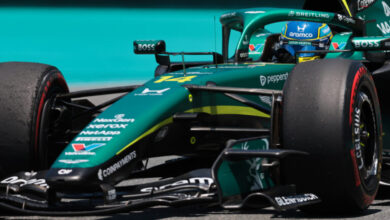
When Ferrari arrived at the Miami International Autodrome, they brought the heaviest technical artillery on the Formula 1 grid. We are not kidding. Maranello squad debuted a sweeping 11-part upgrade package for the SF-26. The package featured a heavily redesigned floor and diffuser with aggressive new sidepod flow conditioners. The main objective was quite simple: assert dominance, close the gap to Mercedes, and leave McLaren in the dust.
And well, that did not age well. Ferrari struggled heavily with tire degradation and balance issues. This left Lewis Hamilton only able to salvage a sixth-place finish, while Charles Leclerc, after a costly late-race spin and a brutal 20-second penalty for cutting chicanes, plummeted to eighth.
But here’s the thing. According to one of the most experienced technical voices in the paddock, the real catastrophe isn’t the lost points in Florida. It’s the terrifying, season-killing “negative loop” Ferrari has just locked itself into.
Ferrari’s Reality Check
Rob Smedley knows exactly how the Maranello pressure cooker operates, having served as a race engineer for Ferrari from 2004 to 2013. Speaking on the High Performance Racing podcast, Smedley delivered a no-nonsense assessment of the fallout that occurs in the factory after your 11-part, multi-million-dollar upgrade completely falls flat.
When asked about the psychological toll such a failure takes on the engineering crew, Smedley didn’t sugarcoat the situation. He admitted the experience is “one-hundred per cent” depressing and “slightly soul-destroying.” But the issue is that the psychological blow is only the beginning.
The real danger is the technical paralysis that follows. Smedley warned that Ferrari is likely entering a “negative loop,” forcing the team to halt forward progress to answer three agonizing questions: “What did you bring? What’s working? [And] what’s not working?”
The Reverse-Engineering Death Spiral
You see, in modern Formula 1, bringing new parts that don’t make the car faster isn’t just a neutral misstep. You can rather call it a compounding penalty. Ferrari’s massive aerodynamic package was approved because its wind tunnel and Computational Fluid Dynamics (CFD) simulations promised a significant boost in performance.


But here’s the thing. The sole fact that the SF-26 had such massive struggles during the Miami GP points to a singular, terrifying scenario: Ferrari’s computer models are lying to them. If a team’s simulation tools fail to correlate with real-world track data, they are essentially flying blind. As Smedley pointed out, Ferrari cannot simply throw the Miami parts in the trash and start designing the next package. They have to stop everything and figure out why the correlation failed.
This whole process will require a gruesome “reverse-engineering process” that forces engineers back into the wind tunnel just to figure out what went wrong. On top of that, under the FIA’s strict Aerodynamic Testing Regulations (ATR), wind tunnel and CFD time is heavily capped.
So every single hour Ferrari spends diagnosing their flawed Miami upgrades is an hour McLaren, Red Bull, and Mercedes spend actually making their cars faster. The Scuderia gambled heavily on a massive, sweeping update to take control of the 2026 season. Instead, they may spend the rest of the year stuck in the wind tunnel, desperately trying to get back to square one.