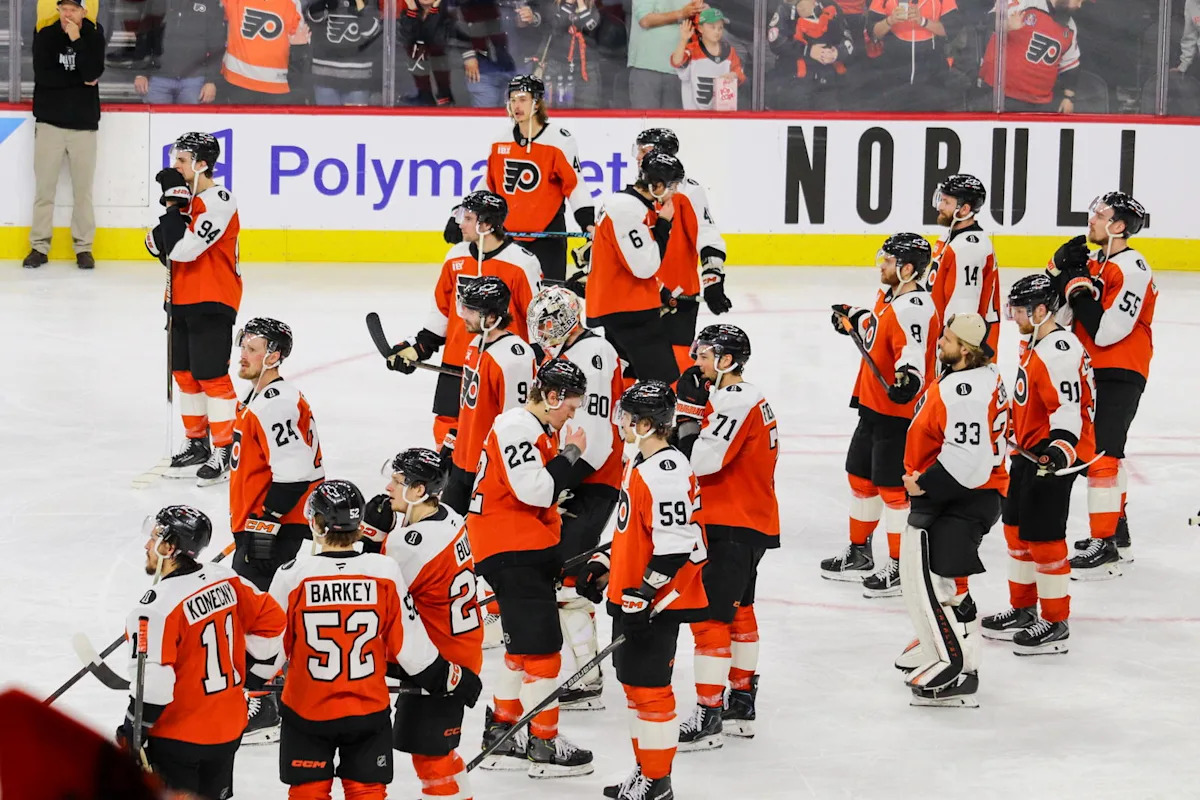
The sound that lingered inside Xfinity Mobile Arena was not heartbreak. Not really.
Heartbreak is quieter than this. It is more devastated, more heavy, more lost because you just don't really know what to say when such a glorious, invigorating season comes to a close.
It does not echo off the rafters after an overtime loss. It does not rise during handshakes. It does not follow players as they stand at center ice and salute a crowd that has spent years waiting for a reason to believe again.
And it certainly does not arrive in the form of 20,000 people refusing to leave.
The Philadelphia Flyers season ended Saturday night in a 3-2 overtime loss to the Carolina Hurricanes, completing a second-round sweep that, on paper, sounds decisive. Clinical. One-sided, even.
But that is not what it felt like inside the building after the puck crossed the line.
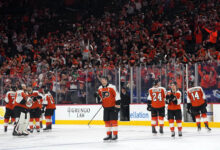
Less than a minute after the final whistle, as Carolina players poured over the boards in celebration, the arena rose anyway. The applause started in pockets before gathering force, swelling into a standing ovation that washed over the ice during the handshake line. Then came the chants.

“Let’s go Flyers!"
Not once. Not politely. The Philadelphia crowd gave their team their flowers the only way they know how—loud, sustained, and defiant.
For some unfamiliar with how Philly fans operate, it might have been shocking. There were expectations of jeers and boos and ridicule. But Philadelphia fans know the difference between a team that loses and a team that gives them something back.
This Flyers team gave them hockey back.
For years, the Flyers had drifted into a strange emotional space within the city—still important, still historic, but disconnected from the pulse that once made the building feel unavoidable in the spring. There were too many false starts, too many transitional seasons, too many nights where the team felt caught between identities.
That changed over the last eight months.
The Night Ended the Way the Season Was Played
The game itself was exhausting in the purest playoff sense.
Carolina did what Carolina has done to virtually everybody this postseason: they compressed the ice, attacked in layers, and forced the Flyers into a game played at a pace that leaves almost no room for hesitation. Their forecheck arrived in waves. Their gaps through the neutral zone suffocated transition opportunities. Even when Philadelphia escaped pressure, there was usually another red sweater waiting a stride later.
The Hurricanes looked like a team built for this stage because they are. And yet the Flyers never disappeared from the game.
That was the striking part of the night. They were undermanned, worn down, carrying injuries significant enough that Tocchet openly acknowledged them afterward, and they still dragged the game into overtime against one of the deepest and fastest teams left in the playoffs.
“I thought we had some guys tired,” Tocchet admitted. “We squeezed as much as we could. I can’t ask for more. We hung in there. [Carolina] is a good hockey team. They run all four lines; they were flying. We’ve got some guys banged up, broken ribs and all that sort of stuff. They gave it all.”
"We squeezed as much as we could" is an honest summary of the series, because by the end, the Flyers were running on conviction almost as much as execution.
Noah Cates was already lost for the series after Game 2, watching from the press box on a scooter with his foot in a boot. Owen Tippett never appeared in the series because of an undisclosed injury, which is reportedly a sports hernia. Other players were clearly laboring through damage that only fully surfaces in May, when the season is close enough to touch that adrenaline temporarily disguises what the body is trying to say.
Carolina’s depth eventually overwhelmed that reality, but the Flyers made the Hurricanes earn every inch of it.
The Most Important Moment Came After the Goal
The defining image of the night was not Carolina’s overtime winner. It was what happened afterward.
During the handshake line, former Flyer and Hurricanes head coach Rod Brind'Amour stopped to speak with Tocchet and gestured toward the crowd. It was a small moment, easy to miss unless you were looking for it, but it spoke to what this team has accomplished in what Tocchet described postgame as putting this organization "back on the map."
Brind’Amour understood what was happening in the building because he remembered what Philadelphia hockey used to feel like. And for the first time in years, it felt that way again.
Tocchet felt it too.
“That’s amazing,” he said of the ovation. “I really want to thank the fans for that. That was awesome for them… It puts us on the map a little bit. I was talking to [President of Hockey Operations Keith Jones] and he was saying, ‘Man, that was awesome to hear the fans cheer the guys on.’ That’s a good thing for the guys to understand—they’ve got these fans behind them and this organization back on the map. We got a taste.”
That's not to say that the Flyers are suddenly finished rebuilding. They are not. Not because they are suddenly Stanley Cup favorites. They know there is still work to be done. But for the first time in a long time, there is alignment between the team and the city.
Philadelphia fans can tolerate losing. What they reject is emptiness, passivity, teams that feel emotionally disconnected from the standard the city expects.
This Flyers team never felt disconnected. They played with pace. They laid the big hits. They fought through injuries that would completely debilitate other sports' athletes. Their young players embraced pressure instead of hiding from it. They made games feel alive again.
That matters here. It always has.
The Young Core Changed the Timeline
The playoffs accelerated the perception of what this team might become.
Not because the Flyers reached the second round. Plenty of teams do that and disappear a year later. But because their young players consistently looked emotionally capable of handling the environment.
Tocchet pointed to Alex Bump as an example after the game. Bump made a costly mistake on Carolina’s second goal, the kind that can bury young players psychologically in playoff hockey. Instead, he responded by scoring the game-tying goal in that same frame.
“Perfect example is [Alex Bump]—he makes a mistake on [Carolina’s] second goal, he gets the tying goal, he gets right back out there,” Tocchet said. “That’s the stuff you want to see. He’s not on the bench pouting. He knew he made the mistake, then he goes out there and bangs one in. That’s the growth you like to see—taking that information and then just rise in the moment.”
Philadelphia Flyers forward Alex Bump (20) celebrates his game-tying goal. (Megan DeRuchie-The Hockey News)
That is the part contenders spend years trying to identify: which young players can absorb failure without shrinking under it. The Flyers saw evidence of that everywhere this season.
Porter Martone entered the NHL and immediately looked comfortable in playoff hockey. Matvei Michkov endured difficult stretches—including being healthy scratched for this Game 4—without losing his confidence. Denver Barkey handled responsibilities larger than anyone initially expected. Even players whose production dipped continued contributing structurally.
This was not a perfect team. Carolina exposed that clearly. The Flyers still need more high-end offensive creation, more experience, more lineup insulation when injuries hit. But they also discovered something harder to manufacture: internal belief that is undeniably authentic and sustainable.
A Team That Learned How to Matter Again
The most revealing quote of the night came from Tocchet when reflecting on his first season behind the Flyers bench.
“How close they are, how resilient, how willing they are to be coached,” he said of his takeaways from this season. “It was just fun to see. I haven’t been back here in 25 years, so just being involved with the Flyers again and seeing people grow with the team. It reminded me back to the days when I played, where the crowd was into it. That’s what I’m most proud about, how [the fans] helped us this year. We had to help them too. They haven’t really had a lot to cheer for.”
That honesty landed because everybody in the building understood it. The Flyers did not win the Stanley Cup. They did not even win this series. But they restored emotional investment in a franchise that had been starving for it.
The connection felt mutual by the end. Players repeatedly talked throughout the season about how the crowd energy changed as the year progressed. Fans responded to a team that played with visible joy, resilience, and edge.
The relationship rebuilt itself in real time, and on Saturday night, even after elimination, nobody wanted to let go of it just yet.
Philadelphia Flyers forward Tyson Foerster celebrates scoring against the Carolina Hurricanes. (Megan DeRuchie-The Hockey News)
The Pain Was Real Too
That optimism does not erase disappointment. Captain Sean Couturier, one of three players on this current team with prior playoff experience and one of the top Flyers performers in the postseason, was candid about how much the loss naturally stings.
“Right now, it’s hard to judge or comment on the season in general,” he said. “It’s a tough pill to swallow right now. We really believed we had a chance. It’s tough right now, but at the same time, I’m proud of the way this team battled to the end. There’s no quit.”
Philadelphia Flyers captain Sean Couturier salutes Flyers fans. (Megan DeRuchie-The Hockey News)
That is the emotional contradiction of a season like this. The Flyers lost. The ending hurt. They genuinely believed and looked like they could keep going.
But for the first time in a long time, the future no longer feels abstract in Philadelphia. It feels tangible. It feels loud. It feels possible. It feels like a group effort that everyone is giving their all to.
Which is why, long after the overtime goal, the crowd stayed standing—not to mourn what ended, but to acknowledge and celebrate what started.
And as Tyson Foerster said on the ice after the game, "We'll be back."