When Wanderers beat Royal Engineers in the first FA Cup final in 1872, none of those taking part at the Oval could have guessed what the competition would become. Because 154 years later, despite every attempt to lessen its meaning, the Cup remains the most gloriously unpredictable tournament in world sport.
Trying to select the best moments was no easy task, but it was a fun one. Sadly few of us have direct recall of the Cup’s glorious first century. Still, there are moments from those days that have become etched into the collective consciousness. While the final has diminished as a national institution, the moments keep coming. And here is my choice.
Yesterday we counted down from 50 to 26. Today we complete the list, from 25 to one. You can give each moment the thumbs up or thumbs down, share your memories and opinions in the comments section, and vote on the top 10.
50. Sutton United beat Cup winners (1989)
Just 19 months previously, Coventry City had won the Cup at Wembley. Success that day had prompted their manager, John Sillett, to insist the club would now be shopping at Harrods. After this third-round defeat, they would be lucky to buy anything at Poundland. With their evocatively named Gander Green Lane stadium rocking, Sutton, then in the Conference, put out their First-Division opponents with an accomplished ease. They won 2-1, with goals from captain Tony Rains and Matthew Hanlan sandwiching a strike by Coventry’s David Phillips.
49. Hero found on Ceefax (2001)
When Roy Essandoh was engulfed by celebrating team-mates after his goal took third-tier Wycombe to the FA Cup semi-final, there would have been several of them who had only just been introduced. In the most ridiculous plot line in Cup history, Essandoh’s agent had responded to an appeal reported on Teletext the week before by Wycombe manager, Lawrie Sanchez. Down to bare bones in a squad ravaged by injuries and suspensions, Sanchez feared he may not be able to name a team to face Leicester in the sixth round. Step forward Essandoh, the Ceefax Cyberman, recently employed playing for Rushden, to deliver the winning goal.
48. Clough and Venables hold hands (1991 final)
It was a fading Brian Clough’s last hurrah, what many recognised as his last chance to add the Cup to his many managerial successes. In typically eccentric style, Clough chose to walk out on to the Wembley pitch at the head of his Nottingham Forest team holding the hand of his rival manager, Tottenham’s Terry Venables. The bemused look on Venables’s face was one of the enduring images of Cup history. And sadly for Clough, it was Venables whose hands were later on the trophy.
Brian Clough (L) held hands with Terry Venables, before Tottenham got the best of Nottingham Forest in the final – Getty Images

47. City beat United on way to treble (2023)
For Manchester United achieving the threesome of Champions League, Premier League and FA Cup in 1999 was a mark of distinction. And then, 24 years on, their noisy neighbours were poised to match the feat. But here was the thing: like they had in 1977 when their other fierce rivals Liverpool were poised to achieve the big three, United had the chance at the last to stop it. This time, however, they were up against Pep Guardiola’s finest side. And, whatever the incentive, on the 100th anniversary of the first final to be staged at Wembley, City were simply too good. In what became known among the City faithful – largely to differentiate this from the many other Cup finals they have reached in the 21st century – as the Gundogan final, the German midfielder scored both City goals and, as captain, lifted the trophy. A week later, against Inter, the treble was completed.
46. Stevenage and Newcastle row (1998)
It was a fourth-round tie packed with rancour. Newcastle reckoned Stevenage Borough’s ground not fit to stage a Cup tie, its temporary stands looked particularly hazardous. Stevenage refused to switch to St James’s Park. Newcastle thought Stevenage disrespectful publicity seekers; the would-be hosts thought Newcastle arrogant. It was never that simple: Newcastle’s safety concerns were legitimate, Stevenage deserved their chance to play at home. After some last-minute repairs, the tie went ahead and, with a draw which cheered up every supporter of the underdog, Stevenage earned a replay. Which they duly lost.
45. Ten-man Man City somehow KO Spurs (2004)
Three-nil down at half-time, away from home, City were apparently out of their fourth-round tie. Especially when, as they made their way to the dressing room for the break, they were reduced to 10 men when Joey Barton (who else?) was sent off for questioning the referee’s integrity. But, extraordinarily, goals from Sylvain Distin, Paul Bosvelt, an equaliser from Shaun Wright-Phillips and a last-second winner from Jon Macken turned expectations on their head in the finest comeback in Cup history. A result for the ages. But imagine any of those names on a City team-sheet these days.
44. Barthez hails taxi for Di Canio (2001)
It was not entirely clear what Manchester United’s goalkeeper Fabien Barthez was attempting to do in the middle of this tense fourth-round tie. With West Ham’s Paolo Di Canio bearing down on goal, he stood with his arm in the air, apparently attempting to bluff the Italian into thinking he was offside. But Di Canio was not, nor was he about to be fooled. Indeed the only fool on the pitch was Barthez, as West Ham went on to win 1-0.
43. Thomas wonder strike sinks Arsenal (1992)
Trailing 1-0 at home to Arsenal in the third round, Wrexham were awarded a free-kick in the 82nd minute. The man who picked the ball up was 37-year-old Mickey Thomas, the winger with history at Manchester United, Chelsea and later HMP Walton, where he served an 18-month sentence for passing counterfeit currency to Wrexham’s youth team players. After a rough-and-tumble tie, the veteran looked barely capable of a tap-in, never mind a 30-yard attempt on goal. But no matter his exhaustion, the Welsh club’s players had worked on a plan in training which involved two men lining up in the Arsenal wall, with Thomas aiming at the space they vacated as they moved out of the way. And it could not have worked better. Thomas’s kick was a rip snorter, thundering through the enforced space and fizzing out of David Seaman’s reach into the top corner of the net. Four minutes later, Steve Watkin’s tap-in of a winner sent the Wrexham fans delirious.
42. Cantona’s winner (1996)
Even in one of the most disappointing finals in Wembley history, a game of stultifying dullness, there was always Eric Cantona. After 85 minutes of stalemate, there, lurking outside the Liverpool penalty area, the Frenchman was poised, waiting as Liverpool’s David James flapped away David Beckham’s corner. His shot was arrow-like, burrowing through the crowded area into the net. With that goal, Cantona achieved remarkable redemption to lead his club to the double, returning from the longest suspension in English football history after his leap into the Selhurst Park crowd. In the process he became the first captain born outside the British Isles to lift the oldest trophy in the game.
41. Sinclair’s bicycle kick (1997)
Not much was happening in this fourth-round tie between QPR and Barnsley at Loftus Road. Certainly John Spencer’s punted cross seemed to suggest little in the way of danger as it floated to the edge of the Barnsley penalty area. But there was Trevor Sinclair, who, with his back to goal, suddenly unleashed the most explosive, athletic, magnificent overhead kick. He did not just connect with the ball, he hammered it over the Barnsley keeper into the net. What a strike, what a goal. It was, however, the one highlight of the season’s Cup for Rangers: they were knocked out in the next round by Wimbledon.
40. Bradford stun Chelsea (2015)
In an era of mega-spending Premier League clubs, upsets like Bradford City’s fourth-round win over Chelsea at Stamford Bridge are increasingly rare. That the League One side – who sat 49 places below the then Premier League leaders in the pyramid – managed to come back from two goals down made it all the more remarkable. Do not let Chelsea’s Premier League collapse in the subsequent 2015-16 campaign take any of the shine off this result: Bradford journeyed to the home of a side who, at the time, were confidently talking of pursuing a quadruple, and staged one of the most remarkable comebacks in the Cup’s history.
39. Vieira bows out in style (2005)
Patrick Vieira’s last touch in an Arsenal shirt was a significant one. After Paul Scholes had missed his spot kick for Manchester United in the penalty shoot-out, never for a moment did the Frenchman look as though he was going to do anything but score. And thus Arsenal won the first shoot-out to decide a final. Never again would there be a replay. From now on, any drawn final would be decided from 12 yards. As for Arsenal, it would be another nine years before Arsène Wenger would lead them to another trophy. During which time every other club in the Football League changed their manager at least once.
38. Waddle’s free-kick (1993)
Sheffield had gone south en masse for the first Steel City derby in the Cup semi-finals. And the game was only 90 seconds old when Wednesday’s Chris Waddle stepped up to take a free-kick so far from goal, his opponents only bothered to construct a one-man wall. Waddle, bought from Marseille the previous summer, duly took advantage, curling a perfect, left-footed strike beyond the reach of Alan Kenny in the United goal to send Wednesday to the final.
37. Wright’s cameo (1990)
Ian Wright, Crystal Palace’s centre-forward, had only just returned to fitness after breaking his leg earlier in the season. From the moment he came on as substitute, his pace and power caused havoc in the Manchester United back line. Steve Bruce and Gary Pallister simply could not keep close to him as he ducked, dived and sprinted, scoring twice as Palace drew 3-3. And, despite the fact they lost the replay, what was it about that Palace side that made history? They were the last all-English-born XI to contest a final.
36. Pearce delivers tough justice (1991)
Just 15 minutes into the ’91 final, Tottenham’s over-excited Paul Gascoigne launched himself at Forest’s Gary Charles on the edge of his own area. Charles went flying, Gascoigne’s cruciate was ruptured, and England’s talisman would never be the same again. To add insult to Gazza’s self-inflicted injury, Stuart Pearce stepped up and matter-of-factly stroked the ball into the Spurs goal. His stern-faced celebration was matched by that of his manager Brian Clough, who remained utterly unmoved by the brilliance of his captain’s work.
35. The Michael Owen final (2001)
Liverpool fans may have little time for him now (something to do with later signing for Manchester United), but in 2001 Michael Owen was lauded as a hero of the Kop. Gerard Houllier’s side had won the League Cup and were heading to the Uefa Cup final when Owen ensured their treble remained on track. He had already equalised Arsenal’s late opener when, with just two minutes of normal time remaining, Patrik Berger sent a beautifully weighted long pass into his path. Controlling the ball perfectly, before dashing between Lee Dixon and Tony Adams, Owen fired, left-footed, past David Seaman. He celebrated with a cartwheel and the broadest smile ever seen at Cardiff’s Millennium Stadium.
34. Allison wears a magic hat (1976)
It was a hat-trick of incredible wins. The flamboyant Malcolm Allison steered Crystal Palace, then mired in the Third Division, past Leeds, Chelsea and Sunderland in successive away matches to reach the FA Cup semi-final. Wherever they went, the manager wore a flamboyant fedora, giving him the air of an extra in Starsky and Hutch.
Malcolm Allison sported his trademark fedora ahead of Crystal Palace’s game against Chelsea – Getty Images
It was an incident after his side’s third-round victory at Scarborough that convinced Allison of the effectiveness of his headgear. “As I was going past their dressing room,” he once recalled, “all their players were in the bath and I could hear them saying: ‘What do you think about that big-headed bastard? First chance we ever have of getting some publicity and he comes along in that stupid hat.’”
33. Wenger’s sportsmanship (1999)
Just an hour after Arsenal had beaten Sheffield United 2-1 in the fifth round of the Cup, Arsène Wenger’s generous offer to replay the game had been accepted by his opponents and sanctioned by the Football Association. Wenger had acted after his team had won through a goal which did not accord with the higher values of the game. A United player was down injured and the ball was kicked out of play to allow him to be attended to. Instead of returning the ball back from the ensuing throw-in, as is the custom, Arsenal took the opportunity to attack and Marc Overmars scored what turned out to be the decisive goal. United’s players, bench and fans were incensed. Wenger was embarrassed and urged the FA to create a precedent. Arsenal, incidentally, won the rearranged tie.
32. Cavanagh evades the Met Police (1966)
So excited was Everton fan Eddie Cavanagh at Mike Trebilcock’s equaliser for his side in the 1966 final against Sheffield Wednesday that he decided he would run on the pitch. Not what you might describe as athletic of build and having partaken of drink, Eddie nonetheless ducked and dived his way past the stewards’ attempts to curtail his run. Shedding clothes at every effort to stop him, revealing a fetching pair of braces, he provoked a hilarious Keystone Cops chase across the Wembley turf that held up play for several minutes. Eventually brought down by a rugby tackle he was carried off the pitch wearing a broad grin, with a cop holding each limb, to huge ovation.
31. Robins saves Fergie’s job (1990)
The board subsequently claimed he was never in danger of the bullet, but at the time everyone believed Alex Ferguson’s job as manager of Manchester United was in jeopardy. He had spent heavily in the previous summer’s transfer market, only to preside over the wobbliest of autumns. His United were floundering in the league, the fans were getting uppity and he arrived in a third-round tie at Brian Clough’s Nottingham Forest knowing only victory would suffice. It was not a pricey incomer, however, but a local youth-team graduate who bought Ferguson time. And with that, completely altered the Old Trafford landscape. When Mark Robins stooped to head the winning goal that afternoon, a dynasty was secured.
30. Cardiff take Cup out of England (1927)
It was a year of firsts: the first time a Cup final was broadcast on the radio, the first – and only – time it was won by a team from outside of England and the first time the referee wore a bow tie to officiate the occasion. Sadly William Bunnell’s sartorial innovation did not catch on. Arsenal, organised by their recently installed manager Herbert Chapman, were the clear favourites. But Hughie Ferguson’s scuffed shot, which Arsenal keeper Dan Lewis made a right mess of trying to pick up, was enough to take the trophy to Wales.
29. Gullit’s foreign first (1997)
As a torrent of money arrived in the game with the formation of the Premier League, so recruitment from overseas picked up. Chelsea were at the vanguard of change, soon to field an entirely foreign XI in 1999. Off the pitch, too, the club were pioneers, and in 1997, the grand Dutchman Ruud Gullit became the first non-British-born manager to steer a side to FA Cup glory. He was helped by the club’s future Champions League-winning manager, Roberto Di Matteo, who put Chelsea in front with a 30-yard screamer just 42 seconds into the match. Such was the pace of change that since Gullit marked his achievement, only one English-born manager has lifted the Cup: Harry Redknapp in 2008.
28. Liverpool’s white suits (1996)
In fact, they were cream. And they were David James’s idea. The Liverpool keeper had a contract modelling for Giorgio Armani. So the Italian tailor dutifully ran up some of his best gear for Liverpool to wear at the final. Unfortunately it made the team – already labouring under the derogatory nickname of the “Spice Boys” because of their allegedly reckless extra-curricular proclivities – look like a bunch of ice cream sellers. Their opponents Manchester United, decked out in sombre navy, duly took note. And cheerfully beat them. As Jamie Redknapp noted years later, had his team won, the suits would have entered fashion legend.
27. Cech’s wonder save (2012)
Chelsea, heading for the Champions League final, secured a magnificent cup double in 2012. And it was largely down to their goalkeeper. Petr Cech’s astonishing save, bending backwards to somehow divert a goal-bound header from Andy Carroll on to the bar, kept his team in the lead against Liverpool. Had that header – smacked with real power off Carroll’s forehead – gone in, how differently might the player be remembered on Merseyside? Instead, it is Cech who is forever associated with that game.
26. Bournemouth stun United (1984)
Bournemouth’s manager, Harry Redknapp, had taken his team out the night before their fourth-round game with Manchester United to an Italian restaurant called La Lupa in Charminster. The maître d’ offered goalkeeper Ian Leigh free pizza for life if he could keep a clean sheet. After beating the Cup holders 2-0, a celebratory evening out was held back at La Lupa. Goalkeeper Leigh was keen to get his reward. However, Redknapp, who had just bought the restaurant, reneged on the deal. “Too right I did,” the veteran boss once admitted. “Ian was 5ft 10in but about 15st in old money. If I’d have given him free pizza for the rest of his life, he’d have eaten me out of business.”
25. Watson scores winner for Wigan (2013)
Substitute Ben Watson had been on the pitch all of nine minutes when he scored the goal that defied all assumptions about who would win the Cup. Against Manchester City, the country’s most expensive team, the player who had been out with a broken leg for much of the season dashed to the near post and met Shaun Maloney’s perfectly delivered corner to flick the ball over a despairing Joe Hart. It is fair to say it was a goal Wigan Athletic’s chairman Dave Whelan – whose own memories of FA Cup finals involved being stretchered off with a broken leg when playing for Blackburn in 1960 – enjoyed.
24. Moran makes unwanted history (1985)
The photograph of referee Peter Willis towering over a distraught Kevin Moran illustrates what, at the time, appeared to be the key moment of the 1985 Cup final. Manchester United’s Irish centre-back was about to become the first player to be sent off in an FA Cup final – no wonder he looked upset. But the truth was, despite the player’s protestations of innocence, Willis had no other option. Moran’s hack at Everton’s Peter Reid when he was bearing down on goal was as clear a red-card offence as could be imagined. Everton supporters thought that would be the moment to help them secure the treble of First Division, FA Cup and European Cup Winners’ Cup. But United’s Norman Whiteside had other ideas. Initially denied a winner’s medal for his misdemeanour, Moran was eventually awarded one a few days after the final.
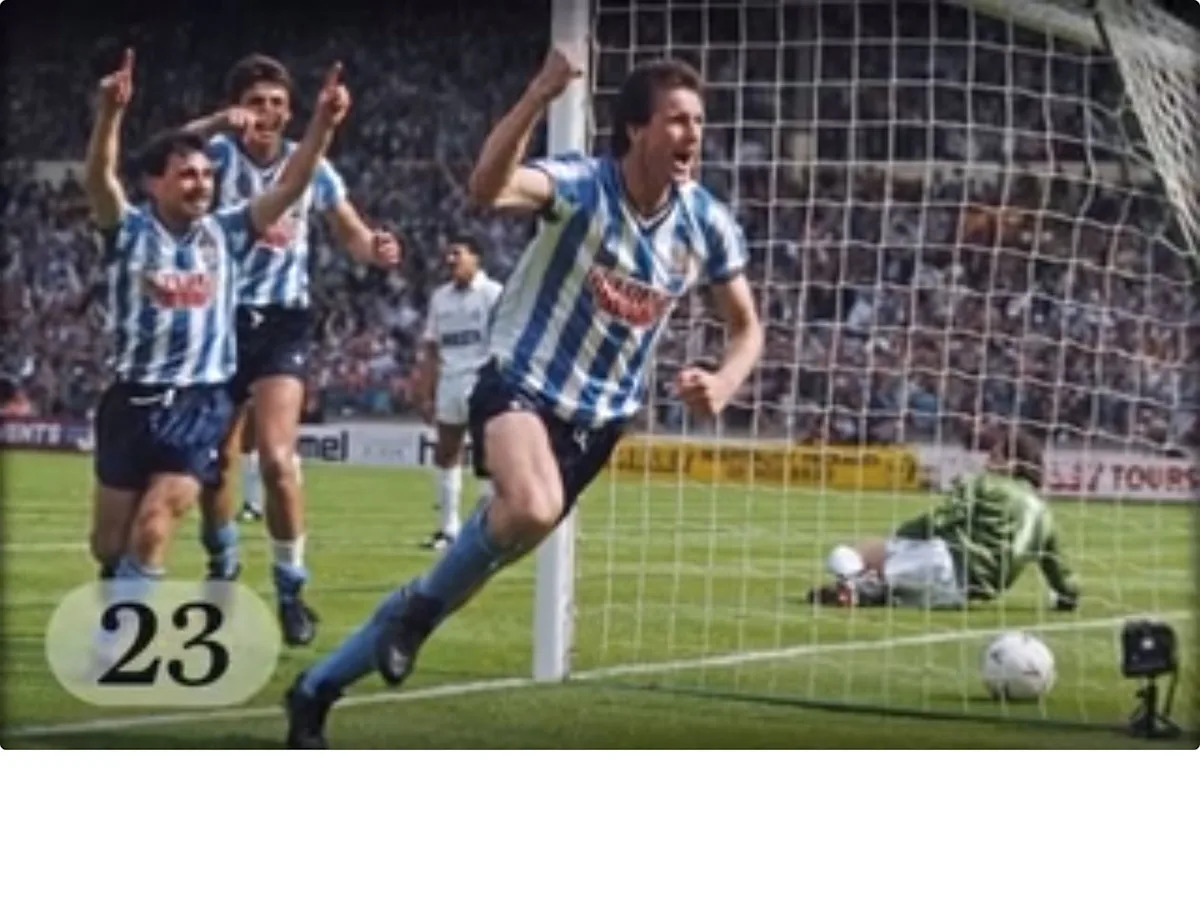
23. Houchen takes flight (1987)
A £60,000 signing from fourth-division Scunthorpe United the previous summer, Keith Houchen scored four goals for Coventry City en route to Wembley. But it was his equaliser against Tottenham Hotspur to make the score 2-2 in one of the most exciting finals of them all that sealed his place in history. Houchen, receiving a Cyrille Regis flick-on with his back to goal on the edge of the area, steered a pass out to Dave Bennett on the right wing. He then turned and dashed forward, flinging himself at the resulting cross to score the most sublimely timed diving header. His goal took the game into extra time, where Gary Mabbutt’s own goal handed the trophy to Coventry for the first and only time.
22. Best scores six (1970)
George Best was returning from a four-week suspension and a then substantial £100 fine for kicking the ball out of the referee’s hands in a League Cup game when he decided to take out his frustration on a hapless Northampton Town, then at the bottom of a four-year downward spiral that took them from the First to the Fourth Division. Sixfields Stadium had never seen anything like it as the Belfast Wizard led an 8-2 romp by Manchester United. Best’s favourite goal was the sixth, as it allowed him to mock his team-mate Denis Law, who had scored six in a Cup tie for Manchester City only to have his goals struck from the record when the game was abandoned. Best’s six-goal haul, as he never ceased to remind Law, was in the record books for eternity.
21. And Smith must score… (1983)
Brighton and Hove Albion had already been relegated from the First Division that season. But with moments of extra time left in their final against Manchester United, they looked as if they were about to win the first piece of silverware in their history when Gordon Smith found himself unmarked breaking into the opposing penalty area. He had already scored in regulation time and Peter Jones, the BBC radio commentator, noting that Smith only had keeper Gary Bailey to beat, yelled “and Smith must score”. But Bailey read the forward’s intentions and saved. The game finished in a tie, Brighton were eviscerated in the replay and Jones’s observation was immortalised by sanguine Seagulls supporters as the name for a fanzine. Smith, incidentally, went on to become chief executive of the Scottish Football Association.
20. Colchester KO mighty Leeds (1971)
By the fifth round, the potential for giant-killing is much reduced. And anyway, this was “Mighty Leeds”, the great side that Don Revie built, at the peak of their trophy-accumulating powers. Except that day at Layer Road, they were beaten by a team of such vintage that they were dubbed “Dad’s Army”. Employing an aerial bombardment, Colchester United never let their rivals settle. Ray Crawford, the former England international, scored twice as the Fourth Division side took a 3-0 lead. Leeds United came back gamely to reduce the arrears to 3-2, but could not find an equaliser.
19. Gazza’s beauty vs Arsenal (1991)
That Spurs beat their north London rivals 3-1 in a semi-final staged at Wembley was enough on its own to stick in Tottenham Hotspur’s memory. That two goals were scored by Gary Lineker was another distinction. But what really made this game was the first goal, scored by Paul Gascoigne. Hammering in a free-kick from some 30 yards, it was the kind of strike previously assumed only to be the preserve of certain Brazilians.
And Gazza was rather chuffed with it. Displaying that enthusiasm for the game that had charmed the nation during Italia 90, he yelled at Ray Stubbs, the BBC’s interviewer, immediately after the final whistle: “I’m happy, so happy. Couldn’t sleep last night, had to have a couple of injections I was so nervous. I’m now away to get me suit measured [punching the air]. Yes!”
18. Brooking’s underdog bark (1980)
Never a day has gone by since his winning Cup final goal that Sir Trevor is not reminded of it. Taxi drivers, London Underground passengers, policemen, everyone wants to talk to him about it. And what they mostly ask is: did you mean it? A diving header was not the elegant midfielder’s trademark, but on this occasion, he bent low to connect with Stuart Pearson’s driven cross to defeat Arsenal and send the bubbles floating across Wembley. It sealed West Ham United’s victory, which remains the last achieved by a second-tier club in the final.
17. George on his back (1971)
The greatest goal celebration in Cup final history was the result of subterfuge. Charlie George, the 20-year-old north London lad, had just secured Arsenal’s first double with his blistering 20-yard shot past Ray Clemence (“If Ray had got to that shot he would have broken his hand, I proper caught it” is George’s memory of the strike). The goal, deep into extra time, won the game. And George marked it by lying flat on his back, arms outstretched, socks rolled down to his ankles. His reason for repeating a celebration he had first trialled in the fifth round at Maine Road? Time-wasting. It was the best way he could think to run down the clock.
16. Stokes’ winner for Southampton (1976)
He may have been so far offside he was practically in Hendon, but Bobby Stokes’s 83rd-minute winner handed the Cup to a Southampton side who had finished sixth in the Second Division that season. The late Stokes, a journeyman midfielder, was described by commentator Brian Moore as “only five foot seven” as he ran on to Jim McCalliog’s lofted ball in behind Manchester United’s defence. He was, however, tall enough to land Southampton’s only FA Cup.
15. Horse of the Year Show ruins Wembley (1970)
Leeds and Chelsea did not much like each other in those days. But on this, the chalk-and-cheese rivals could agree: the pitch for their 1970 final was a joke. Churned up by the Horse of the Year Show a week earlier, it resembled the venue for the world ploughing championships. The two teams duly played up to the conditions, staging a game which redefined the term agricultural. After kicking lumps out of each other for 120 minutes, no winner emerged. So it was decided that the replay would be staged at Old Trafford, where at least there was a rumour of some grass on the playing surface.
14. Pardew dances on his way to Wembley (1990)
Hammered 9-0 at Anfield earlier in the season, Crystal Palace were deemed to have no chance in the semi-final against Kenny Dalglish’s double-chasing Liverpool. But, with manager Steve Coppell employing more physical tactics than he had in the league game, the lead swapped hands promiscuously until Andy Gray scored an equaliser with just three minutes of normal time left. Then, in the second period of extra time, came the finest moment of Alan Pardew’s playing career. A corner from Gray was flicked on by Andy Thorn and there was Pardew – not renowned as a goal-scorer – bundling the ball home to win the game 4-3. His jig of delight was somewhat more appropriate than his dad-dance touchline celebration when his Palace team took the lead against Manchester United in the 2016 final.
13. Fergie’s face as United pull out of the Cup (2000)
The look adopted by the newly knighted Sir Alex Ferguson spoke volumes. After their treble season, United called a press conference to announce they would not be defending the FA Cup. Instead, as European champions, they were heading to Sepp Blatter’s new folly: the Club World Championship in Brazil. Part of the Football Association’s plan to ingratiate itself with Fifa in its attempt to land the 2006 World Cup, it involved sabotaging the organisation’s own competition: United could not adequately appear in both. Ferguson’s face suggested he was more than aware of quite what a disservice his club were doing to tradition. As for England’s 2006 World Cup bid: well that worked out well, didn’t it?
12. Lincoln’s staggering run (2017)
Lincoln City’s Cup run began in November 2016, when they beat Altrincham at home. Nobody then thought what might come next. But under the imaginative management of Danny Cowley (who had a roomful of statistics students from the local university at the Sincil Bank stadium to help him study opponents), they moved on to beat Oldham Athletic, Ipswich Town, Brighton and, most notably, Premier League Burnley to become the first non-league representatives in the quarter-finals since before the First World War. It was at the Emirates that Arsenal finally made league position tell, dispatching them 5-0. But the momentum gleaned from the Cup run spurred them on to promotion back into the Football League.
11. Gerrard’s howitzer (2006)
One of the most stunning goals topped one of the finest individual FA Cup final performances. With West Ham leading 2-0 and then 3-2, Liverpool looked out of it in the last final to be played at Cardiff’s Millennium Stadium. Steven Gerrard, however, had other ideas. His late 30-yard howitzer of an equaliser lifted a nation off its sofas and took the game into extra time. Liverpool eventually won on penalties. And of course Gerrard scored his.
10. Palace’s tears of joy (2025)
The comedian Mark Steel recalls that when the final whistle sounded, confirming that Eberechi Eze’s goal had won the Cup for Crystal Palace, the reaction among many fans was not to leap around in delight but to burst into tears.
Their emotion was understandable. Never did they expect to see their club win a trophy. Especially not when their opponents, the titans of Manchester City, were playing their third final on the bounce. But Palace were superb that day, Eze’s finish rounding off a breakaway goal of sublime quality, while Dean Henderson saved a penalty from Erling Haaland, the Premier League’s top scorer. For many a neutral it was a result that restored some integrity to the competition, demonstrating that, even in its showcase final, the upheaval of certainty remains a possibility.
9. Motson hails Wimbledon’s ‘Crazy Gang’ (1988)
The tradition is that FA Cup giant-killings only happen in the early rounds. By the final, it is the big boys sparring for the spoils. But here were Wimbledon, a club who had gained entry to the Football League only 11 years previously, an outfit who had spent most of their 100-year existence scrabbling around the amateur circuit, actually lifting the trophy itself. For that May afternoon in 1988, Liverpool – 17-time champions of England – were beaten by the Wombles. Or as the sheepskin-coated BBC stalwart John Motson put it, in a line you sense he had prepared specially for the occasion, “The Crazy Gang have beaten the Culture Club”.
8. Ricky Villa’s waltz (1981)
Ricky Villa had been substituted after a disappointing showing in the first FA Cup final to feature an Argentine. But, after that game was drawn, he found redemption. In the replay he was magnificent. He opened the scoring for Tottenham against Manchester City, then, after Steve MacKenzie had equalised with a brilliant long-range strike, he picked up the ball midway into the City half. Initially, his loping run did not seem particularly venomous, but as he checked, dummied and cut back, it turned into something glorious. He suddenly found himself with space to hammer the ball past Joe Corrigan. The goal was voted the greatest of the 20th century in an online poll.
7. Hamstrung in the Matthews final (1953)
The “Matthews Final” in May 1953 might never have been so named had Eric Bell, the Bolton Wanderers left-half, not torn his hamstring midway through the first half. In the days before substitutes, Bell was obliged to stay on the pitch, somehow even nodding in a cross to put Bolton 3-1 up. But his inability to run was brilliantly and ruthlessly exploited by Stanley Matthews, who tore time and again into the space he left unoccupied to manufacture Blackpool’s recovery and put himself in Cup folklore.
6. Hereford’s invasion of the parkas (1972)
Ronnie Radford’s howitzer strike, the mudbath pitch, John Motson’s first Cup commentary: few things speak to the FA Cup quite like the third-round replay between Southern League Hereford United and First Division Newcastle in February 1972. But it was the moment the pitch was invaded by hundreds of exuberant lads dressed for the occasion in their coats with fur-lined hoods that etched the game indelibly in the collective memory.
5. The White Horse final (1923)
It was the first final staged at the newly constructed national football stadium at Wembley. And the crowd control as West Ham took on Bolton Wanderers was beyond chaotic. As an estimated 300,000 descended on a stadium intended to hold less than half that number, thousands of people, finding themselves with nowhere else to go, poured on to the playing area. So bad was it, that questions were asked in the House of Commons about policing and safety. That the event is not recalled as the Wembley Stadium Disaster was not thanks to the stewards, policemen or turnstile operators, however. It was down to a horse called Billy. So efficient was he in restoring some sort of order to proceedings by guiding the fans off the pitch before Bolton’s 2-0 win that the event has been known ever since as the “White Horse final”. Though that description is not strictly accurate; Billy was in fact a grey.
4. Trautmann breaks neck (1956)
A Second World War paratrooper, who had won the Iron Cross fighting on the Eastern Front, Bert Trautmann had been a prisoner of war in Lancashire and stayed on after the hostilities ended. Initially suspicious of the German, Manchester City fans came to revere the great keeper after his bravery towards the end of the 1956 Cup final. He had dived at the feet of Birmingham City’s Peter Murphy and snapped two vertebrae in his neck. Eschewing pain, he stayed on the pitch to help his side to a 3-1 win. He struggled up the Wembley steps to receive his medal in evident discomfort, propped up by two team-mates, and his break was not diagnosed until three days later. In an era when players roll around squealing at the merest touch by an opponent, that is what you call heroism.
3. Giggs exposes his chest (1999)
In extra time in the semi-final replay between the nation’s heavyweight teams at the time, Manchester United’s Ryan Giggs picked up a loose pass by Arsenal’s Patrick Vieira and carried the ball deep into opposing territory. With the most vaunted defence at the time closing in on him, he simply outpaced them all, dinking and jinking until he slammed the ball past David Seaman. Aware of the treble-enhancing significance of his goal, Giggs pulled off his shirt and whirled it above his head, thus exposing what became the most famous chest hair in the game.
2. Montgomery’s double save (1973)
It was the save that won the Cup. Sunderland, the underdogs’ underdogs, were winning 1-0 in the final through Ian Porterfield’s 32nd-minute goal. But Leeds United’s determined comeback reached a boiling crescendo midway through the second half. As they laid siege to the Wearsiders’ goal, it seemed impossible that Sunderland could hold on. However, despite the pressure, Don Revie’s illustrious side could find no way past Jim Montgomery. If his first save from Trevor Cherry’s diving header was not amazing enough, how he managed to tip on to the bar Peter Lorimer’s rebound defied all laws of physics. Miraculous, it was the double save that broke Leeds’s resolve. No wonder Bob Stokoe, the Sunderland manager, sought Montgomery out for special congratulations the moment the final whistle sounded.
1. Sixth-tier Macclesfield beat the holders (2026)
In a competition that is more than 150 years old, it might seem a heavy dose of recency bias is at play here. But of this we can be sure: as time goes on, this result will become ever more meaningful. Because in one plot line it perfectly encapsulates what makes the FA Cup the competition it is. Even as its majesty has been reduced over the years – from the removal of replays to the five-day third-round weekend – one thing remains gloriously undiluted about the Cup: the concept of the giant-killing. In American sport there is no possibility of it. Like nothing else on the British sporting calendar, what the FA Cup delivers is the chance of an upset at every turn. And none has ever been bigger than this one.
Here, in the third round, the holders Crystal Palace faced a part-time side sitting 117 places below them in the league pyramid, a team made up of teachers and fitness trainers, managed by John Rooney, the less renowned brother of England legend Wayne. It should have been a walkover. But it was not. What was only the ninth win by a non-league side over top-flight opponents in the past 100 years of the FA Cup was no fluke. It was a matter of discipline, determination and chances taken. A win made all the more memorable for the home fans by the fact that their club had only recently risen, phoenix-like, from bankruptcy. And while nobody thought Macclesfield would go on to lift the trophy (indeed they lost in the next round to Brentford) for those who swarmed on to the pitch to celebrate at the end, this was their cup final.
Try full access to The Telegraph free today. Unlock their award-winning website and essential news app, plus useful tools and expert guides for your money, health and holidays.