Pittsburgh Penguins trades, Evgeni Malkin, and prospect readiness. The Pittsburgh Penguins Q&A, delivered by our readers via X, drove straight to the heart of the most pressing issues and the potentially tumultuous terrain over which Penguins general manager Kyle Dubas will traverse this summer.
We received a few dozen questions and it might be the most fun PHN Q&A in the site’s history, not because the answers will be purely speculative or an enjoyable exercise, but because Dubas was more transparent than he has been at any point in his Penguins tenure and we have a genuine insight into what he wants to do.
The Dubas presser on Tuesday felt a bit more like the younger, Toronto version of Dubas. However, unlike Toronto, in which he had to answer to a group of wannabee GMs and bureaucracy, Dubas is in complete control of the organization here. And his words should not be discounted, even when they give an answer that some will reject upon delivery.
The topic about which Dubas was the most open was the new contract for Malkin. As of Saturday morning, there is not a news announcement or hint of a deal. Why? To repeat our rhetorical questions (that were criticized on Tuesday, but are what everyone is asking today), if Dubas “would love to have him back,” why isn’t a Malkin deal done? And if Malkin was so eager to return, and Dubas opened the door to his return, why hasn’t he signed?
Unless Malkin is stuck in Florida with a bum ticket on Spirit Airlines and a dead cell phone, there is clearly an issue or multiple issues being discussed behind closed doors. And in those extra Dubas comments about Malkin being physically different (which were NOT a compliment, despite widespread misunderstanding), and Dubas specifically saying he was prepared to make fans and people unhappy for the good of the team, should ring loudly.
If it hasn’t become clear, Dubas signaled to Malkin that he was welcome back, but on Dubas’s terms, not Malkin’s.
Trades, Malkin, and prospects. Giddy-up.

Pittsburgh Penguins Q&A
**I think that there is something people ignore when debating the value of having Geno back for a year. At his age, you can’t assume he will be as good as he was the past year. There is a good chance that he may be far worse. Do you think that is part of Dubas’ calculations when he was talking about Geno being good in bursts after some time off? Could that be the plan for next year if he returns? — Scott Bosjancic
Absolutely correct. The examples of players over 40 having point-per-game seasons are few. Mark Recchi had a good season at 42 years old, in which he notched 48 points. Teemu Selanne put up 80 points in 2010-11. And at 43, Jaromir Jagr notched 66 points.
Oh, and in 1968-69, at age 40 Gordie Howe had 103 points.
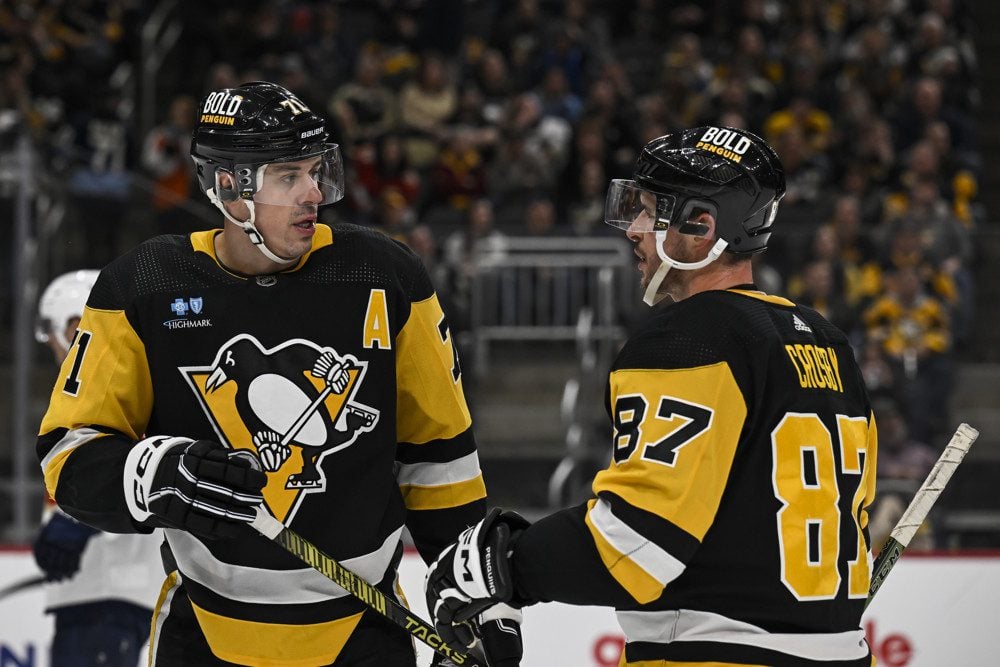
That’s pretty much the list of forwards over 40 having great seasons. This is where Dubas’s assessment of Malkin NOT being in the same bucket physically as Sidney Crosby or Kris Letang becomes crucial. Malkin had a resurgent year that bucked the trend of two years of increasing decline. The odds that he could maintain this season’s pace are small. IF Malkin returns, the projections will need to be much lower, and it would absolutely be plausible that the Penguins would schedule time off for Malkin (i.e. healthy scratches).
**Multiple reports that Geno wants 2 years. Should that be a deal breaker for Dubas? (Even if it’s NOT a 35+ contract) — Jim Stripsky
Sorry, there isn’t necessarily a report out there confirming this. A couple of people heard that was the holdup. Before the whispers and conjecture become perception, the important facts to know are Malkin did NOT say he wanted two years when he spoke to the media on breakup day. And none of the reporters or national folks chasing this story have that as fact.
To the question, a two-year deal for Malkin should firmly be out of the question. If that is indeed the ask, then Dubas’s comments could be seen as a direct rebuttal. Yes, an absolute deal breaker. No question.
**Of the current prospects in the system, who are the most untouchable, if any, at this point. Also who is most likely to be trade fodder — Awompa1
Great question, Awompa.
The short and dramatic reality is that if Dubas is going big-game hunting for “an impact” player in his mid or late 20s, no prospect can be off limits. None.
I would argue that the Penguins’ rebuild is getting interesting, and a big splash could appropriately be held to a little splash. The number of Penguins youngsters under 25 who could be in the lineup next season, combined with some of the later 20s veterans on the roster, such as Parker Wotherspoon and Blake Lizotte, and Sidney Crosby, creates a nice base.
The lineup could include any and all of the following: Ben Kindel, Egor Chinakhov, Elmer Soderblom, Bill Zonnon, Harrison Brunicke, Rutger McGroarty, Avery Hayes, Ville Koivunen, and Owen Pickering.
None are untouchable, but several could be key parts of the Penguins’ future.
**Which young goalie has the best chance to make the roster next year? –Greg
Since the organization chose Sergei Murashov over Joel Blomqvist as their playoff starter for the Wilkes-Barre/Scranton Penguins, it’s obviously Murashov, who had better stats (.919 save percentage) and has a higher ceiling.
My impression from comments around the organization and even from Murashov is that Blomqvist is not happy being in Murashov’s shadow. During his late season recall, Murashov was caught off guard and hedged when discussing the WBS net share. After some hemming and pauses, Murashov said the two have a “respectful” relationship. Murashov’s body language confirmed his words that it’s not a close or warm relationship.
It wasn’t long ago that Blomqvist was the heir apparent, and after a short but rough stint in the NHL, he was banished to the AHL for the last 18 months. One could expect Blomqvist to be the far more motivated of the two goalies this summer, which might pay dividends in the fall.
But people in the organization always include Blomqvist in the conversation. There will be an actual competition next fall, and I am not entirely convinced that Murashov is ready, primarily because his rebound control is still rough. A goalie can get away with a lot more mistakes at the AHL level that become red lights at the NHL level.
The organization is hoping competition brings out the best in everyone.
**How does Jake Livanavage factor into the Pens’ plans. Seems like he would be playing for WBS if he were a top tier prospect. — RJ
Easy, now. Livanavage wasn’t eligible to play in the AHL this season because he wasn’t on the roster by the AHL cutoff, which coincided with the NHL trade deadline on March 7. However, they didn’t sign him to an entry-level contract and let him play an NHL game simply for decoration. One would expect him to be in the competition for an NHL spot next fall. If he impresses, he could stay. If he needs some seasoning, then he goes to WBS.
As a left-handed defenseman, he’s currently in the mix with a gaggle of players, none of whom are guaranteed a spot, including Ryan Graves and Owen Pickering, for the third-pair left spot. Expect Dubas to bring in a free agent or two to compete for that spot as well.
**How does one square KDs open casting call for “20 somethings seeking opportunity” with the reality that if Geno returns there is one open forward spot (not even counting WBS guys). Are trades imminent this summer? –Kyle in Cryptoland.
Based on Dubas’s wishlist, there just has to be several Penguins trades, doesn’t there?
Dubas and coach Dan Muse seem to hold a higher opinion of Tommy Novak’s place in the lineup, but his performance in March and in the playoffs should be a red flag. The very same goes for Justin Brazeau.
If Dubas wants to move forward, incorporate more young players into the lineup, and attract free agents, there simply has to be a few Penguins trades.
**How about a trade for Ryan Graves and a first-round pick and a decent prospect for Elias Pettersson? Would you make that trade? Especially with the way Dan Muse has been so good at bringing out the best in most players? — Logan Kreinke
Absolutely not. No way, no how.
Pettersson has six years remaining on a contract that carries an $11.6 million salary cap hit. Even if Vancouver were to eat a good chunk of that, it’s still six years for a player who has tanked over the last two seasons, and the reasons for his struggles are entirely self-inflicted. His teammates and the organization have called out his dedication and preparation. New presidents of the organization, Daniel and Henrik Sedin, said their message to Pettersson was “preparation” and “culture,” where he has to lead.
Dan Muse and the Penguins’ player development are good, but they’re not Annie Sullivan. No matter the cost, it’s a hard pass until he shows the maturity and desire to be a winner. I also think 31 teams agree, especially at full boat because Vancouver has thus far refused salary holdback to make a deal.
Not even if Vancouver attached assets to make the deal. Right now, the Penguins simply cannot have a well-paid player who is not creating a winning culture.
**Trade Scenarios: Penguins: 2026 1st RD Pick, Koivunen, Novak. Ducks: Mason McTavish. –OR– Penguins: Girard, Brazeau, McGroarty, Pickering 2026 1st RD Pick 2027 1st RD Pick Maple Leafs: Austin Matthews — Douglas Penz
Nope.
First, that’s far, FAR too much for McTavish, who stumbled in the first year of a six-year, $42 million deal. And secondly, that’s not nearly enough, nor the right type of package for Matthews.
If Toronto trades Matthews, use the Mikko Rantanen deal as your guide. Colorado got a young player with similar potential and three more assets.
If Zonnon or Kindel are strong next season and show potential to rise above the 60-point center role, or if Harrison Brunicke shows himself to be a potential No. 1, that’s the level of pieces it will take for a big splash on the trade market. Right now, the Penguins have some magic beans in the form of draft picks, and some seedlings, but that’s all.
Dubas doesn’t really have enough pieces and parts to spare for a mega-splash like Matthews, but there are more attainable big fish, such as Jason Robertson. There are also a few players like Chinakhov, who could be available for the Penguin’ mixture of assets.
Robertson would be more attainable because he’s a winger, wants a big contract, and Dallas cannot afford him. Make no mistake, a deal for Robertson would cost dearly, but not as much as Matthews.
Lastly, we got so many questions that we’ll do a Part II on Sunday, but one name I’ll put on the table who would be a fitting target as he’s part untapped potential, part reclamation, and part potential top-of-the-lineup player is the Seattle Kraken’s Shane Wright. He would be an affordable lump of clay for Muse and the sports science department to elevate into a No. 1 center, or top-six winger for a long time.
Wright would check many of Dubas’s boxes. All except an impact player in his later 20s.
The post Penguins Q&A: More on Malkin, Trade Targets, and the Goalies appeared first on Pittsburgh Hockey Now.
Related Headlines
-
Penguins Grades: Rickard Rakell, the Hot Streak, & His Future
-
Dubas Presser: A Big Wishlist, Between the Lines, & Signaling Penguins Trades
-
Grading the Penguins’ Big Three: Crosby, Malkin & Letang
-
More Trades, More Moves–Why Penguins Can’t Be Quiet This Offseason