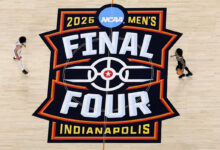
May 17—Even 39 years ago, NCAA tournament expansion was a hot topic.
In March 1987, days before the 49th edition of the tournament started, Dick Schultz, the chairman of the NCAA Division I Men's Basketball Committee, spoke to reporters about expanding the NCAA tournament — an almost annual tradition by that point.
The first bracket included eight teams in 1939. It doubled to 16 teams in 1951 and kept growing: 22 in 1953; 32 in 1975; 40 in 1979; 48 in 1980; 52 in 1983; 53 in 1984; and 64 in 1985.
Was 64 enough? That's what reporters wondered.
"Would an expansion to 96 teams alleviate the problem of filling the last few spots?" Schultz was asked.
"It wouldn't matter," Schultz said. "There'd still be parity in the last four or five spots, and we'd still have a difficult time picking them."
Then a reporter asked if the NCAA could have a tournament that included every Division I team.


"How about an all-comers tournament?"
"Realistically, we just can't do that," he said. "Logistically, it wouldn't work. We figured out that currently, with all the conference tournaments, 220 teams can play their way in. That's a large percentage (76 percent) of all Division I schools. The other 70 have the opportunity to get in by record."
Decades later, the NCAA tournament hasn't grown as large as those questions suggested it would. The field expanded to 65 teams in 2001 and 68 teams 10 years later. The latest move to 76 teams for men's and women's basketball will take place in 2027, after a decision by the NCAA earlier this month.
What does this mean for local programs?
The Dayton Daily News talked to Neil Sullivan and David Sayler, the athletic directors at the University of Dayton and Miami University, respectively, and Wright State men's basketball head coach Clint Sargent last week to get their thoughts.
JP Nauseef, the founder of the Big Hoopla, the event that celebrates the start of the NCAA tournament at UD Arena every year, also offered his opinions on what the changes mean for the NCAA tournament tradition at UD Arena.
A reason for expansionSullivan supports a larger field because it'll award a few teams every year from conferences like the Atlantic 10 that would have been left out in previous seasons. Expansion was inevitable, he said, with the growth of Division I and the emergence of mega-conferences such as the 18-member Big Ten.
Even though he supports expansion, Sullivan knows the A-10 won't benefit as much as the top conferences.
"The Power 4 really drove this expansion for the middle of their conferences," he said, "and schools like Dayton will have to fight them off hard."
The A-10 sent two teams to the NCAA tournament in 2026, but it would have been one if Virginia Commonwealth had not beaten Dayton in the A-10 championship game. VCU would not have received an at-large bid despite having what would have been a 26-8 record after the regular season and the A-10 tournament. A year earlier, VCU would also have missed the tournament with 27 victories if it had not beaten George Mason in the A-10 final.
In both seasons, VCU wouldn't have had to worry about winning the A-10 tournament if the field had numbered 76 teams.
Sullivan was also in favor of expanding the tournament because of the difficulty comparing teams that don't play each other and don't have common opponents.
Sullivan used the Miami RedHawks, Texas and Southern Methodist as examples. Miami received an at-large bid after finishing 31-0 in the regular season. Texas was 18-13. SMU was 19-12.
"Miami, Texas and SMU could not have gotten at-large bids by more disparate paths," Sullivan said. "Just completely opposite. I think SMU had 13 Quad 1 games, and Miami had zero. So with such an imbalance in good teams everywhere, we've been in support of (expansion) because I think it's becoming so statistically difficult to differentiate these teams. You can add all the metrics: Wins Above Bubble. You can have KenPom rankings. You can have all that. But the reality is that when the NCAA tournament expanded to 64 teams, I think there were only 280 Division I teams, so roughly 23 or 24% of the teams were in the field. Division I now has 365 teams, and only about 18 1/2 percent or so make the field. It's been a fundamentally different equation."
An unfair systemSayler does have an issue with tournament expansion in that he doesn't think it was the most pressing problem for the NCAA and it benefits teams in the Big Ten, Big 12, Southeastern, Atlantic Coast and Big East conferences more than anyone else.
"I'm honestly a bit mystified as to why this was the issue that we chose to deal with from a standpoint of I'm not sure who is really asking for it, and there are lots of other things that need to be addressed," he said. "So I was a little surprised that it became such a hot-button topic and issue. And I certainly wish there were some other things that the collective group that works with college basketball at the NCAA would deal with."
At the top of that list for Sayler is scheduling for programs like this. As Miami took criticism last season for the quality of its non-conference schedule, Sayler was vocal about Miami's efforts to create a tougher schedule and its failure to do so because higher-ranked programs refused to play Miami.
Miami had little margin for error just to get into the bubble conversation. One regular-season loss might have ruined its at-large chances.
"It's nearly impossible to get the big schools to play on the road," Sayler said. "They have everything stacked in their favor. The way the NET (NCAA Evaluation Tool) is calculated and the importance that's placed upon it, it clearly favors those Power 4 schools. So the issues of expanding the tournament just magnify the problems. (The system) already benefits the power schools, and now they actually get a little bit of an additional benefit with tournament expansion. When is it going to stop, and when is some leveling off going to happen? That's really what I would like to know. Is the whole industry going to be a bit more balanced and give a fair shot to everybody?"
Sayler knows the system will continue to favor the power conferences.
"It's the same problem you see every year with the 64-team format," Sayler said. "There are teams on the bubble that never go off the bubble. Those power conference schools have such a window. They can lose games and not be penalized, whereas when we lose a game, it's like it's all over. You're out. And that's going to keep happening. Those teams on the bubble, those power schools, now they're just going to get in the tournament. There's not even going to be that fear at the end that they might not make it."
A regular season that mattersLike Miami, Wright State plays in a conference where the only path — except in rare instances, like with Miami this past season — to the NCAA tournament is through the conference tournament.
The Horizon League last produced two NCAA tournament teams (Butler and Cleveland State) in 2009. Miami was the first MAC team to receive an at-large berth since 1999, when Wally Szczerbiak led the RedHawks to a historic season.
Sargent, who earned his first tournament berth as a head coach this past season, understands the viewpoint of the fans who think expanding the tournament lessens the importance of the regular season.
Many fans and national media members pointed to the examples of some of the first four teams left out of the 2026 tournament — Auburn (17-16) and Indiana (18-14) — as teams they don't want to see in the NCAA tournament.
"I think you want it to be as difficult as it possibly can be to make it in," Sargent said. "I'm just a big believer in the regular season mattering as much as it possibly can to drive competitiveness. It gets to the point where it gets too big, and now people are apathetic towards the regular season and regular-season championships."
The regular season will still matter as much as ever in most of the 31 Division I conferences.
"You always want to be able to schedule in a way that can improve your seed line and put yourself in the best possible position to create a great resume," Sargent said, "but, ultimately, we have to be great in our league to position ourselves to make the tournament. That's still my focus."
A change for DaytonThe expansion of the NCAA tournament means the end of the First Four, but Dayton's NCAA tournament tradition will continue. There will be six opening-round games at UD Arena in 2027 instead of four. Another site will also host six games on Tuesday and Wednesday in the first week of the tournament.
The 12 winners of opening-round games will advance to the round of 64, playing Thursday and Friday games in the first round against teams that did not play in the opening round.
Nauseef expects all the events The Big Hoopla has put on in the past surrounding the games in Dayton, such as a four-mile run, to continue.
"This is a 33% bump in teams, games, fans, excitement," Nauseef said. "This is a great outcome. I call it, 'The Bigger Hoopla.'"
UD Arena has been the site of 145 NCAA tournament games since it opened in 1969. That's far more than any other venue in the country. In 2024, UD won a bid to continue hosting the First Four through 2028. With six games in each of the next two years, the number of NCAA tournament games played in Dayton will climb to 157.
The First Four Local Organizing Committee hopes the tradition continues for years to come.
"That first year of Hoopla, we had the President (Barack Obama) and the Prime Minister (David Cameron) come at our invitation, and there was a big festival," Nauseef said, "and then the year after was the first time it sold out, and then in 2013, we sold out 10 games in a row. Then we had Charles Barkley and Dick Vitale in there last year and had the best TV numbers ever. Dayton has been a real part of the tournament because the people and the fans and the Dayton community and the basketball operation made it that way."