LAUREL, Md. — Long before he became the voice of the Triple Crown, before millions of viewers came to recognize the rhythm and rise of his calls on NBC broadcasts every spring, Larry Collmus was just a Maryland teenager standing alone in a tiny booth at Laurel Park.
He would watch the horses thunder down the stretch and practice race calls to himself, dreaming about one day getting his chance.
Forty-one years later, racing’s biggest stage is coming back to him.
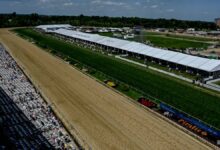
For the first time in its 151-year history, the Preakness Stakes will be run at Laurel Park this weekend while historic Pimlico Race Course undergoes a sweeping redevelopment project. And when the horses turn for home Saturday evening, the call will come from the same announcer who once sharpened his craft inside this very building.
For Collmus, the Preakness Stakes represent both a national assignment and a full-circle homecoming.
“Every year feels like a personal homecoming for me, whether it be Pimlico or Laurel,” Collmus said. “I spent so much time there, as the backup announcer and at all the tracks in Maryland. It’s a big deal to be that guy that gets to call the race for NBC. But it’s double meaning for me to come back to Maryland, where it all started, for sure.”
There might not be a person connected to this year’s Preakness who better captures the spirit of Maryland racing.
Collmus, 59, now lives in Monmouth Beach, N.J., and still spends much of the year moving with the racing calendar. But his roots are forever in Maryland. He grew up in the state and called his first race at Bowie Race Track as an 18-year-old in 1985 and worked as the assistant announcer at Laurel Park, Pimlico, Bowie and Timonium before building a career that carried him across the country.
His most significant career leap came in 2011, when Collmus was at Gulfstream Park in Florida and received a call from NBC executives about three weeks before the Kentucky Derby. Tom Durkin, the former voice of the Triple Crown and the Breeders’ Cup, was stepping down. Collmus initially thought someone was playing a joke on him. He remembered saying, “That’s Tom Durkin’s gig!”
By the end of a trip to 30 Rockefeller Plaza in New York City, it was his.
Four years later, when American Pharoah swept into Belmont Park with a chance to end racing’s 37-year Triple Crown drought, Collmus was no longer the kid practicing in an empty booth. He was the voice trusted with the moment. In 2018, when Justify completed his unbeaten march through the Triple Crown, Collmus was there again for one of the sport’s most iconic calls.
Yet Maryland remains his personal center of gravity.
A different kind of Preakness
This year’s Preakness will undoubtedly feel different.
There will be no packed Pimlico infield overflowing with black-eyed Susans, backyard traditions and generations of Maryland memories. Attendance at Laurel Park will be significantly smaller, with a capped attendance just under 5,000, while Pimlico undergoes a reconstruction project designed to modernize the historic track and preserve the future of racing in Baltimore.
Still, there is a uniqueness about Laurel becoming the center of the racing universe, even if only temporarily.
“It’s going to be a hugely different feel because of the capped attendance,” Collmus said. “It’s only going to be a few thousand of our friends there rather than the ruckus party that we’re used to. We’re certainly looking forward to that coming back when we get back to Pimlico because having that big crowd there is part of the feel.
“It’s going to be tremendously different to be at Laurel, but obviously it’s a step that has to be taken to get to the next place.”
Even now, after decades in the sport, Collmus prepares for races much the same way he did as a young announcer trying to break through.
Preakness week will bring production meetings, broadcast run-throughs and even one adjustment he cannot prepare for by memory. Because of the setup at Laurel Park, Collmus expects to call the race while sitting down from inside the “old announcer’s booth,” something he said he cannot remember doing at any point in his career. He plans to call several races from that spot Friday, during the Black-Eyed Susan Stakes, to get comfortable before the weekend’s main event.
Flash cards are never far from reach throughout the week, often tucked into Collmus’ pocket or strapped near his waist as he studies silks, post positions and jockey assignments with obsessive precision. Before post time Saturday, he will quietly repeat names to himself while scanning the horses through his binoculars.
Then, after NBC host Ahmed Fareed (traditionally Mike Tirico) tosses the broadcast upstairs, Collmus will take over.
For roughly two unforgettable minutes, one of Maryland’s own will guide horse racing through another historic chapter.
“It is a harrowing experience, but I wouldn’t switch places with anybody,” Collmus said. “I love the fact that I’m able to do it.”
Dave Rodman, the longtime voice of Maryland racing and one of Collmus’ close friends in the business, understands the care that goes into a call before the horses reach the gate.
“We’ve been up for the same job multiple times in our careers, and it’s funny how we land at different spots and continue to support each other and share our Maryland roots,” Rodman said. “We always collaborate before the Preakness about silks, who’s going to wear what. The preparation is a huge part of the process before a big race.”
When asked to describe Collmus, Rodman pointed to the balance that has made him one of racing’s signature voices.
“Accuracy and excitement are the two critical factors in big-stage races,” Rodman said. “And without going too over the top is imperative. He checks those major boxes.”
That dedication has helped make Collmus one of the defining voices of modern horse racing. Now the 151st Preakness Stakes brings him back to the place where his passion first captured him.
A Maryland announcer who once practiced from a small booth at Laurel Park is returning home this weekend to call the state’s signature race.
“I hope I don’t sound like I did 41 years ago,” Collmus said with a laugh. “I like to think I got a little bit better over that time. I’m still a kid when it comes to being at the track.”