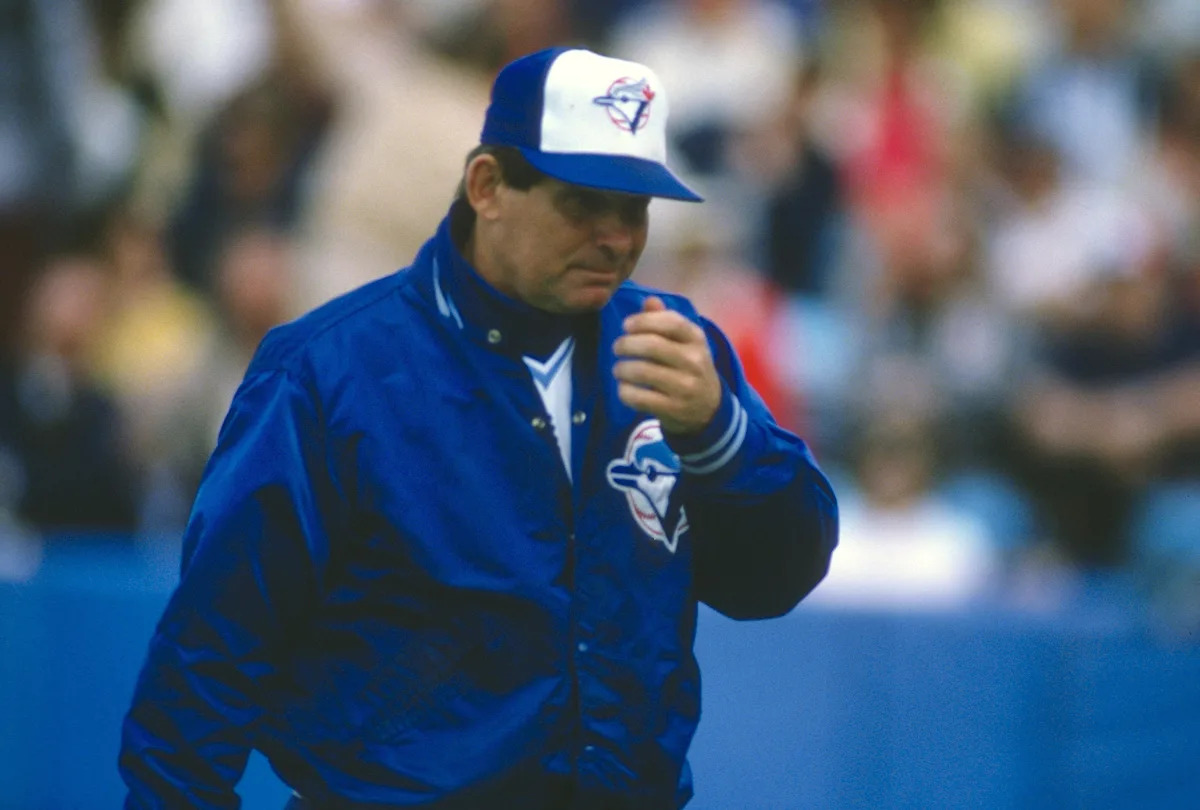
Bobby Cox passed away yesterday, just a few days short of his 85th birthday.
Cox became our third manager after Roy Hartsfield and Bobby Mattick. After five losing seasons, fans were frustrated and eager for change. Cox was the first manager who appeared focused on winning.
Cox had managed the Atlanta Braves for the previous four years, working to turn them into a contender. Progress was being made, but the 1981 season was disrupted by a players’ strike, resulting in a strange, split season where the Braves struggled in both halves. Back then, the team was owned by Ted Turner (who died just a few days before Cox), who loved the spotlight and wanted to be associated with a winning club. Turner didn’t want a losing team—he wanted admiration. Even so, he never seemed entirely convinced that firing Cox was the right move:
Asked at a press conference who was on his short list for manager, Turner replied, “It would be Bobby Cox if I hadn’t just fired him. We need someone like him around here.”
The Blue Jays moved quickly to hire Cox, recognizing the opportunity. It proved to be an inspired decision.
Bobby quickly identified players with limited ability and put them in platoon roles, maximizing their contributions.
In 1982, he implemented a platoon at catcher, dividing playing time between Ernie Whitt—who had hit just .236/.307/.297 the previous season—and Buck Martinez, a long-time backup whose on-base and slugging numbers were typically modest. Cox also paired two backup middle infielders at third base, left-handed hitter Rance Mulliniks and right-handed Garth Iorg, creating an effective left-right platoon.

In 1983, Cox devised an elaborate outfield platoon system: Dave Collins played left field against right-handed pitchers, while Jesse Barfield took over right field against left-handers, with George Bell shifting between the two positions as needed.
In 1984, Cox continued his platoon approach at designated hitter, using Cliff Johnson against left-handed pitchers and Willie Aikens against right-handers. The following season, Al Oliver became the primary DH versus right-handed pitching.
The catcher and third base platoons worked very well. 1983 Whitt and Martinez hit 27 home runs and drove in 89 runs between them. Cox doesn’t deserve all the credit. In 1982, Cox brought in Cito Gaston to be the hitting coach. Cito taught Whitt and Martinez to pull the ball, which they took to well, especially Whitt, whose swing became an all-out pull.
Arguably, one of the most important contributions Bobby Cox made was bringing in coaches Cito Gaston and John Sullivan. Cito’s story is well known, and the organization owes Cox a great deal for introducing him to the Blue Jays. Sullivan, meanwhile, remained with the team as bullpen coach until after the 1993 season.
In Bobby’s 4 years with the team, a number of our best players became regulars: Willie Upshaw, Jesse Barfield, Rance Mulliniks, George Bell, Jimmy Key, Jim Acker, Tony Fernandez and Tom Henke, to name a few.
His time with the Jays wasn’t an instant success. The Jays went 78-84, finishing 6th in 1982, but Cox had a lot of the parts in place that would move the team up the standings.
In 1983, the Blue Jays made a significant leap, finishing 89-73, though it was only good for fourth place. Ernie Whitt discovered his power, hitting 17 home runs in 123 games, while Willie Upshaw and Jesse Barfield each contributed 27 homers.
Cox benefited from the Jays’ farm system, which finally began producing major league-calibre players.
The Blue Jays matched their win total in 1984, finishing 89-73 for the second straight year. This time, they placed second, though they remained 15 games behind the Tigers, who dominated the league with a 104-58 record. George Bell became a full-time player for the first time, hitting 26 home runs and driving in 87. Rance Mulliniks broke through at the plate, batting .275/.373/.467, while Lloyd Moseby enjoyed his first standout year, hitting .315/.376/.499 with 18 home runs.
After four years under Cox’s helm and in our ninth MLB season, the Blue Jays finally reached the playoffs in 1985. Sadly, we fell to the Royals in a dramatic seven-game ALCS. Cox’s platoon strategies, which had been so effective, were ultimately exploited by Royals manager Dick Howser. With the Jays up three games to one, Howser countered by starting a right-hander and then bringing in a lefty during the middle innings, prompting Cox to remove his left-handed bats from the lineup. This allowed closer Dan Quisenberry—a submariner who was dominant against right-handed hitters but vulnerable to lefties—to avoid facing our left-handed threats. Coupled with the challenge of containing George Brett, who torched the Jays with a .348/.500/.826 line and three home runs, these tactical moves cost the team the series. Nevertheless, Bobby was named AL Manager of the Year for his efforts.
After the playoff loss, the Braves offered Cox their general manager position. He accepted and remained with Atlanta until 2010. The Blue Jays stayed playoff contenders for the next eight years and, of course, eventually won the World Series twice. It’s hard to imagine those championships happening without Bobby Cox’s influence—especially considering he was responsible for bringing Cito Gaston into the organization. Many of the players and coaches who played key roles in those playoff runs got their start under Cox.
Cox had a 2195-1698 record as a manager, the fourth-most wins in baseball history. He also holds the MLB record for most ejections, generally in an effort to keep his players from being ejected.
I always admired Bobby Cox. His commitment to platooning was remarkable. With today’s eight- or nine-man bullpens, it would be much harder to platoon at so many positions. I valued how everyone on his bench knew their role and had a purpose. Cox wasn’t afraid to put his faith in young players, giving them meaningful chances to prove themselves rather than moving on too quickly. With young pitchers, he often started them in the bullpen, letting them gain experience against big-league hitters in less stressful situations. I thought he was our first real manager; the previous ones seemed more like caretakers. There was no expectation of winning, and they didn’t do much to push the team towards it.
If Bobby Cox had stayed on after the 1985 season, it’s hard to say how much would have truly changed—and it’s probably not worth dwelling on. The Blue Jays got their World Series wins, and Cox enjoyed a remarkable run in Atlanta. I like to imagine he could have prevented the sudden decline after 1993, but in reality, he likely wouldn’t have stayed on as manager under Gord Ash. By that point, he probably would have wanted a general manager role instead.
Cox’s achievements with the Braves earned him a place in the Hall of Fame, but his time with the Blue Jays laid the foundation for the Blue Jays’ later success as well.