ARLINGTON, Tex. — Do the Chicago Cubs need another starter?
That’s one of the questions facing team President Jed Hoyer after Matthew Boyd’s left meniscus surgery, which followed the season-ending loss of Cade Horton and Justin Steele’s setback in his return from last year’s revision repair surgery on his left elbow.
It’s too early for trade rumors to start, but the San Francisco Giants dealt catcher Patrick Bailey to the Cleveland Guardians on Saturday, so pulling off a deal is not impossible.
In this age of tweeting for tweet’s sake, rumors are bound to pop up, including an erroneous report Friday that the Cubs had talks with the New York Mets about Freddy Peralta, which was picked up on mlbtraderumors.com before the team quickly shot it down.
Column: Ordinary day in an extraordinary run for Chicago Cubs, who post their 2nd 10-game winning streak
The report was retracted in a separate tweet, but that didn’t stop the internet, which never sleeps. It was picked up by aggregating websites focusing on Cubs news and discussed again Saturday on the team’s flagship radio station, WSCR-AM 670. Views of the original tweet and the retraction reached almost 600,000 as of Saturday night.
The tweet worked, even if it was wrong, the story of our times.
The Cubs did not respond to an inquiry Saturday. But with almost three months left until the trade deadline, they probably can count on dealing with more of the same kind of stuff — whether the rumors are valid or not.
Either way, the good news is that Boyd’s injury was deemed relatively minor, and he’s already working his way back. The hope is Boyd can return to the rotation sometime in June after incurring the freak knee injury while playing with his kids.
Jameson Taillon, who starts Sunday in the series finale against the Texas Rangers, spoke with Boyd and said he’s in good spirits and has been getting treatment at Wrigley Field during the trip.
“He takes incredible care of his body,” Taillon said Saturday. “He invests a lot of money in his recovery and his diet. He’s a great dad and was just playing with his kids. He was like ‘That’s how I’m going to go down?’ But he’ll be back, and he’ll be better and will help us.”
Meanwhile, the combo of Ben Brown and Javier Assad, who combined for 7 2/3 scoreless innings in Friday’s 7-1 win over the Rangers, could reduce Hoyer’s urgency to make a move that would cost the Cubs any top prospects.
Manager Craig Counsell said Saturday that he needed to be careful with how he stretched out Brown and wasn’t sure how often he could use both in the same game to eat up the bulk of the innings. With the Cubs’ injury luck, Counsell basically has to go into prevent-defense mode.
“Where we’re at with starting pitching right now, unfortunately you always have to look to ‘What’s next?’” he said. “We’ve got to have guys stretched out just to handle the innings if something else happens.”
The foursome of Shota Imanaga, Taillon, Edward Cabrera and Collin Rea doesn’t exactly resemble “Maddux-Smoltz-Glavine,” the core of the great Atlanta Braves rotations of the Bobby Cox era. They have only one All-Star appearance among them — Imanaga’s selection in 2024, when he pitched for the National League at Globe Life Field.
But entering Saturday’s game in Texas, the Cubs were a major-league best 27-12 with a 20-3 since April 14, with a pair of 10-game winning streaks for the first time since 1935. The starters were a combined 11-2 with a 3.51 ERA in the 23-game stretch, sixth-best in baseball.
Imanaga is 4-1 with a 2.01 ERA in his five starts in the stretch, followed by Taillon (2-0, 3.80 ERA), Rea (2-1, 4.35 ERA) and Cabrera (2-0, 4.38). Boyd (1-0, 5.52 ERA) struggled the most before his knee injury.
Cabrera, who took the mound Saturday in search of the Cubs’ 11th straight win, allowed three earned runs or fewer in all seven of his previous starts.
Fans always want their teams to add pitching, no matter the cost. Do Cubs players have the same attitude?
Related Articles
-
Column: Ordinary day in an extraordinary run for Chicago Cubs, who post their 2nd 10-game winning streak
-
3 numbers that stand out in the Chicago Cubs’ 9-game winning streak: ‘It’s pretty special’
-
Chicago baseball report: Cubs adjusting arms on the fly — and White Sox prospect Hagen Smith making strides
-
Chicago Cubs complete sweep for 9th straight win overall and 15th in a row at ‘electric’ Wrigley Field
-
Column: Matthew Boyd’s freakish injury brings back old myths about Cubbie Occurrences
“We all know what our goals are here,” Taillon said. “So if there is a way to make our team better, I think every single player would answer with a resounding yes if it would make the team better.
“But we talked all spring about the depth we have, and Ben Brown is out there throwing four pitches (Friday) night. He’s added a sinker (to his four-seamer and knuckle-curve) and is trusting his changeup a little bit. I saw a dude who is evolving in front of our eyes and matured a lot. You feel good every time he’s been out there.
“And Javy Assad, there’s no ego. He’s been put in some tough spots the last couple years, been sent down because he has options and the way the roster management has worked. He’s been a pro about everything and works his tail off and competes. In my eyes he’s a big-league starting pitcher. It’s a really nice luxury to have.”
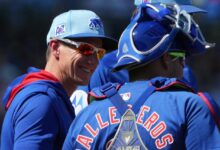
The one certainty is that Counsell is not using the Cubs’ hot streak as a reason to stick with the status quo. He started Michael Conforto again at DH on Saturday over Moisés Ballesteros, who cooled off on the last homestand, hitting .091 (2-for-22). Conforto was 8-for-17 (.471) with two home runs in his last eight games.
“Michael, he’s been on it,” Counsell said. “And Mo has not been on it. So that makes it a little bit easier. If I could’ve played 10 guys, I would’ve played 10 guys.”
Counsell said he didn’t have to talk with Ballesteros to explain the decision-making, and that players understand when someone else is producing more for them. After all, it’s not Little League.
There wasn’t much to worry about on a 90-degree night in Texas. The air-conditioned ballpark made everything comfortable inside, and the Cubs were as hot as they’ve been in 91 years.