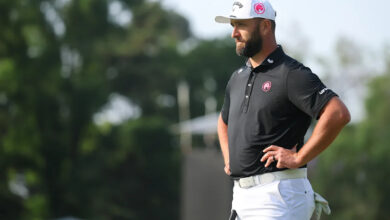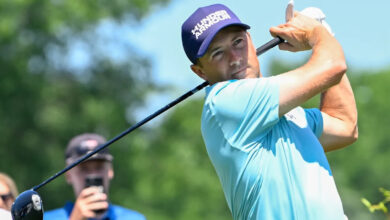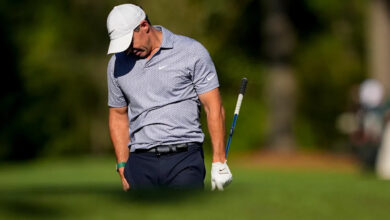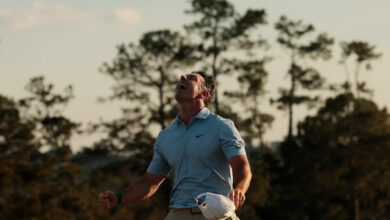
NEWTOWN SQUARE, Pa. — They’ve won four of the last five majors between them. They’re without question the two best players in golf, both on trajectories to join the game’s historical greats. Yet somehow, they’ve never squared off on a major Sunday.
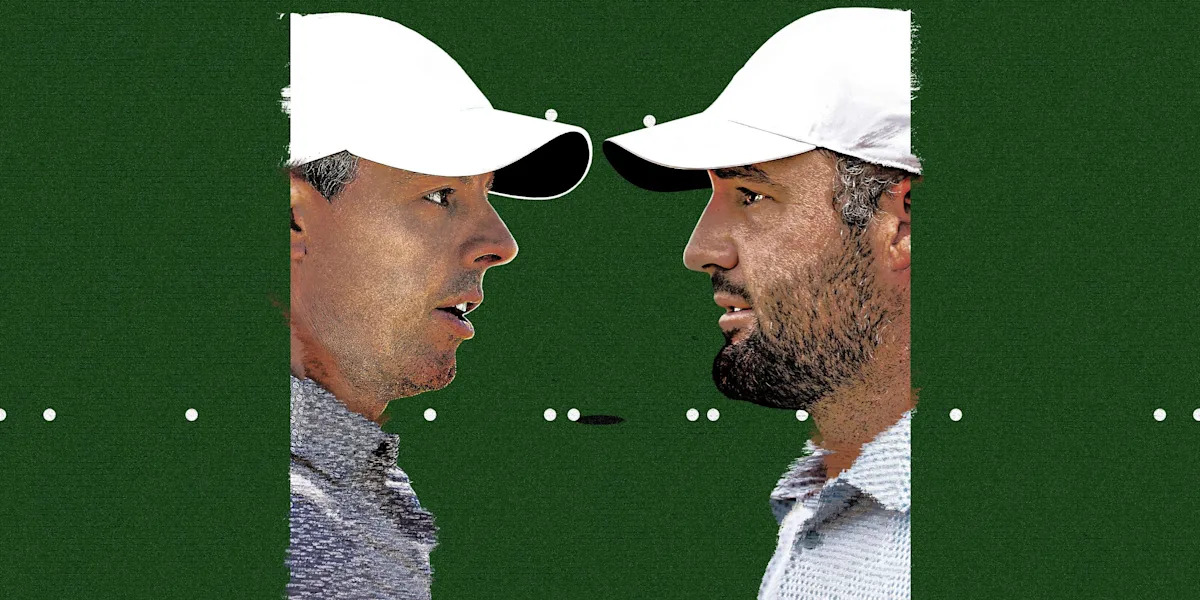
Scottie Scheffler vs. Rory McIlroy. Head to head. You want it. I want it. The entire golf world wants it. So why hasn’t it happened yet? And could it happen this week at Aronimink?
McIlroy and Scheffler have done battle head-to-head before — in the Ryder Cup singles match at Bethpage last year, where Scheffler won 1-up, and at the 2025 Optum Golf Channel Games, where Scheffler won by a single inch. Yes, really.
Play 2026 Soccer Pick 'Em with FOX One and make your picks for the world's biggest soccer tournament
“He's a guy I always see in the gym, the practice facility,” Scheffler said of McIlroy recently. “If we're playing the same tournament, we see each other a lot because we're all doing the same things in order to get ready.”
Yet somehow, they both never seem to be ready at the same time. In the 17 majors held since the start of 2022 they’ve both finished in the top 10 in the same tournament just seven times. Consider how their signature major wins and near-wins have gone over the last four-plus years:
(Josh Heim/Yahoo Sports illustration)

2022 Masters: The leaderboard shows that Scheffler won and McIlroy finished second, three strokes back. The leaderboard doesn’t tell the whole story. Scheffler ran away with this tournament, and McIlroy started the final day 10 shots back but crafted one of his classic pressure’s-off charges up the leaderboard.
2022 Open Championship: McIlroy lost in the final holes to Cams — Smith and Young — while Scheffler was a nonfactor at T21.
2023 U.S. Open: This one could’ve been a contender were it not for Wyndham Clark having the tournament of his life. Clark beat McIlroy by a stroke; Scheffler was two behind McIlroy.
2024 Masters: Scheffler won; McIlroy was irrelevant to the final at T22.
2024 U.S. Open: McIlroy and Bryson Dechambeau dueled for the trophy; Scheffler, vexed by the Pinehurst rough, was T41 — the last time in the past nine majors he’s finished outside the top 10.
2025 Masters: McIlroy famously claimed this one, at long last, and Scheffler had the grace to finish three strokes back of the McIlroy-Rose playoff.
2025 PGA Championship: Scheffler ran away with this one at Quail Hollow; McIlroy, still reeling from post-Masters euphoria, ended up T47.
2025 Open Championship: Another major, another Scheffler stomp. McIlroy at least roused himself into a top-10 finish for this one, though he was never a factor and finished six strokes behind Scheffler.
2026 Masters: The reverse of the 2022 Masters. Scheffler fought back from deep in the field to finish solo second, but McIlroy came to the 18th needing only a bogey to hold him off and avoid a playoff. After a nerve-wracking tee shot — it’s McIlroy, what else would you expect? — McIlroy got the bogey and the second green jacket.
The vastness of tournament fields means that it’s rare two players at the top of the game meet up for a face-to-face Sunday afternoon duel. For every Jack Nicklaus-Tom Watson Duel in the Sun, there are a dozen battles with less name recognition, and three dozen runaway majors. The drama is always there, even if the star power isn’t.
Scheffler and McIlroy are currently ranked No. 1 and No. 2 in the world, by a wide margin. The distance in world ranking points between McIlroy and No. 3 Cameron Young is about the same distance between Young and No. 11 Xander Schauffele. (Of course, the distance between Scheffler and McIlroy is about the distance between McIlroy and No. 30 Patrick Cantlay, but we’ll leave that aside for now … along with the question of where DeChambeau and Jon Rahm fit in this mix.)
Both speak eloquently about the other’s skills. McIlroy has praised Scheffler’s “relentlessness,” adding that “I think his faith has a big part to do with how comfortable he is with doing that because he accepts whatever happens, whatever comes his way, and he moves on. … There's not a lot of volatility there in his life and in his game, and I think that sets him up so well for the future.”
“His ability to drive the ball is … it's the best that I've seen,” Scheffler said of McIlroy before the Cadillac Championship a few weeks back. “Not only with his speed, but how accurate he is as well. He's able to take out certain things on some golf courses that not many players can do. He does it in a way where he hits a lot of fairways as well.”
Aronimink, site of this week’s PGA Championship, sets up well for both players to have a strong week — McIlroy because it’s a bombers’ paradise, Scheffler because … well, every course sets up well for him. The two rank first and third on the PGA Tour in scoring average, first and second in birdie average, first and fourth in overall strokes gained, with Scheffler leading all. The numbers point to a Scheffler-McIlroy showdown, and so do the vibes.
McIlroy begins his PGA Championship at 8:40 Thursday morning, while Scheffler goes off at 2:05 Thursday afternoon. And with any luck, they’ll be teeing off a whole lot closer to each other on Sunday.