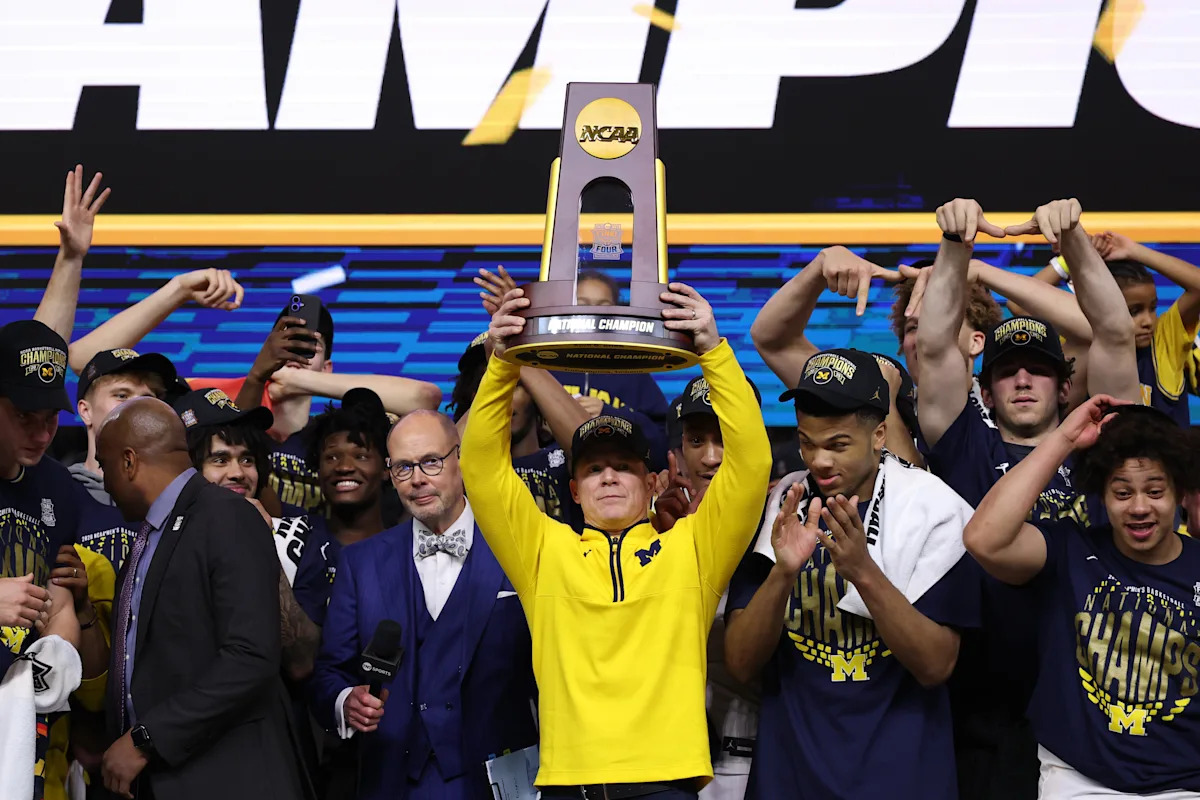
It’s been a big year for the Big Ten.
When Indiana won the College Football Playoff in January, the conference celebrated its third consecutive national championship on the gridiron. Over the past week, Big Ten teams emerged as the last ones standing in this year’s March Madness, with Michigan winning the NCAA men’s tournament and UCLA claiming the crown in the NCAA women’s tournament.
The Big Ten is the first conference since the SEC in 2007 to sweep the national titles in those three sports. That year, Florida football and men’s basketball hung banners, and Tennessee women’s basketball added to its growing trophy case under Pat Summitt.
But there’s more that comes with the Big Ten’s latest display of dominance than just pride. The conference’s success in the 2026 NCAA tournaments has earned it some big bucks. In fact, according to a Thursday report from the Associated Press’ Eric Olson, the Big Ten made at least $69.4 million in incentives from this year’s March Madness, including $63 million on the men’s side, the most among the conferences.
Nine Big Ten teams made this year’s men’s tournament, with Michigan and Illinois both advancing to the Final Four. Twelve Big Ten teams got into the women’s field of 68, with UCLA headlining that bunch.
Since 1991, in the men’s tourney, the NCAA has pulled from the money it makes from tournament broadcast deals to reward conferences for team appearances and performances, according to the AP, which reported that a similar, albeit less lucrative, system was put in place for the women’s tourney last year.
The NCAA pays the conferences directly. From there, the conferences follow their own policies to dish out the money to the programs that earned incentives. Conferences won’t start to receive payments for the 2026 tournaments until April 2027, per the AP.


The payments are reportedly paid out over six years on the men’s side and over three years on the women’s side.
How much are Michigan’s and UCLA’s titles worth?
How much money each participating tournament team earns depends on how many “units” they rack up. The AP broke down the payout structure as such:
-
A unit is acquired for every tournament game a team plays in. An extra unit is granted to the championship team. So because Michigan men’s basketball played six games and won the national title, it will end up with seven units. The same goes for UCLA women’s basketball.
-
While the value of a unit reportedly increases each year, units carry different weight in the men’s and women’s tournaments.
-
The AP, citing an NCAA spokeswoman, reported that the estimated value of a unit for this year’s men’s tournament will be around $350,000 per year. In other words, over the six-year payment cycle, one unit will amount to at least $2.1 million. Quick math tells you that Michigan’s run should earn the Wolverines $14.7 million or more in incentives.
-
The value for a unit in this year’s women’s tournament was $75,000, per the AP. That value will reportedly dip to $63,000 next year while the NCAA fully funds the system. In its calculations, the AP used that $63,000 number as an estimated value for a unit in 2028. Following that projection, one unit would amount to at least $201,000 over the three-year payment cycle. Along the way, UCLA women’s basketball will bring in north of $1.4 million in incentives for its march to the top of the sport.
The titles the Wolverines and Bruins won were monumental. UCLA women’s basketball had never won an NCAA championship, let alone played in an NCAA championship game. The program’s victory accounted for the Big Ten’s first women’s basketball national title since Purdue’s in 1999.
Meanwhile, Michigan men’s basketball ended its streak of runner-up finishes with its first national championship since 1989. The Wolverines getting over that hump meant that the Big Ten ended its two-plus-decade national title drought on the men’s side, too. That dry spell began after Tom Izzo’s Michigan State went the distance in 2000.