The Philadelphia Flyers have managed to score just three goals over the course of their last three playoff games, and if they continue to struggle, they will suffer a swift exit at the hands of the Carolina Hurricanes.
Already down 2-0 in the series and dealing with multiple injuries, the Flyers need a group of their stragglers to both up their game and account for their fallen teammates.
Defenseman Rasmus Ristolainen leads the Flyers in playoff points so far with five in eight games, while his fellow blueliners, Travis Sanheim and Jamie Drysdale, are two of the team's three total players with multiple goals this postseason.
That might have worked against a mediocre team like the Pittsburgh Penguins, but it certainly won't fly against a Stanley Cup contender like the Hurricanes.
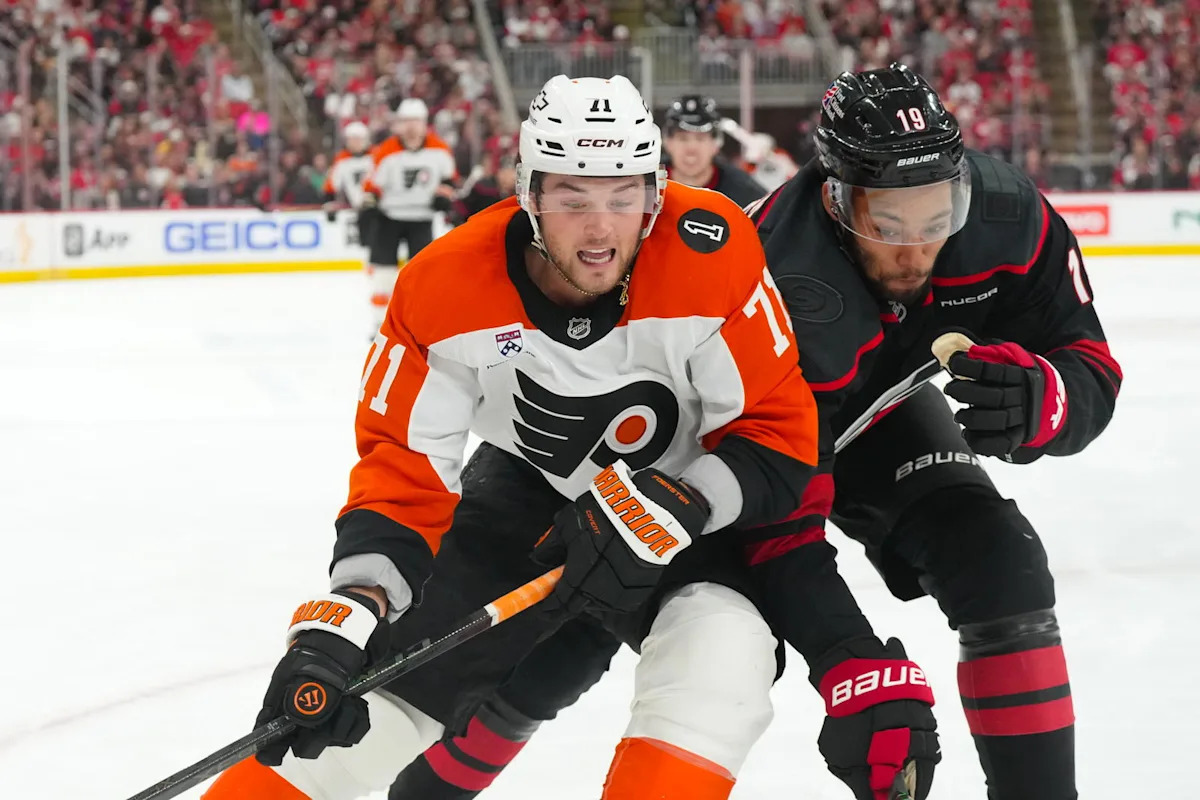
The obvious place to start with these struggles is at wing, where Tyson Foerster, despite playing in all eight playoff games for the Flyers thus far, is stuck in second gear with zero points.
Defenseman Emil Andrae is the only other Flyer without a point, and he's played in just three games averaging 11:06 of ice time. Foerster averages a whopping 18:31.
The reason Foerster has so much to prove, especially right now, is because of how many other options the Flyers have at his position.

Owen Tippett In or Out? Flyers Face Important Lineup Decisions
Owen Tippett In or Out? Flyers Face Important Lineup Decisions The Philadelphia Flyers offered injury updates on Owen Tippett and Christian Dvorak.
Alex Bump always looks like such a dynamo with the puck on his stick, and Denver Barkey is quickly becoming a coach's favorite due to his competitiveness, mobility, and positional versatility.
Foerster has one year remaining on his contract at a $3.75 million cap hit and has yet to develop his playmaking and skating, and he has to compete with the likes of Owen Tippett, Matvei Michkov, Porter Martone, Bump, Nikita Grebenkin, Jack Berglund, and more for a spot in the lineup, both now and in the future.
The hallmark of the 24-year-old's game is his shot; Foerster scored 13 times in just 29 games this season and tallied 45 goals over the previous two years.
The playoffs, though, are exposing Foerster's one-dimensionality, and as a young player, he will need to evolve and show the Flyers something before the end of the postseason to re-solidify his future in Philadelphia.
Continuing at the winger position, we have to put Travis Konecny in the spotlight.
The Flyers' highest-paid player with an $8.75 million cap hit, Konecny has just one goal and four points in eight games this playoff run, and notably came up short on a breakaway in overtime in Game 2 that would have otherwise sent the Flyers back to Philadelphia with a series tied at 1-1.
Konecny, 29, has always been in the crosshairs of fans due to his historic playoff struggles, producing just two goals and 12 points in his 30 career postseason games to date.
It's a bit odd, too, considering that Konecny has scored 30 goals twice in his career and has recorded no fewer than 60 points in each of the last four seasons.
Flyers Mock Draft 1.0: Looking for another Lane Hutson?
Flyers Mock Draft 1.0: Looking for another Lane Hutson? If they're lucky, the Philadelphia Flyers can get their own Lane Hutson by selecting Xavier Villeneuve in the 2026 NHL Draft.
He, more than anyone, should be a player the Flyers can rely on in crunch time, but he is not the one driving the bus for the team.
Last but certainly not least is Matvei Michkov, whose struggles have been well-documented at this point.
The 21-year-old looked great in overtime in Game 2 and helped produce the game-winning moment in Game 6 against the Penguins, but one point in seven games is objectively not strong enough for a player with his talents.
Noah Cates, Michkov's center for most of the season, is out for the rest of this series against the Hurricanes, so the odds favor Michkov playing on a more offensively-oriented line for the last few games.
The Russian phenom will probably never be a player who creates offense with his own legs, but he always know where to be and when in the offensive zone and constantly seeks open ice and advantageous scoring positions.
With the Flyers dying for offense, now is the time for Michkov to arrive and prove himself.