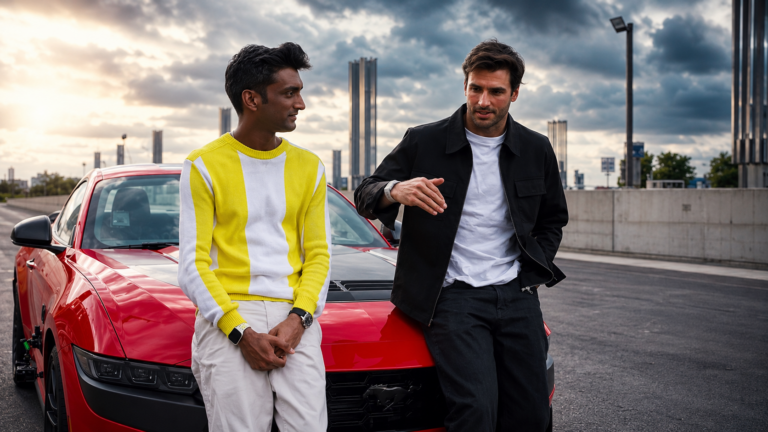
Formula 1 is heading back to Madrid for the first time in 45 years, and the man doing the honors of christening the asphalt is exactly who you’d expect it to be. Williams driver Carlos Sainz has completed the first laps of the Madring circuit, doing so in a 450bhp Ford Mustang GT with F1 presenter Lawrence Barretto riding shotgun.
Sainz is the circuit’s official ambassador, which makes him the natural choice to put the first rubber on a track that will host the Spanish Grand Prix come September. The lap was exploratory at first – a slow tour to take stock of what’s there – and then considerably less so.
Sainz’s verdict was clear through his face alone. His overarching conclusion on the 5.4km, 22-turn circuit is that it’s faster than it looks, largely because of the purpose-built high-speed section that dominates the second half of the lap.
“I think it’s something very difficult to describe for me because it’s something that I always dreamed about, you know, just having the opportunity to race at my hometown,” the Spaniard said. “Madrid is a great city, a city that I’ve always talked well about, a city that now is getting to be known quite a bit more, and that now having this Formula 1 track will be amazing.”
He added: “The atmosphere will be incredible. I think Madrid is a city that welcomes a lot of these big events. Obviously, we’re known for the Real Madrid team, but apart from that, we have so many other things going on during the year. And I’m sure this event will be the biggest one yet. And I think you guys are gonna enjoy it.”
What Makes the Madring Different From Any Other Street Circuit
The Madring takes advantage of public roads alongside a purpose-built section, earning it the hybrid street circuit label.
During the lap, Sainz and Barretto talk through how that split personality plays out in practice. The IFEMA paddock section runs tight and urban – 90-degree corners, long straights, walls close enough to concentrate the mind – before opening up into something altogether more unusual.
The straight between Turn 2 and Turn 4 runs a full kilometer, described by Sainz as a continuous curve rather than a true flat section. Carrying speed through it without lifting, he says, is going to require commitment. Then comes an elevation change over a highway bridge – the car crests a blind rise and drivers will be on the brakes without being able to see the apex below. That kind of feature tends to separate drivers quickly.
The signature piece, though, is La Monumental.
La Monumental at Turn 12 is a 24% banked bend stretching 550 metres, which Sainz has highlighted as the potential icon of the circuit. It goes up and then back down across its length, meaning the banking isn’t static – drivers will be managing load while the geometry is shifting under them. Sainz compares the concept to Zandvoort’s banked corner, La Monumental being a sweeping right-handed banked curve similar to the banked Luydenyk corner at Zandvoort.
The difference is scale: at 500 meters, it’s expected to be the longest banked turn on the Formula 1 calendar.
Grandstands will wrap both sides of the curve, with capacity for up to 45,000 fans forming what Sainz describes as a tube of spectators around the corner – an image that tracks well with the circuit’s ambition.
“Last year, I got an ambassadorial role here and I wanted to make sure I could help as much as possible the circuit to do a good job in Formula 1,” he told his passenger. “As I said before, I love this place, I love Madrid, I love this… the atmosphere here. I love coming back to Madrid every time I can. I wanted to make sure the story was a success.”
Hurtling out of the half-oval, Sainz expects the tight Turn 13 left-hander to be a key overtaking opportunity, before a series of high-speed Valdebebas esses, which remind him of Spa and Silverstone, brings the lap back toward the IFEMA complex.
The width throughout, he argues, is the detail that most distinguishes Madring from other street-style venues. More room means more lines, and more lines means drivers can actually set up overtakes rather than just hoping the car ahead makes a mistake.
“It iss wide and I think it’s gonna create the ability to overtake because I think at least the width is something we sometimes miss in street tracks. As you see, for example here, after those high-speed corners, we have a small straight and you arrive into a wide braking zone, which always as a driver gives you more the impression that you can maybe throw a move.”
During the hot laps, Barretto discovers first-hand what the banking does to lateral grip. The car simply doesn’t want to slide, the angle forces it to stick, which leaves Sainz pushing harder through the Monumental than he’d expected to on a first pass. He opens the throttle on the sections the track allows and visibly tests the limits on the sections it doesn’t, sliding the Mustang through a couple of corners while Barretto hangs on, equal parts terrified and delighted.
“This is gonna be properly quick,” the Williams driver said. “I mean it’s gonna be 1 kilometer flat out from Turn 2 to all the way down to Turn 4. And it’s a bit in-turn, so it’s not gonna be as easy maybe as it seems now. Like it’s all gonna be turning, turning, turning, like a very long parabolica, but all easy flat out before you arrive to this big braking zone here under the bridge.”
The race will mark F1’s return to Madrid for the first time in 45 years, following the sport‘s last appearance in the city at Jarama in 1981.
Sainz grew up here, started karting here, and watched his father, two-time World Rally Champion Carlos Sainz Sr., retire from rallying in front of thousands lining Madrid’s main streets. That moment, he says, was probably the first time he truly grasped how deep the motorsport following ran in the city.
The Madring will host the 2026 Spanish Grand Prix on September 13.
Near the end of the cooldown lap, Sainz looks across at Real Madrid’s training ground just beyond the barrier
“It’s a bit of a sporting hub now Madrid, isn’t it?” he said. “You’ve got two massive football teams. You’ve got stages of the Vuelta as well… Madrid Open tennis… And now you’re gonna have this. It must be cool to grow up round here and to see this massively.”
Whether the circuit lives up to the ambition of its signature corner remains to be seen in September. But if Sainz’s expression at the end of those first hot laps is any measure of what’s coming, the wait looks worth it.