When Jackie Stewart clambered out of the cockpit of his Matra MS10 after the rain-drenched 1968 German Grand Prix, he had no idea that he was about to bequeath motorsport one of its most iconic nicknames. “I said Nürburgring was like the most difficult and the most dangerous circuit of all: The Green Hell,” the Scot later recalled.
Stewart was not lying. Although he won that race by four minutes, in what is widely considered one of the greatest victories in the history of Formula One, he was in a state of shock by the finish. Even on a dry, sunny day, the demands of the old Nordschleife – 22.835km (14.189 miles) through dense, tree-lined hills, with concrete walls, high curbs, and steep drops right at the edge of the tarmac – were intense. On this day, the rain and fog was so severe that Stewart, starting sixth, could not see the cars in front of him. In his autobiography Winning is Not Enough, he described the race as a “teeth-gritting effort”, recalling of that first lap: “Visibility is so pathetically poor I can’t even see Chris’s [Amon] car in front of me […] I am simply driving into this great wall of spray. I pull out to pass him but the spray is dense and I’m driving blind.”
All of which helps to explain why there is so much interest in Max Verstappen’s participation in the Nürburgring 24 Hours this weekend. There is a mythology that has built up around the Nordschleife. While Formula One no longer races around the old circuit – the last time a grand prix was held there was in 1976 when Niki Lauda almost died in a fiery accident immortalised in the film Rush – sports cars still do. And the prospect of a four-time F1 world champion, almost universally regarded as the best F1 driver on the grid right now, taking part in such a different type of motorsport, on such an iconic track, has clearly captured the public’s imagination.
Four-time world champion Verstappen is doing something no active F1 driver has done before – Mark Thompson/Getty Images
For a start, and for the first time since 1970, the event is a complete sell-out.
Nürburgring 24 Hours is not the Le Mans 24 Hours. It does not have the same prestige. Nor is it Daytona, North America’s most prestigious sports car endurance race. The Nürburging 24 Hours has always been a big draw for committed petrolheads, who camp in the forests and light fires along the banking. But this year, thanks to Verstappen’s participation, interest has exploded. Nearly 300,000 fans are expected across the four days of the race weekend, with ADAC, the German automobile club which organises the event, already having to pull the Dutchman out of the opening ceremonial parade, and the meet-and-greet and autograph sessions, arguing it would pose a safety risk.
At least part of the fascination has to do with the risks involved.
Precise figures are hard to come by, but the Nordschleife has claimed the lives of at least 70 drivers down the years. And that is not including marshals or spectators, or indeed members of the public who choose to take on The Green Hell in their own cars. The circuit hosts regular “Touristenfahrten” (tourist drives) when anyone with a valid license and a road-legal vehicle can take part.
These days, as the safety of the cars and the marshalling and the circuit itself has improved, the majority of fatalities occur in those public sessions. But a stark reminder of the dangers involved arrived last month when Juha Miettinen, a Nordschleife veteran at 66, was killed in a seven-car accident around 25 minutes into a planned four-hour Langstrecken-Serie (NLS) race. The tragedy received more than the usual amount of coverage since Verstappen himself was taking part in the race, albeit not on track at the time. “Shocked by what happened today…” Verstappen posted on Instagram afterwards. “Motorsport is something we all love, but in times like this it is a reminder of how dangerous it can be. Sending my heartfelt condolences to Juha’s family and loved ones.”
Amateur racing driver Juha Miettinen, 66, was killed in an accident at the circuit last month
Even earlier this week, there was a very scary incident during qualifying in when the No 146 Porsche of Michelle Halder, Janina Schall, Carrie Schreiner and Fabienne Wohlwend careered into the back of the stranded No 900 Porsche, very nearly hitting driver Alexander Hardt who had got out of the No 900 and was waving his hands trying to slow oncoming traffic. Hardt was fined €300 fine for a breach of Article 13.9, “not going to a zone of safety in the fastest way”.
This is the thing you have to understand about the Nürburgring 24 Hours. The field is enormous and consists of various different categories. Unlike a single-class endurance race such as the Rolex 24 at Daytona, or even the multi-class but relatively streamlined Le Mans, the Nürburgring 24 Hours operates across a vast span of performance and driver categories simultaneously. The 2026 entry list had 161 cars across 23 classes. This means that as they lap through the night, possibly in wind and rain, you have drivers like Verstappen in GT3 cars, passing touring and production cars which are predominantly gentleman-driver and club-racing entries. The slower cars might be 30-40 seconds per lap slower across, meaning the closing speeds can be enormous – ironic when you consider some of the negativity around Formula One at the moment.
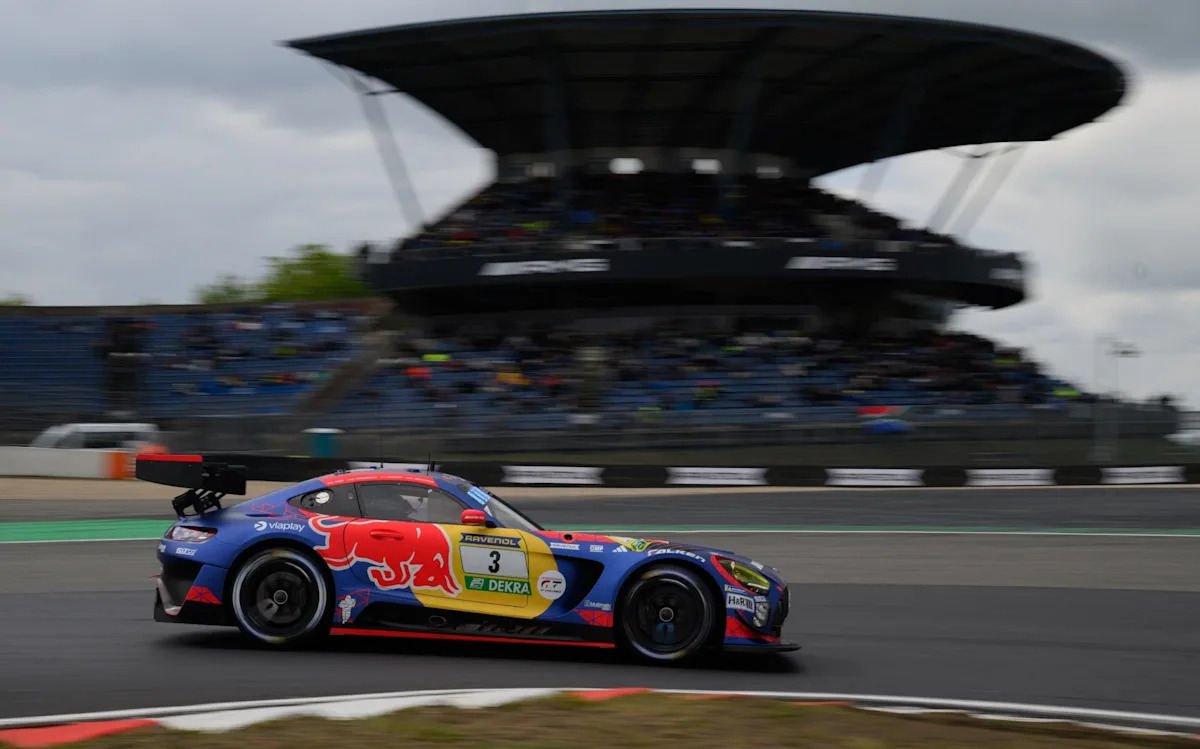
But that is exactly why there is so much interest. Verstappen may well be the fastest driver in the world. And he may well be racing against a handful of other GT3 cars (the “SP9” entries, the highest category, number 41 this year, with Verstappen advancing his team of three into final qualifying on Friday and his team-mate Dani Juncadella putting their No 3 Mercedes-AMG GT3 Evo fourth on the grid). But he will still have to navigate the 25.3km Nordschleife layout in the dark – something he only did for the first time on Thursday – passing much slower cars in the process, with all the risks that involves.
To say this is unusual for a Formula One driver would be putting it mildly. Plenty of F1 drivers (more than 30) have entered the Nürburgring 24 Hours in the past. But not active ones, and none with four world titles to their name. Of those, Lauda is the only F1 world champion to have actually won the race, in 1973, near the start of his F1 career. Verstappen deserves huge credit for giving this a crack, and so do his Red Bull team for letting him. With all the moaning about F1 at the moment – particularly from Verstappen himself, who has likened the current era to “Mario Karts”, calling it “anti-racing” – there is a real sense of shining a spotlight on a different type of racing. “Real” racing.
Verstappen is a racer’s racer. He has already said he wants to do this every year. Perhaps he will quit F1 and focus on it entirely at the end of this season. “What inspired me the most is that it’s one of the best tracks in the world, or the craziest track in the world, in a good way, that you can race at,” he said recently. “It is one of these special races that you just want to compete in and win. It’s probably going to be the best feeling [racing in the dark]. You’re by yourself, pushing in the night. The car is normally fastest in the night, so I’m looking forward to it.”
Verstappen says he is looking forward to driving in the dark, as ‘the car is normally fastest in the night’ – Christian Kaspar-Bartke/Getty Images
It is a fascinating prospect, although he would be wise to remember Stewart’s words. When I went out to see the Scot in his Geneva home last autumn we spoke a bit about the Nürburgring, and the death threats he received from German fans when, as president of the drivers’ association, he pressured to have the Nordschleife temporarily removed from the calendar for safety improvements (it was eventually replaced entirely by the modern-day Nürburgring). Stewart described the Nürburgring that day as the “best racing track in the world” but added: “Anybody who says they liked the original circuit is either telling a fib or they didn’t go fast enough.” It has changed a bit since then but it still remains a beast. Verstappen’s Green Hell awaits.
Try full access to The Telegraph free today. Unlock their award-winning website and essential news app, plus useful tools and expert guides for your money, health and holidays.