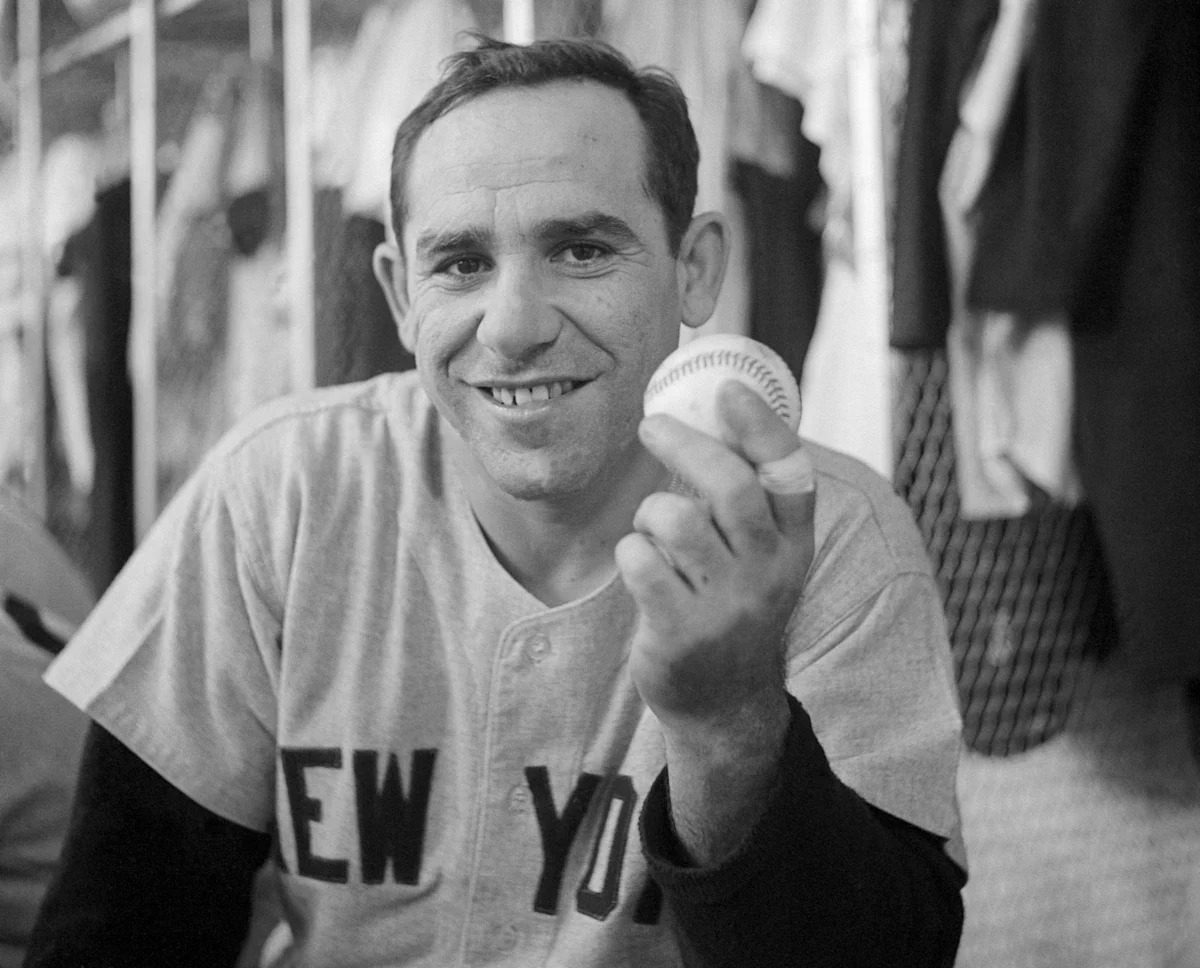
The best stories in sports, no matter what era they come from, exist because of those who battle against the odds. Michael Jordan’s “Flu Game” is so excellent because he fought illness to play in a massive playoff game and lead the Chicago Bulls to victory with 38 points. And while it’s not a flu game, the career of Yogi Berra, standing at 5-foot-7 behind the dish and losing multiple potential major league seasons to World War II, is about as impressive as anyone’s in baseball. Oh, and he was somewhat of a philosopher, too, seeing as his “Yogi-isms” have stood the test of time. Today, the former Yankee and Hall of Famer would be celebrating his 101st birthday.
Lawrence Peter “Yogi” Berra
Born: May 12, 1925 (St. Louis, MO)
Died: September 22, 2015 (West Caldwell, NJ)
Yankees Tenure: 1946-1963 (player); 1964, 1984-85 (manager); 1976-83 (coach)
Yogi Berra was born Lorenzo Pietro Berra to Italian immigrant parents, Pietro and Paolina, after Pietro immigrated to the United States of America via Ellis Island, and his family followed. Born in St. Louis and raised in the working-class area called “The Hill,” Berra and close friend/fellow future baseball icon Joe Garagiola attended what was then called South Side Catholic, later renamed St. Mary’s High School. After eighth grade though, he left school to work.
This departure from school also led Berra into the baseball world, something his family didn’t know much about prior to his birth. He joined American Legion ball after dropping his education, and there he met future major leaguer Jack Maguire, who according to SABR, supposedly gave him the nickname of “Yogi.”
As the story goes, Maguire and fellow future major leaguer Bobby Hofman went to the movies with Berra and saw a travelogue on India. In the film was a yogi (one who practices yoga) who either looked like Berra, or who sat with crossed legs, as Berra did on occasion. Whatever the case, from then on Berra was Yogi.
Berra developed his catching and hitting well enough to be looked at for a minor league position, but he was overlooked by his hometown team, the St. Louis Cardinals, at the beginning of his journey. However, Branch Rickey, the man most famous for running the Brooklyn Dodgers and putting Jackie Robinson on the field in a major league uniform, saw something in Berra. At the time, he was with the Cardinals organization and felt as if there was an oversight on Berra (unsurprising given his track record of spotting such things), and, most importantly, knew he’d be leaving for Brooklyn soon enough to have a chance to get Yogi on his squad. But before Rickey could acquire him, the Yankees swooped in, as it seems like they have always done in their long history as a club.
After being signed by New York, Berra played minor league baseball for the Norfolk Tars in 1943 before the war took him away from baseball. At ages 18 and 19, Berra was overseas fighting the Nazis in World War II. And he wasn’t just across the ocean on a boat, but he was truly fighting, manning the USS Bayfield as a gunner’s mate during the storming of Omaha Beach in Normandy. Yogi ended up being wounded during his service, being hit by a machine gun bullet on the left hand, and after he made it back from the conflict, he was awarded the Purple Heart.
All of this came before his major league career began at the age of 21 in 1946, when he played his first game on September 22nd. He tallied two hits in four at-bats with a home run and two RBI. He played only seven games with 23 plate appearances, and in his next season, he played 83 games with a slash line of .280/.310/.464 and an OPS+ of 115. This was also the same year that the Yankees defeated the Brooklyn Dodgers in seven games in the first-ever televised World Series. Berra played in six of the games, contributing one home run, a seventh-inning clout of Game 3 at Ebbets Field against Ralph Branca.
It was the first pinch-hit home run in World Series history. Overall, though, he struggled a bit with the bat, finishing with a .158 average.
From then on, Berra would spend the next 16 years of his career wearing pinstripes and, most importantly, winning.
In 1948, at the age of 23, Berra posted a season batting average over .300, the first of three seasons in his illustrious career when he did so. He was two shy of the 100 RBI mark as well, playing in 125 games. The Yankees did not make the World Series that year, but the next would set the stage for a dynasty to be born. In 1949, in 116 games, Berra was above average but still looking to make a name for himself on a team with players like DiMaggio, Phil Rizzuto, and Tommy Henrich taking center stage. The Yankees won the World Series in five games against the Dodgers again.
Then, the 50s rolled around, and Berra took his play to another level. Slashing .322/.383/.533 for an OPS of .915 and an OPS+ of 135, Yogi finished second on the team in bWAR as well, 0.7 points under Rizzuto and .002 behind him for the team batting lead. Along with DiMaggio, those three were the bane of existence for anyone who crossed their paths, while reliable players like Hank Bauer could come alive at the plate under manager Casey Stengel. Joining them via the pitching staff was a young rookie named Whitey Ford, too, who made his presence felt with a 2.81 ERA in 20 games played, setting the Yankees up for what was to be a fantastic decade.
In 1951, Berra won his third World Series ring (this time against the New York Giants) and first Most Valuable Player award, beating out his batterymate Allie Reynolds and pitcher Ned Garver of the St. Louis Browns. This was also the first season in which the majors were treated to the talent of another legend-in-the-makng, Mickey Mantle. And the winning trend led by those names would continue over the coming years, too.
The Yankees won their final two of five-straight World Series championships (against the Dodgers in seven and six games, respectively, in 1952 and 1953), led by Berra’s leadership behind the plate, his potent bat, and his charismatic energy.
View Link
In 1954 and 1955, despite not making the World Series and then losing to the Robinson, Duke Snider, Pee Wee Reese, Roy Campanella, and Gil Hodges-led Dodgers in seven games, Berra still walked away with two MVP awards. He had over 100 RBI in both seasons, and a 129 OPS+ through them as well. And it wasn’t as if he was exclusively crushing balls over the fences. Instead, it was as it always had been: Berra knew where to put his bat at the right time and contributed runs for his team consistently. Yogi had an earned reputation as one of the best “bad ball” hitters in MLB history, capable of doing damage on just about any offering, no matter how much the pitch sailed outside the strike zone.
Berra continued his true dominance into 1956, when he finished second in the MVP voting (the seventh year in a row that he finished at least top five) to his teammate Mantle, who led the majors in runs (132), home runs (52), RBI (130), batting average (.353), slugging percentage (.705), and OPS (1.169). The Yankees won another World Series that year, too, making it the seventh of Berra’s career. And in that World Series, Berra was the catcher for Don Larsen’s perfect game, the first no-hitter and only perfect game ever to be thrown in MLB’s postseason. Right after the strikeout to end it, an iconic image was born.
WORLD SERIES – Brooklyn Dodgers v New York Yankees
After 1956, though, Berra’s individual career began to softly fade from MVP levels. He still finished within the top 20 of voting from 1957 to 1960, but he wasn’t the on-base machine that he had been in years past. Over those four seasons, Berra had only one year (1959) with an OPS above .800, when he ended the season at .809. Of course, he was still a valuable asset behind the plate, chatting up players in the batter’s box and contributing runs when they were needed. However, at the age of 35 in 1960, he was not the same player, and he ceded more time at catcher to rising star, trailblazer, and close friend Elston Howard.
Age didn’t stop the Yankees from winning during the back end of Berra’s career, though. They came away with the eighth championship of his tenure as Yankees catcher in 1958, and then after dismissing Stengel amid the heartbreak of losing to Bill Mazeroski’s 1960 Game 7 walk-off homer in Pittsburgh, the club under new skipper Ralph Houk (previously a third-string backup to Yogi) won back-to-back titles in 1961 and 1962 against the Cincinnati Reds and the now-San Francisco Giants.
Yogi’s career petered out with the Yankees by 1963, when he finished with one final All-Star appearance, the 18th of his illustrious career. He was a player-coach by then, too, so he wasn’t appearing in nearly as many games — he racked up a season’s worth between 1962 and 1963. Amid a run of five consecutive pennants, the Yankees hatched a plan to have Houk move up to the front office and Berra to succeed him as manager.
Yogi dealt with quite a bit of criticism from media and fans who were at the very least skeptical that he could rein in some of his longtime teammates and pals, let alone manage when he’d only coached part-time before. And the path to the pennant was no breeze, as with the Baltimore Orioles and Chicago White Sox giving them a fight, they only had sole possession of first place on seven gamedays prior to mid-September. They were stuck in third in late August at the time of the infamous “Harmonica Incident” between Yogi and infielder Phil Linz; soon after, they began to play a little better, and a span of 20 wins in 24 games was enough to win the flag. Led by Bob Gibson, the Cardinals beat them in a seven-game World Series — a loss that led to Yogi’s surprising ouster after just one year at the helm, with St. Louis skipper Johnny Keane hired to take over.
Although it hurt in the moment, it was a blessing in disguise that Berra was spared from having to guide the aging late-’60s Yankees, who would immediately stumble into the AL cellar under Keane with not much young talent coming to help them. In hindsight, Berra’s work in ’64 was probably more impressive than people initially thought. Regardless, Stengel was happy to poach his old backstop to coach for his New York Mets in Queens, beginning in ’65. He also managed to put him in four games, Yogi’s last career at-bat coming on May 9th (thus creating the awkward final “New York, N.L., 1965” on his Hall of Fame plaque, the only detour from his Yankees dominance).
Berra would go on to win a World Series with the Mets in 1969 as a coach under new manager Gil Hodges of Dodgers fame, and he took over as the skipper following Hodges’ tragic, sudden passing in the spring training of ’72. Yogi led the Mets to a surprising pennant in ’73 despite just 82 wins in the regular season, as they won an underwhelming NL East and then upset the 99-win “Big Red Machine” in the NLCS. They nearly beat the dynastic Athletics as well, but lost a 3-2 series lead in Oakland. The A’s won Games 6 and 7, and Berra never again managed in a Fall Classic again.
Dismissed by the Mets in 1975, Yogi returned to the Yankees’ coaching staff under former teammate Billy Martin just in time for the 1977 and 1978 World Series championships. Before the 1984 season, Berra was named the team’s manager, but George Steinbrenner, ever the unhappy camper, was not pleased with the team’s state and fired him 16 games into the 1985 season. Furious at “the Boss” for the quick hook after being promised to manage all year—and hiding behind his GM on the news of the firing himself—Yogi refused to return to Yankee Stadium for over a decade.
In the meantime, Berra became a bench coach for the Houston Astros from 1985 to 1989, helping a young Craig Biggio break out behind the plate before retiring at the end of the ’80s. With assistance from Suzyn Waldman, the thaw between the Yankees and Yogi faded in the late ’90s when Steinbrenner personally came to him to apologize. Back in the fold, he got to throw out World Series first pitches, bond with rising stars like Derek Jeter and Jorge Posada, and—along with Larsen—helped create an unforgettable moment for David Cone prior to his 1999 perfect game.
Overall, Berra finished with an esteemed military career serving his country in a gruesome war, one of the most incredible major league careers ever, and a perfectly commendable managerial career with two pennants and a record above .500. He passed away from natural causes at his home in West Caldwell, New Jersey, at the age of 90, and 11 years later, we honor him. Happy Birthday, Yogi!
See more of the “Yankees Birthday of the Day” series here.