From now until preseason camp starts in August, Land-Grant Holy Land will be writing articles around a different theme every week. This week is all about Ohio State heroes; from the biggest names in Buckeye athletic history to underappreciated icons to the athletes who will eventually become all-time Buckeye greats. You can catch up on all of the Theme Week content here and all of our ”Buckeye Heroes” articles here.
As a group, traditional tight ends (i.e. not the hybrid receivers and pass-catching specialists that make up half of that group today) are usually thought of as bruisers rather than brains.
Ohio State’s John Frank defied that characterization throughout his playing days, and he ultimately left his successful and lucrative career in the NFL to finish medical school and to help people.
There were early signs that Frank wasn’t your typical brawny football player. While attending Mt. Lebanon High School near Pittsburgh, Frank volunteered in Dr. Thomas Starzl’s surgical laboratory.
Starzl was an expert on organ transplants. He was part of a team that performed the world’s first liver transplant on a human and was considered the “Father of Modern Transplantation.” Frank would eventually go on to perform many transplant surgeries of his own in a much different area of the body.
After high school, Frank became a Buckeye in 1980 and earned a starting job at tight end from 1981 through 1983, where he racked up numerous accolades and school records, including becoming Ohio State’s all-time leader in career receptions (121) and yards receiving (1,481) by a tight end.
Even after 46 years, Frank still ranks in the top 20 among all pass catchers in yardage and in the top 15 in receptions regardless of position.

Frank got on the field early, appearing in 10 games as a freshman in 1980, catching five passes for 65 yards as one of the backups to starter Brad Dwelle. Other star pass catchers on that team included Doug Donley and Gary Williams, who constantly made plays for quarterback Art Schlichter in an offense that featured running backs Tim Spencer and Calvin Murray.
Over the course of his career, Frank set a single-season record for receptions by an OSU tight end (45) in 1981 and equaled that feat in 1983. His play in 1981 helped the Buckeyes finish as Big Ten co-champions.
His total of 641 receiving yards in 1983 still stands as the most in a season by an Ohio State tight end, and he’s still among the top 10 tight ends in school history in career touchdowns (9).
Although he was only a member of one conference title-winning Buckeye squad during an otherwise forgettable era of OSU football, he went to four bowl games during his career and won the last three: the Liberty Bowl after the 1981 season; the Holiday Bowl following the 1982 campaign; and the Fiesta Bowl after the 1983 season.
Frank was named the team’s MVP and a second-team All-American after his final season in Columbus.
Frank earned second-team All-Big Ten honors in 1981 and first-team All-Big Ten honors in his final two years in Scarlet & Gray.
Meanwhile, the big tight end was crushing it in the classroom as well. A two-time Academic All-American, Frank was a Rhodes Scholar nominee as a senior. He even turned down an invitation to the NFL combine to study for finals.
Frank graduated from Ohio State in June 1984 with a Bachelor of Arts in chemistry. During his undergraduate academic career, he co-authored several research papers and was already a published medical journal author.
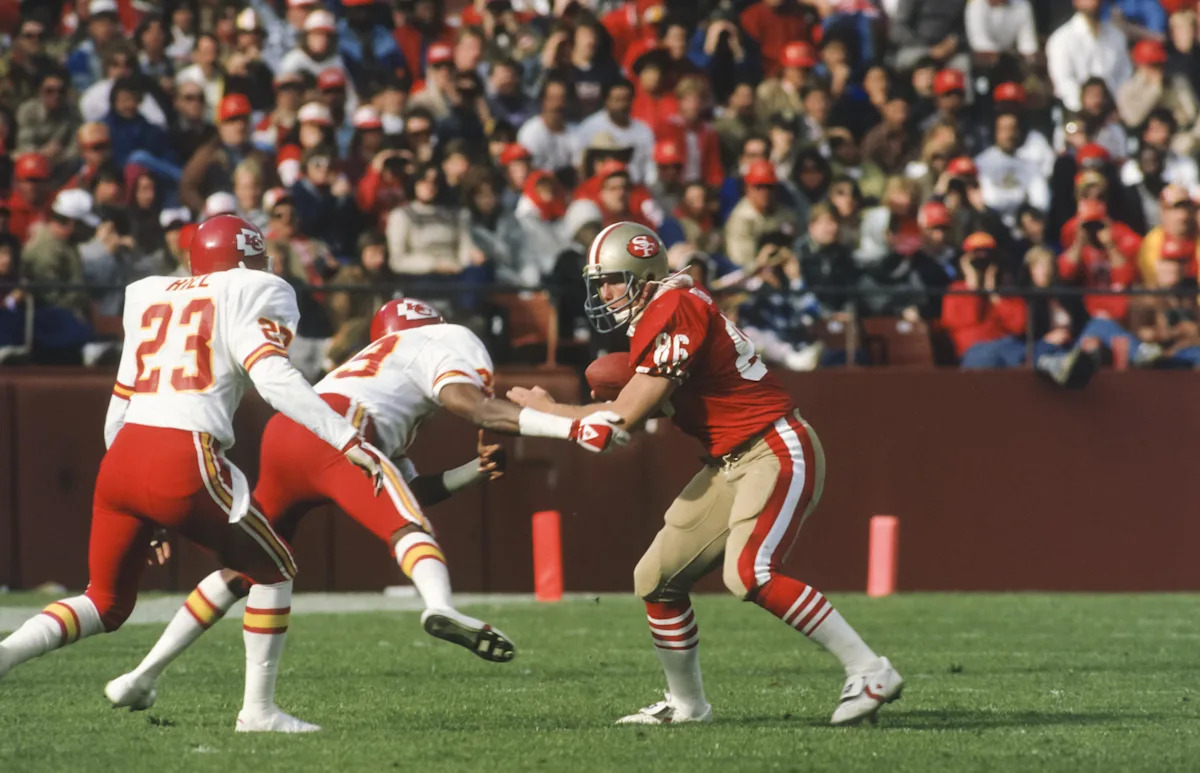
Drafted in the second round by the San Francisco 49ers (No. 56 overall), Frank had a short but productive and successful career in the NFL. From 1984-1988, Frank appeared in 66 games with the 49ers, catching 65 passes for 662 yards and 10 touchdowns. He helped San Francisco win two Super Bowls during his stay in the Sunday league, bookending his pro career with championships.
After his rookie year, the 49ers beat the Miami Dolphins in what was essentially a San Francisco home game just 40 minutes down the road at Stanford Stadium. His second title came after the 1988 season by beating the Cincinnati Bengals in Miami. Frank caught two passes for 15 yards against the Bengals that night after not getting a catch while backing up Dwight Clark in Super Bowl XIX.
Meanwhile, Frank was attending medical school at Ohio State in the offseason. He walked away from his NFL career after the Super Bowl in early 1989 to finish his studies, receiving his doctor of medicine in June of 1992. Frank became a board-certified otorhinolaryngologist — a designation given to head and neck surgeons or ear, nose, and throat doctors/surgeons.
Ultimately, Frank became a Fellow of the American College of Surgeons, an assistant professor of Clinical Otolarygology at Columbia University College of Physicians and Surgeons, and The Ohio State University College of Medicine-adjunct.
He became a specialist in hair-restoration treatment and transplant surgeries, opening the Anapelli Hair Clinic in New York City — now the John Frank MD Hair Clinics — and expanded his practice back to Columbus in 2014. Although it’s not exactly liver transplantation, Frank has dedicated his life to helping people, and he left a successful NFL career to do it, which is rare.
Through Frank’s storied playing career, he achieved much, including induction into the National Jewish Sports Hall of Fame in 2006 and the Ohio State Athletics Hall of Fame in 1998. He is also a member of the All-Century Ohio State Football Team and Ohio State’s Varsity Hall of Fame.
For his endeavors on and off the field, Frank is worthy of being remembered as a Buckeye hero.