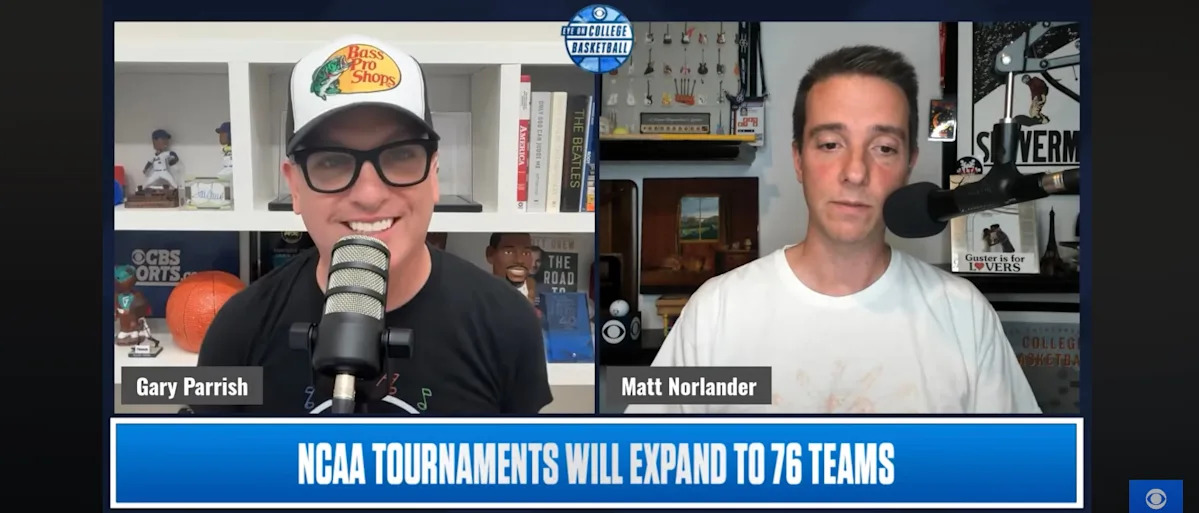
It’s difficult to reach a consensus on anything in America. However, almost everyone reacted with dismay to the news that the NCAA Tournament will expand to 76 teams in 2027. One of the most popular sporting events will be altered in a way that the majority of fans and the media vehemently oppose.
Change is coming, and there is nothing we can do about it. So, what will this mean for our TV viewing experience? We recently spoke with college basketball insider Gary Parrish about the future of March Madness. Parrish is a CBS Sports columnist and television analyst, a co-host of the Eye On College Basketball podcast with Matt Norlander, and the host of The Gary Parrish Show on Grind City Media.
Note: This interview has been edited and condensed for length and clarity.
Awful Announcing: What’s your immediate reaction?
Gary Parrish: “I share the opinion with most that it’s a net negative for the sport and that we haven’t been leaving good teams out of the bracket as much as we’ve been putting some very mediocre teams in it, certainly at the power-conference level. Now, with an expanded field, it’ll just be more of that, to some degree, at the expense of the regular season.
“All of that said, I stop short of the hyperbolic claim that ‘it’s going to ruin or kill the sport.’ I can’t think of many examples where expanding the postseason has destroyed anything. We have expanded the NFL playoffs, Major League Baseball, and the NBA, and we still enjoy those postseasons. So, I don’t think it’s great, but I also don’t think it’s nearly as devastating as some have suggested.”
Who is the biggest loser in all of this?


“People who like to get a bracket on Sunday and know exactly who their favorite team is playing will know less of that now than ever before. There was a time when Greg Gumbel would come on CBS, and we’d have a 64-team bracket, and you would know immediately who you were playing, where you were playing, and when you were playing.
“Now, the bracket’s going to come out on Sunday, and a not-insignificant number of people aren’t going to know who their first game in the NCAA Tournament is going to be against because we’re waiting for teams to play into the main bracket. Again, not the biggest thing in the world, but part of this sport’s popularity is built around brackets and filling them out, and now that’s a more complicated process than it’s ever been.”
Who is the big winner?
“It’s the SEC. It’s the Big Ten. I guess, to some degree, the ACC and the Big 12 as well, but the Big Ten and the SEC were really driving this, and it’s simple to understand their motivation. Over the decades, these leagues have grown accustomed to sending a certain percentage of their teams to the NCAA Tournament.”
How have the power conferences justified expansion?
“Well, when you’re in the SEC and you expand and you add big brands like Texas and Oklahoma, or you’re the Big Ten and you expand and you add big brands like UCLA and Oregon, or you’re the Big 12 and you expand and you add big brands like Houston and Arizona, when you’re pushing everybody else in your league down spots, in some cases multiple spots, by definition making it more difficult for them to win as often in conference, by definition more difficult to build at-large resumes, and also more difficult for you to get the same percentage of league members into the NCAA Tournament that you used to get, so what is a way to address that?
“Think of this not as a basketball tournament but as a restaurant with a certain number of tables. If all the tables are full but you would like to seat one more couple, the best way is to add another table with more chairs. That’s what they’ve done.”
Is there any benefit for the mid-majors?
“Yeah, a mid-major conference is going to get a second team in certain years that otherwise wouldn’t. That’s going to happen, but that’s not why we’re doing it. We are mostly doing it because the power conferences want it. It’s a revenue generator, and in college athletics for a long time now, we’ve been doing almost anything we can to generate revenue…
“Once upon a time, if you qualified for the NCAA Tournament, you were still going to be alive on Thursday afternoon, because that’s when we were going to start it. Now, a lot of teams will have their postseason experience done before most of us really lock in to what is traditionally known as the NCAA Tournament, specifically on that first Thursday of the NCAA Tournament.”
So, it’s not really much of a benefit?
“We have created eight more spots in the NCAA Tournament, but each year you’ll find that most of those spots go to SEC, Big Ten, Big 12, ACC, and/or Big East schools. To go back to the restaurant table analogy, it is like this restaurant just got more tables. They built a whole new wing with a new room, and there are more tables, so it’s theoretically easier to get into the restaurant now than it’s ever been, but you don’t even know where to find the phone number to make a reservation. In the meantime, your rich buddies over in the SEC and the Big Ten have the phone. They’ve got a secret number.”
Was there a single person driving all this?
“I don’t think any one person has the power to get something like this done. To get something like this done, you’ve got to have people with the power to do it involved. That would be the NCAA. You’ve got to have people with power to throw around who are willing to go down this path. That would be the SEC and the Big Ten. You’ve got to have television networks that are willing to pay for it. So, there’s no one person who made this happen. Greg Sankey, the SEC commissioner, has been the most powerful and vocal proponent of this for many years. Once he started talking about it publicly, it became pretty clear we were going to get to this day. He is one of the most powerful people in college sports.”
Do you have a sense of what the NCAA Tournament’s broadcast partners, CBS Sports and TNT Sports, think of this?
“I certainly wouldn’t want to speak on behalf of Turner, CBS, or anybody else. I’m just a columnist/podcaster. But it’s more about live sports programming. If they didn’t think they could make money from it, I don’t know that they’d be going down this path. And if we’re going down this path and the television networks are pleased with how it looks on paper, at least we’ll see how it plays out. Obviously, the fan reaction has been less than ideal. But the television networks, the NCAA, and everybody involved were smart enough to understand what they were walking into. They knew they were doing something largely unpopular with college basketball fans.”
Do we know how the new play-in games format will work?
“I’ve still got to figure out where these games are going to be played. Some of them will be in Dayton. Some of them will be at a site to be determined. But in the simplest terms, we used to start with two games on Tuesday night. Then we’d get two more games on Wednesday. One of those games that night was between 16 seeds. The other was between at-large teams. By Thursday, we’re at 64. Let’s go. This will start earlier on Tuesday than it’s ever started. You’ll have more games than you’ve ever had. You’ll have more teams competing to play into the main bracket than you’ve ever had. So, it will look different on Tuesday and Wednesday.”
Are we heading toward a day when the NCAA Tournament includes 96 teams?
“Sure. If somebody with the power to make it happen is convinced there’s more money to be made by doing it. I understand the sentiment that it can be too much. I’m not a basketball coach trying to get a team into the NCAA Tournament. I’m not a television network executive trying to generate revenue for a network. I’m not a power-conference commissioner trying to get more of my teams into the field. I’m just a basketball fan. As a basketball fan, if it were up to me, we’d have 64 teams. It fits perfectly on a piece of paper. Everybody knows who they’re playing on Selection Sunday.”
The post Gary Parrish calls some media reaction to NCAA Tournament expansion ‘hyperbolic’ appeared first on Awful Announcing.