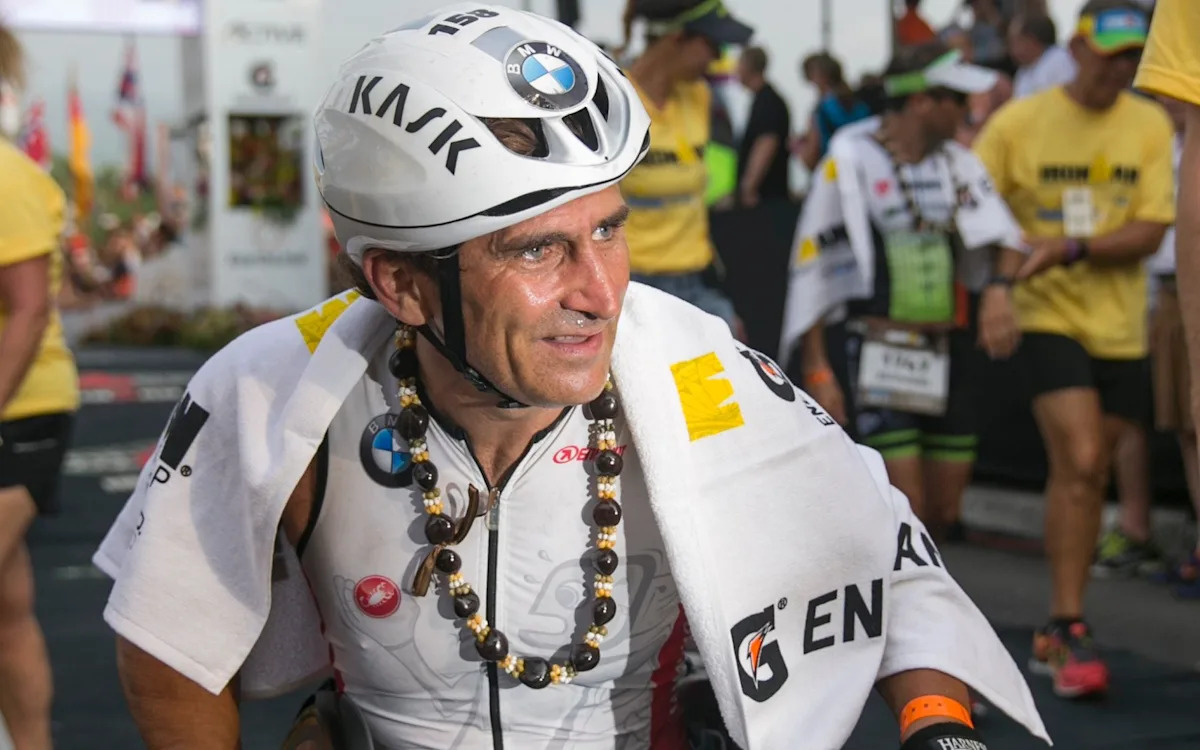
To say that Alex Zanardi was revered in motorsport would be a bit like saying Albert Einstein was well regarded in the field of science. A ridiculous understatement. Zanardi, who has died aged 59, became one of the most beloved figures the sport has known. Admired not so much for his achievements on track – although there were many, including back-to-back series titles in IndyCar in 1997 and 1998 as well as stints at Jordan, Minardi, Lotus, and Williams in F1 – as his indomitable spirit off it.
The horrific Champ Car accident in 2001, which cost him both of his legs and nearly his life, would have ended the careers of most drivers. Zanardi, who was read his last rites on the helicopter ride to the hospital, came back to inspire millions, competing in modified cars, using hand controls and winning four World Touring Car Championship races.
He then had a wildly successful second career as a handcyclist, winning four gold medals and two silvers at the 2012 London and 2016 Rio Paralympics.
The image of Zanardi holding aloft his wheelchair at the end of the H4 time trial at Brands Hatch in 2012 was one of the most enduring images of those extraordinarily uplifting Games. I remember getting in touch with him one year later to ask for his memories of that race, and that moment, and he joked that it was just a relief to have finally won at Brands after finishing second in F3000 in 1991 and again in 2009 in BMWs.
Zanardi celebrates after winning the men’s individual H4 time-trial at London 2012; (below) with his medal – Leon Neal/AFP
Alastair Grant/AP
Zanardi did not deny that he was humbled by the reaction, though, and the overall impact of those Games. He recalled being stopped by “a very nice lady” the following morning who asked to take a picture with him. “Frankly, I was a little surprised because in normal clothes, in England, I don’t get stopped for that purpose so often and that morning it had already happened several times,” he said. “Well after she handed me a copy of The Telegraph asking if I could sign it. Wow, when I spotted the picture [of his celebration] I told myself I had to find the photographer who took it to have it for me, but I soon realised it was everywhere! “I’m very proud of it,” he admitted, laughing. “If it wasn’t me in it I would probably join many others in saying ‘Wow that bloody guy looks so strong!’

“But that moment, those Games as a whole, were just incredible, an indelible memory I’ll never get tired of telling. The message ‘inspire a generation’ really went through. Sport always has the capacity to inspire if you’re able to focus not only on the result achieved by an athlete, but to understand how he got there.”
Zanardi, who was born in Bologna on October 23, 1966, made his F1 debut in 1991 for Eddie Jordan. Although he would end his career with a solitary point in motorsport’s elite category, won in a Lotus at the 1993 Brazilian Grand Prix, when he was team-mates with Johnny Herbert, he was highly rated as a driver and later achieved success in the CART series in the United States, winning back-to-back championships in 1997 and 1998 for Chip Ganassi, before returning to F1 for the 1999 season with Williams. He lost his drive at the end of that season to a British teenager by the name of Jenson Button.
Zanardi found success in the CART series in the late Nineties, before returning to Formula One with Williams (below) – Jamie Squire/Getty Images
Ferran Paredes/Reuters
‘I survived for about 50 minutes with less than one litre of blood’
The American Memorial 500, the fateful Champ Car race which took place at the Lausitzring in Germany on September 15, 2001, very nearly did not take place at all.
Just four days after the Twin Towers had been felled by terrorists, all sporting events in the United States had been cancelled and it was debated until the last minute whether it was appropriate to stage this European leg of the CART series. In the end organisers decided to run it in honour of the victims of 9/11. Zanardi was leading the race when he lost control at the exit to the pit lane, veering across the grass and into the path of rival Alex Tagliani, who was flying down the straight at close to 200mph. The force of the impact sliced Zanardi’s car in two, ripping off his legs. Doctors estimated he was 10 minutes from death. His heart stopped seven times.
The crash that nearly cost Zanardi his life – Matthias Hiekel/EPA
“I shouldn’t have survived that accident,” he once said. “I basically survived for about 50 minutes with less than one litre of blood. Science says that’s simply impossible.”
The story of Zanardi’s rehabilitation made him a hero to millions. He battled with depression as he adjusted to his new life with his wife, the equally irrepressible Daniela Manni, and three-year-old son Niccolò, and returned to racing using prosthetic limbs he had designed himself. He also visited the Lausitzring in 2003 to complete the final 13 laps of that fateful race, testing a modified BMW F1 car at Valencia in 2006, shaving off the bottom of his prosthetic legs to allow him to fit in cockpit
He always said he considered himself lucky. “The first day in the rehabilitation centre I saw a kid in my situation, and his life went through my eyes like a movie. Growing up, going to school, being always the one needing help. Going to the disco, sitting while all his friends are dancing because he cannot do that, not finding a girlfriend. I mean, that’s tough. For me, it is a piece of cake in comparison, because I have my life, I have my wife, Daniela, my wonderful son, Niccolò.”
Sadly, a second serious accident on June 19, 2020, after he collided with a truck while making a descent on the Obiettivo Tricolore Italian national road race for Paralympic athletes, led to severe facial and cranial injuries and a withdrawal from public life.
Tributes to Zanardi flooded in after the news broke on Saturday morning, from former team-mates and team bosses to sports administrators and public officials, reflecting the deep affection in which he was held.
Giorgia Meloni, the Italian prime minister, said on X: “Italy loses a great champion and an extraordinary man, capable of turning every challenge of life into a lesson in courage, strength, and dignity.
“Alex Zanardi knew how to bounce back every time, facing even the toughest challenges with determination, clarity, and a strength of spirit that was truly exceptional.
“With his sporting achievements, with his example, and with his humanity, he gave all of us much more than a victory: he gave hope, pride, and the strength to never give up. On behalf of myself and the government, I extend my heartfelt thoughts and the sincerest closeness to his family and to all those who loved him. Thank you for everything, Alex.”
Stefano Domenicali, president and chief executive of Formula One, added: “I am deeply saddened by the passing of my dear friend Alex Zanardi. He was truly an inspirational person, as a human and as an athlete. I will always carry with me his extraordinary strength.
“He faced challenges that would have stopped anyone, yet he continued to look forward, always with a smile and a stubborn determination that inspired us all.
“While his loss is profoundly felt, his legacy remains strong. At this time, my heartfelt thoughts and deepest sympathies are with his wife Daniela, his son Niccolò, the rest of the family and all those who had the privilege of knowing him.”
Former rival Heinz-Harald Frentzen posted: “Rest in peace, Alex Zanardi. A champion on the track, a legend in life. Your courage and smile will live on forever.”
Ganassi wrote: “No words can express my feelings about this guy.”
Formula One held a minute’s silence on the grid before Saturday’s sprint race in Miami.
Toto Wolff, the Mercedes F1 team principal, said Zanardi was an example of “true courage” whose exploits inspired him when he was a young up-and-coming driver.
“In motor racing, we talk a lot about courage,” Wolff said. “Every now and then you meet someone who truly defines what that means. Alex Zanardi was that person. As a young racing driver, I admired Alex’s skills behind the wheel. What he achieved, particularly in America, showed what a talent he was. What he achieved after his accident was even more inspiring, though. He showed that even when life challenges you, it does not have to define you. That adversity can be overcome with humility, humour and optimism. His example will continue to inspire and act as a reminder of what true courage really looks like.”
Try full access to The Telegraph free today. Unlock their award-winning website and essential news app, plus useful tools and expert guides for your money, health and holidays.