The date is October 2, 1978. With the Yankees down two in the seventh and two runners on, a light-hitting shortstop steps to the plate at Fenway Park. After fouling a ball off his foot, he turns on one.
Deep to left! Yastrzemski will not get it, it’s a home run! A three-run home run for Bucky Dent and the Yankees now lead by a score of 3-2. Bucky Dent has just hit his fifth home run of the year into the screen.
In a franchise whose history is chock full of indelible moments, this one ranks near the top. Dent’s soaring shot above the Green Monster keyed a Yankee victory in a one-game playoff against their most hated rivals, erasing what had been a 14-game division deficit and setting them on the path towards their 22nd title. Of course, Dent never would have been in position to make history if not for contributions up and down the Yankees’ roster all season long.
Here in 2026, Yankees’ starting pitchers are neck-and-neck with the Dodgers’ for the best rotation ERA in baseball. To be sure, we’re still in the early going, but with Carlos Rodón and Gerrit Cole set to reinforce this already exemplary group in the near term, we appear to have the makings of a special rotation. The last time the Yankees led MLB in rotation ERA? Nearly 50 years ago on that ‘78 squad. It was a top-heavy group, led by an all-world Ron Guidry. But the Yankees could neither have led baseball in rotation ERA nor mounted their historic regular-season comeback without the high floor provided by all the members of their pitching staff.
Let’s dissect the anatomy of a league-best rotation, starting with its ace. Guidry’s ‘78 season is the stuff of legend. After earning a starting role the year prior, going 16-7 with a 2.82 ERA, he transformed into the best pitcher in the game at the age of 27. He led baseball in wins (25), ERA (1.74), and shutouts (9). In particular, that ERA ranks third in club history behind a mid-World War II Spud Chandler season and a 1910 Deadball Era Russ Ford campaign aided by the emery ball. Gator also struck out 248 which slotted third behind Nolan Ryan and J.R. Richard that year but remained a Yankees record until surpassed by Cole in 2022 — a much more high-strikeout era.*
*For one point of comparison, when K% is weighted to adjust for the circumstances of the league at the time, 1978 Gator scored a 198 K%+, whereas 2022 Cole had a 146. It’s no shade on Cole, just a testament to Guidry,
This is the year Louisiana Lightning set a Yankees record with 18 strikeouts in a game (“holy cow!”), began a Yankee Stadium tradition with the two-strike clap, captured the Cy Young, and finished runner-up in MVP voting.
Tomes have and will be written about Guidry’s historic campaign (here’s a great piece by Mark Feinsand if you want a deeper dive). And while, of course, the lanky lefty’s utter dominance is the primary reason Yankees starters led the game in ERA, I’m going to focus more on the less-heralded supporting cast who made sure one of the greatest pitching seasons in baseball history was not for naught.
1975 was Bobby Bonds’ first season in pinstripes after coming over in a surprising trade for fan favorite Bobby Murcer. Despite going 30/30, it would also be Bobby’s last. Before the ’76 season, the Yankees made a controversial deal, shipping the established star off to the Angels for two promising youngsters who would become pillars of their late-’70s run: center fielder Mickey Rivers (an excellent player in his own right) and starter Ed Figueroa. Figueroa was a steady contributor throughout his time in New York who posted his best season in ‘78. The right-hander from Puerto Rico won 20 games while pitching to a 2.99 ERA, finishing seventh in Cy Young voting. And, in a season that saw injuries to some key starters, Figueroa joined Guidry as the only Yankee to stick in the rotation all season.
In what will become a trend, the 29-year-old performed much better in the second half than the first. He went 13-3 with a 2.46 ERA after the All-Star break. This included a season-saving performance in game 161. With the Yankees clinging to a one-game lead over the red-hot Red Sox, Figueroa twirled a complete-game shutout against Cleveland to help the Yankees keep pace, winning his 20th game in the process.
The mid-season boost may have come at least in part due to a change at manager. “(Billy Martin) treated me like dirt, a second-class citizen,” Figueroa recounted about his contentious relationship with the divisive Yankees skipper. “He has told people I’m gutless and cannot pitch under pressure. He never said anything good about me.” Conversely, he felt that Martin’s replacement, the mellow Bob Lemon, “treats me like a man. He lets me pitch to the hitters my way. I have more confidence with him.”
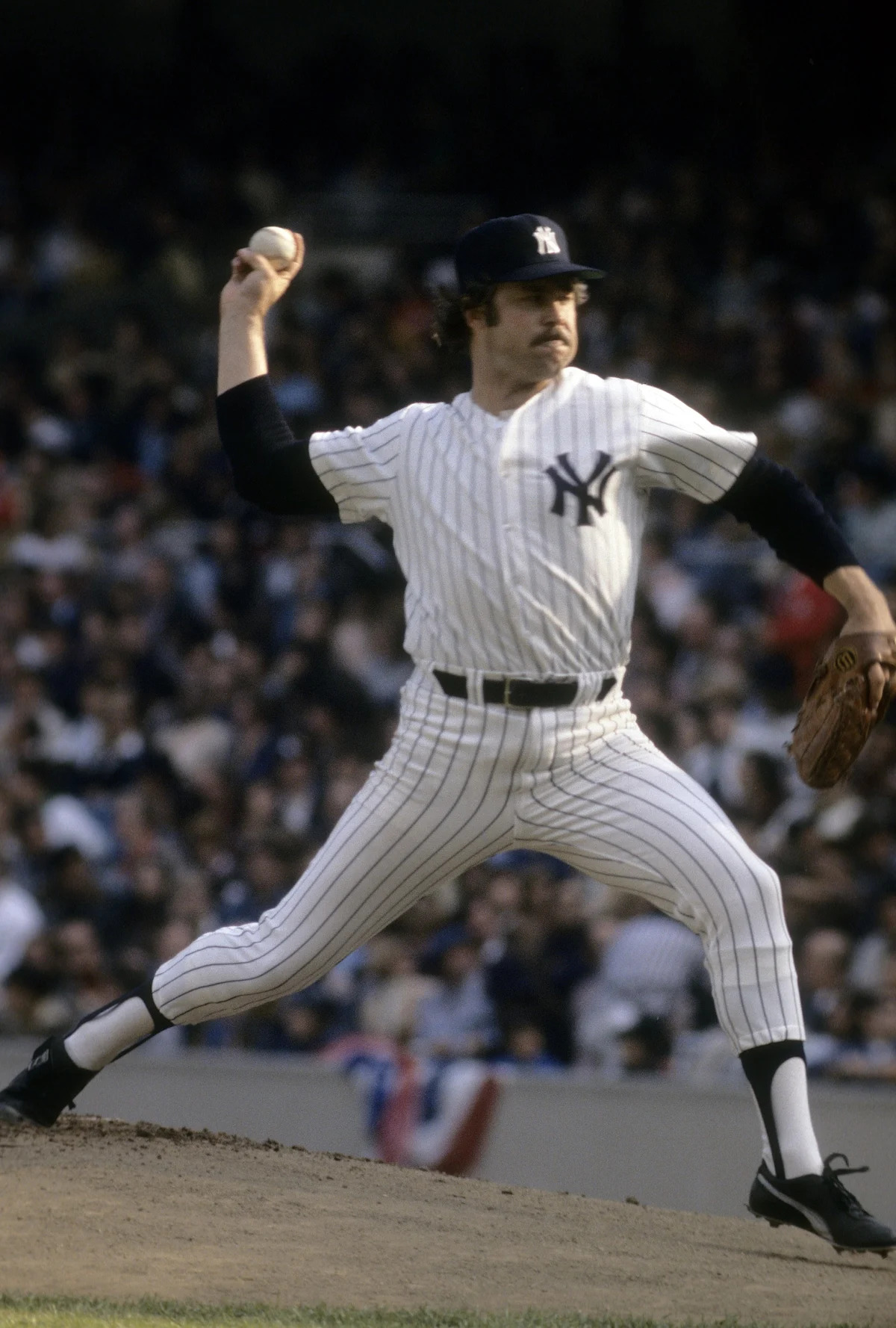
Behind the two stars at the front of their rotation, the man with the most starts in ‘78 was Dick Tidrow. A swingman who started just nine games the prior three seasons combined, injuries forced the 31-year-old into the rotation for nearly the whole year (he ended up starting 25 games). Despite going 7-10 in those starts, he pitched to a solid 3.83 ERA, keeping the train on the tracks as New York worked through quite a bit of turmoil. While Tidrow would pitch for six more seasons, he’d start just one more game, making the ‘78 season an unexpected but pivotal last hurrah for him as a starter.
Next up was a rookie named Jim Beattie, who ended up starting 22 games. Drafted in the fourth round in 1975 out of Dartmouth, the 6-foot-5 right-hander quickly ascended through the minor-league system, earning a spot in the starting rotation to begin the ‘78 season. And, while he was the weakest cog in the Yankees’ rotation for much the year, he was a more than capable number-five starter, posting a 3.73 ERA and 98 ERA+. Beattie’s shining moment came during the famed “Boston Massacre,” a four-game sweep from September 7-10 in which the Yankees outscored the Red Sox 42-9 and pulled even in the standings. Beattie started the second game of the set and, with two outs in the eighth, was on track for his first complete game and his first shutout. That’s when an error by backup catcher Mike Heath, who’d come on to replace Thurman Munson in the rout, led to two unearned runs and chased Beattie before he could finish the job. Beattie would go on to greater success with the Mariners before moving to the front office, serving as a GM with both the Expos and Orioles as well as a longtime scout with the Blue Jays.
The most ill-fated member of the ‘78 Yankees’ rotation was Don Gullett. A former first-rounder who’d burst on the scene with Cincinnati in 1970 at the age of 19, Pete Rose once said the fireballer was “the only guy who can throw a baseball through a car wash and not get the ball wet.” By the fall of 1976, he was a two-time champion and a seasoned veteran, signing with the Yankees on one of the first notable free agent contracts and posting an impressive 14-4 record. But his shoulder was starting to give out. He’d make just eight starts in ‘78 before undergoing shoulder surgery that would end his career at the age of 27. Years later, he continued to rue the premature end of his once-promising career:
“I’ll always wonder what I might have done with seven or eight more years. It’s the goal of every player to get into the Hall of Fame in Cooperstown. I’m not saying I would have or could have made it. But we’ll never know.”
Still, in those eight starts, Gullett went 4-2 with a 3.63 ERA. In a regular season that ended in a tie, it’s certainly possible that his efforts to persevere for as long as he did through his shoulder problems made the difference in getting to game 163.
Seven others started games for the Yankees in ‘78. Six of them appeared in six or fewer games and factored minimally into the rotation’s ERA crown. The seventh ended up in the Hall of Fame.
By 1978, Catfish Hunter was no longer the ace who’d finished top-four in Cy Young voting four years in a row. Diagnosed with diabetes that spring, he was also plagued by arm problems and developed a groin surgery along the way. His nadir came on July 27th, when he allowed six runs without getting an out against Cleveland. “I was doubtful at mid-season if I’d ever pitch again,” he conceded later in the year.
Amidst this crisis of confidence, the Yankees’ team physician performed some manipulations to break up adhesions that had formed in the eight-time All-Star’s shoulder. He was a man reborn. Catfish allowed no runs in 17 innings across his first two starts in August and, in 11 August and September starts, went 9-1 with a 1.71 ERA. “When he had to have it, he had great stuff,” said Lemon, a Hall of Fame pitcher himself, admiringly of Hunter’s resurgence. “He was in command and was getting the pitches where he wanted them. That was a pitcher out there.”
With the chance to clinch the AL East in game 162, Lemon handed the ball to Hunter. He reverted to his earlier form, allowing five runs in 1.2 innings en route to a trouncing that set up the one-game playoff. In that game, while not as unhittable as he’d been for most of the season, Guidry kept his team in the game with 6.1 innings of two-run ball.
After Dent keyed the victory that day, the rotation was up-and down in the playoffs. Figueroa allowed eight runs without making it out of the second in either of his first two starts, doing little to refute Martin’s cruel barb that the pitcher could not perform under pressure. Tidrow was bounced to the bullpen, allowing one run in 4.2 World Series innings. Beattie acquitted himself nicely in two starts, including a pivotal two-run outing in Game 5 of the World Series that staked New York to a 3-2 series lead and netted him his first career complete game.
Guidry was in typical form, allowing just one run in each of his two outings. And Hunter gutted out three starts, culminating in nailing down the World Series clincher in his 22nd and final playoff appearance.
While you can never anticipate the kind of season that Guidry put up in ‘78, the Yankees have the type of front-of-the-rotation talent in Cole, Rodón, Max Fried, and Cam Schlittler to go toe-to-toe with any rotation in the league. As we’ve already seen, though, as injuries take their inevitable toll, a rotation’s success also hinges on its depth. The likes of Will Warren and Ryan Weathers have significantly raised the floor that can be expected from Yankees’ starters. It’s a potent formula for regular-season dominance that mirrors one of the greatest staffs in franchise history.