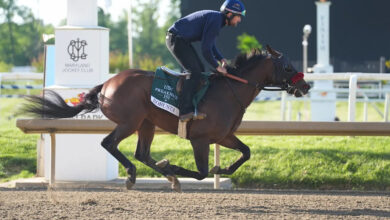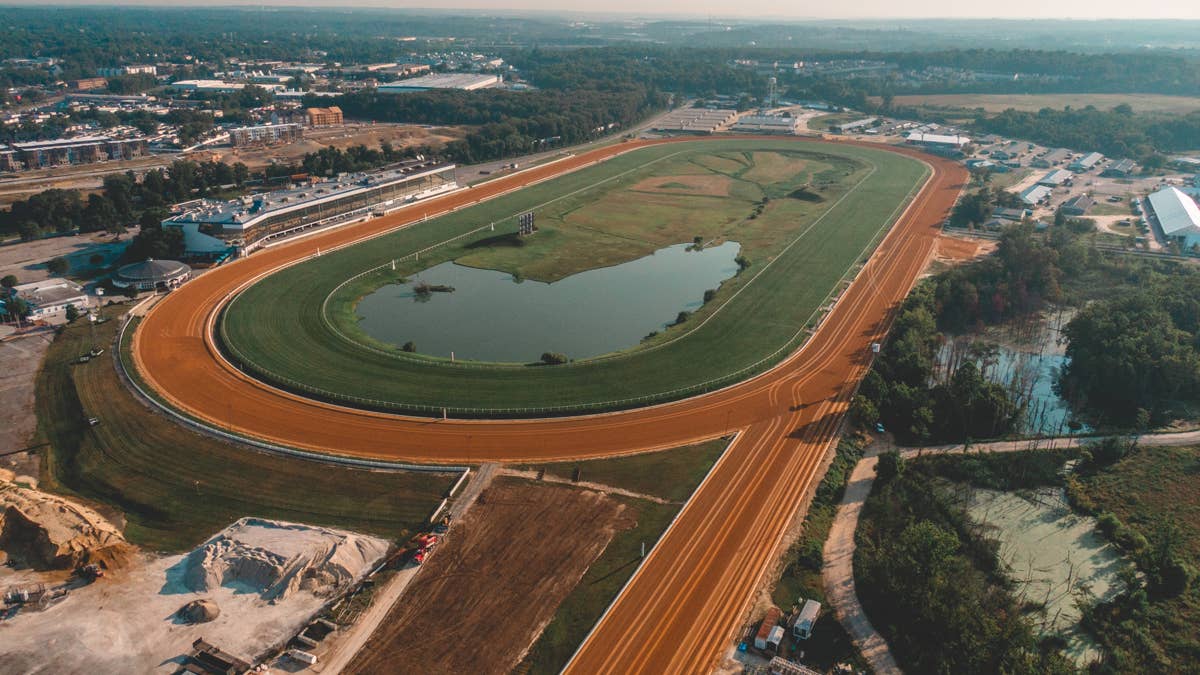
Next Saturday, May 16, the 151st running of the Preakness Stakes (G1) will take place not at Pimlico Race Course in Baltimore, Md., but at Laurel Park, about 30 miles to the south. The move is a result of the ongoing $400 million reconstruction and renovation project at Pimlico, which has necessitated the temporary relocation of Maryland’s premier race and the Triple Crown’s middle jewel. The Preakness is expected to return to Pimlico for the 2027 racing season as construction of the new grandstand progresses.
While the Maryland Jockey Club has shuffled dates and venues in the not-so-distant past, this marks the first time since 1909 that the Preakness will be contested at a venue other than Pimlico. Historically, the race has only left Baltimore twice: once in 1890 to Morris Park in New York, and from 1894 to 1908, when it was held at New York’s Gravesend Race Track on Coney Island.
Laurel vs. Pimlico
The Preakness is contested at a distance of 1 3/16 miles (9.5 furlongs). When held at Pimlico, over the mile-long dirt oval, the gate is placed 1,030 feet back from the finish line (3/16ths of a mile, plus a run-up distance of 40 feet). The track is famously narrow at just 70 feet wide, creating a tighter environment where horses must navigate a 1,327-foot final turn before a short 1,152-foot final stretch. This configuration often favors horses with tactical speed, as the shorter stretch and narrower turns provide less time to build the momentum needed to run down the leaders.
In contrast, the Kentucky Derby is a longer test of 1 1/4 miles (10 furlongs) held on the wider 80-foot Churchill Downs track with a 1,234.5-foot final stretch, allowing more time for closers to make their run.
So what’s the difference? The Preakness at Laurel will offer a distinct departure from the typical layout at Pimlico, utilizing Laurel’s 1 ⅛-mile (9 furlongs), 95-foot-wide dirt oval. The 1 3/16 mile distance is infrequently contested at Laurel; the last race held at that distance occurred on Aug. 6, 2022, in the Bald Eagle Derby, won by Vance Scholars (the run-up distance was 30 feet for that race).
Laurel Park utilizes a two-wire system to maintain flexibility in race distances, specifically employing a second finish line further down the stretch to allow for a one-turn mile that begins from the backstretch chute. Because of this, the starting point for the Preakness will be located just behind the sixteenth pole, before the first finish line. The biggest difference will be the length of the stretch. Because the Maryland Jockey Club will use the first of Laurel’s two finish lines for the Preakness, the final homestretch will be only 1,089 feet — shorter than Pimlico’s 1,152 feet. The Preakness will end at the first wire.
The current track record for the Preakness distance at Laurel Park was set over two decades ago prior to the track being widened in 2005. On Oct. 21, 2000, a horse named Testing completed the 1 3/16 miles in 1:54.51 while carrying 121 pounds.
Full Gates
The move to Laurel Park imposes a strict 14-horse maximum number of starters for this year’s Preakness Stakes. As the second-oldest Triple Crown jewel, established in 1873, the race has only exceeded a 14-horse field twice in 151 years.
In 1928, a record 18 horses went to post at Pimlico for the 53rd running. Harry Payne Whitney’s homebred Victorian, sent off at 9-1, led nearly gate-to-wire to edge 21-1 longshot Toro by a nose. And just four years earlier, Nellie Morse became the fourth filly to win the Preakness. She topped a field of 15 males over a heavy, sloppy track in 1:57 1/5. [Even more impressive? She had won the Pimlico Oaks (now the Black-Eyed Susan) just three days prior.]
A 14-horse field has only been reached seven times: 1894, 1917, 1921, 1970, 1992, 2005, and 2011. The 2011 running remains one of the most talent-dense full fields in recent memory, in which Shackleford fended off Kentucky Derby winner Animal Kingdom, Florida Derby winner Dialed In, and future Breeders’ Cup Classic champion Mucho Macho Man.
No Derby Runners?
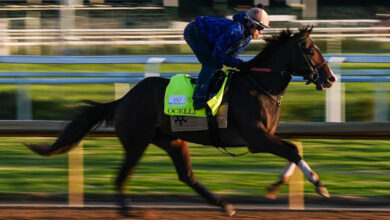
Official statements from Cherie DeVaux Racing have confirmed that Kentucky Derby winner Golden Tempo will not run in the Preakness Stakes. Trainer Whit Beckman is tentatively considering the Preakness for Kentucky Derby third-place finisher Ocelli, and trainer Doug O’Neill told the Daily Racing Form he is considering entering 14th-place finisher Robusta. The last year the Preakness was run without a single Kentucky Derby starter was 1922. The reason? Both races were held on the same day, May 13.
This story was originally published by Paulick Report on May 7, 2026, where it first appeared in the News section. Add Paulick Report as a Preferred Source by clicking here.