A group of protesters stood near the entrance to Laurel Park on Saturday, holding signs accusing horse racing of cruelty, while fans dressed in bright spring colors streamed toward Maryland’s biggest racing weekend of the year.
“Horse racing kills horses,” one sign read.
“Horse racing is animal abuse,” another bright green poster read.
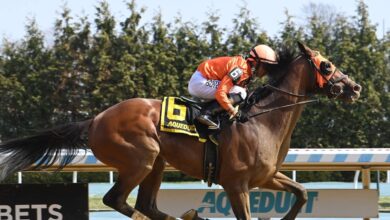
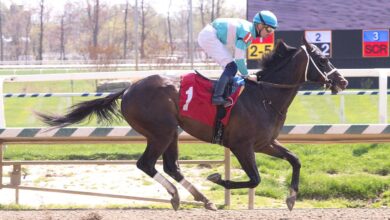
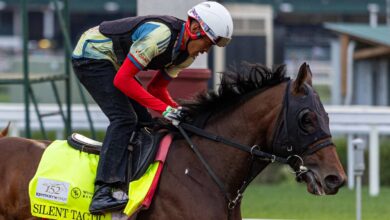
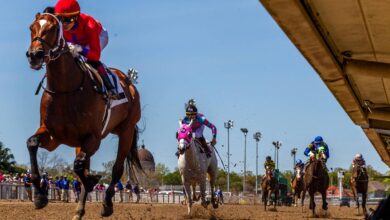
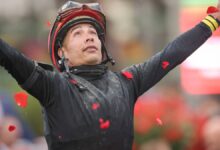
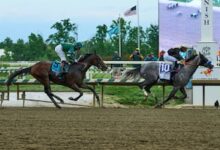
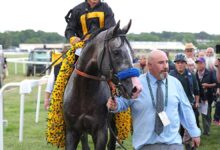
Inside the track, the atmosphere still carried pieces of the familiar pageantry tied to the Preakness Stakes, even if Laurel Park could not fully replicate the spectacle of a traditional Preakness at Pimlico Race Course. By the evening, Napoleon Solo and jockey Paco Lopez claimed first place in the 151st Preakness Stakes, temporarily relocated to Laurel while Pimlico undergoes a massive renovation.
But even amid the pomp and circumstance, it felt impossible to fully separate the sport from the question waiting outside the gates or from the jaw-dropping emotion from the day before.
Hit Zero died suddenly on Friday after the inaugural race on Black-Eyed Susan Day, sparking debate surrounding Maryland’s grand racing event.
After spending the past week following horse racing up close for the first time at this scale, learning about the passion poured into racing, and speaking to owners, fans and figures emotionally invested in the sport’s future, I came away certain of this much: Horse racing will continue, and the people who love it will continue fighting for the future of racing. But each death makes the sport more difficult to defend.
Hit Zero’s death demands attention beyond the immediate sadness of the moment. Kathy Guillermo, senior vice president of People for the Ethical Treatment of Animals, said questions remain about the horse’s medical and physical history before the race.
“I want to know what medication the horse had been on the last several months, what physical condition the horse was in, what layoffs he may have had, any period of injury or illness,” Guillermo said. “There’s a lot to be determined before we really know what happened to him.”
In an interview with The Baltimore Sun, Hit Zero’s owner Justin Horowitz described the devastating moment he was delivered the news and how his family continues to grieve. Horowitz also acknowledged accepting the risks associated with horse racing when he first fell in love with the sport.
“There was nothing more [trainer Brittany Russell and veterinary personnel] could have done,” he said. “This is a brutal thing that’s happened, and we’re all sad. But I don’t question the care Hit Zero received, not one bit.”
2026 Preakness day at Laurel Park | PHOTOS
Discussions hovering around horse racing and the unfortunate deaths involved feel flattened into two extremes, either portraying the entire sport as inherently cruel or dismissing death as unavoidable collateral damage.
The reality feels … more complicated.
Many clearly love the animals at the center of the sport. Several owners who participated in the Preakness pointed to the declining number of deaths in recent years and to the relationships among ownership groups and trainers. But love alone is not enough to shield horse racing from its pessimists.
According to Horse Racing Wrongs, a nonprofit organization advocating for the end of horse racing that obtained state data through public records requests, 425 horses died in Maryland racing-related incidents between 2014 and 2025. The group also reported 24 horse deaths at Laurel Park in 2025.
Additionally, there are some signs that the sport has made safety improvements in recent years. Racing fatalities nationally have declined under new safety measures and federal oversight through the Horseracing Integrity and Safety Authority.
According to HISA, the national racing-related fatality rate dropped to 0.90 deaths per 1,000 starts in 2024, the lowest since tracking began in 2009 and roughly a 55% decrease during that span.
Those improvements deserve some acknowledgment.
But the challenge becomes even more significant in Maryland, especially following Hit Zero’s death at Laurel Park, because state officials are not only preserving horse racing culturally as a tradition. They appear to be going all in.
Pimlico is undergoing a roughly $400 million state-backed redevelopment tied to keeping the Preakness in Baltimore. Gov. Wes Moore recently announced a $48.5 million agreement for the state to acquire Laurel Park and redevelop it into a training facility, describing the move as part of securing Maryland’s horse racing industry long-term. Churchill Downs has also agreed to purchase the intellectual property rights to the Preakness Stakes and Black-Eyed Susan Stakes for $85 million, with Moore on Saturday indicating the state plans to retain an opportunity to match the agreement.
That is an enormous public and state commitment to a sport increasingly forced to defend its future and ethics.
The bright signs and group of disgruntled protesters near the front entrance of Laurel Park represented the discomfort surrounding horse racing.
Should horse racing’s future be decided by its most devoted supporters and those pouring their personal finances into the sport and the betting world surrounding it?
Or by everyone else, including casual fans, younger audiences, taxpayers and those still unsure whether the beauty, tradition and economic impact of the sport outweigh its darkest moments?
The Preakness will eventually return to a rebuilt Pimlico. The sport will continue to celebrate its traditions and defend its progress as the Triple Crown advances to the Belmont Stakes.
But horse racing’s future in Maryland depends on whether the larger public can still accept the deaths associated with it.
Have a news tip? Contact Josh Tolentino at jtolentino@baltsun.com, 410-332-6200, x.com/JCTSports and instagram.com/JCTSports. Josh appears as a host on The Sun’s “Early Birds” podcast.